Ajit Pawar No More: DGCA Says 'Low Visibility', But Weather Website Shows Baramati Visual Range Was 4 km At 8.30 AM
The conditions at the time of the crash (approximately 8:45 AM) technically placed the flight well within operational safety limits

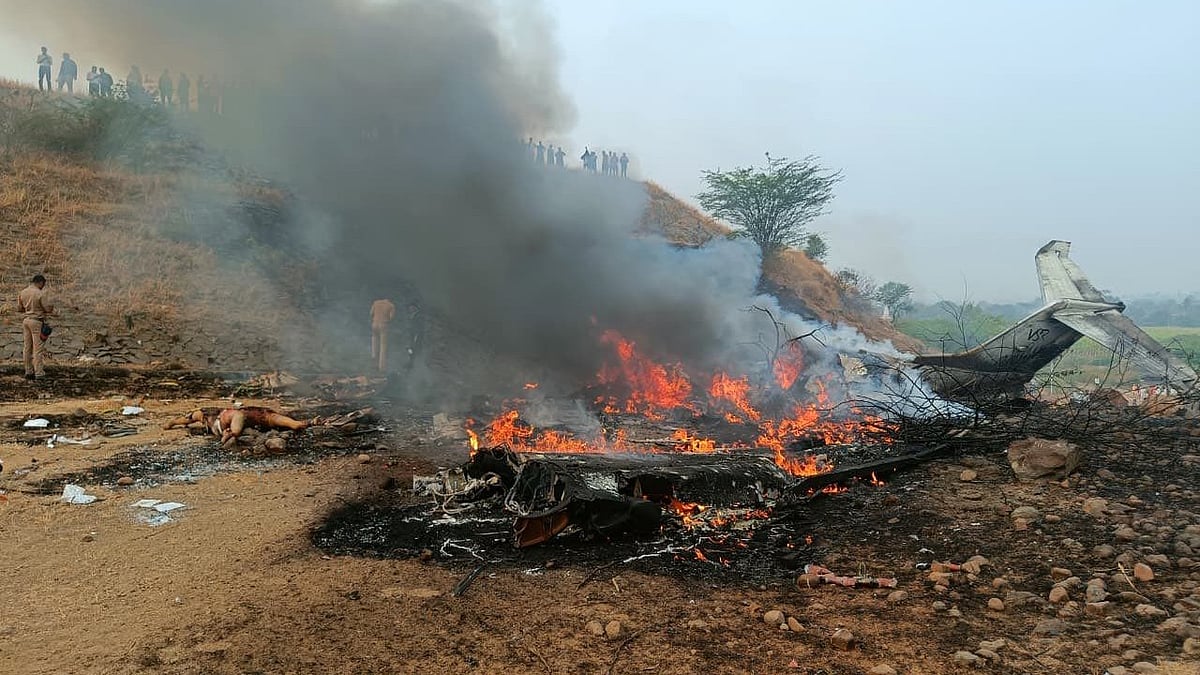
Ajit Pawar's Death: CCTV Footage Of Plane Crash In Pune's Baramati Surfaces | Sourced
A dense blanket of fog is being cited as the primary cause of a tragic aviation accident in Baramati on Wednesday morning.
The crash of a Learjet 45 claimed the lives of Maharashtra Deputy Chief Minister Ajit Pawar and four others after the aircraft went down near the edge of the Baramati airstrip.
According to the Directorate General of Civil Aviation (DGCA), as cited by a News18 report, the flight crew was attempting a visual landing in reportedly treacherous conditions when the aircraft became unstable at a low altitude, striking the ground just short of the runway.
The disaster highlights significant infrastructure challenges, as the Baramati airstrip lacks an Instrument Landing System (ILS).
Without this technology, which provides automated guidance to pilots, the crew was forced to rely on manual visual techniques despite "extremely low" visibility reported across the Pune–Baramati corridor.
Flight data suggests the aircraft bypassed the runway on its initial approach and performed a wide turn, a manoeuver consistent with an aborted landing, before crashing on its second attempt.
The impact resulted in a catastrophic explosion followed by a fierce fire. The intensity of the flames hampered immediate rescue operations, making it impossible for emergency teams to reach the wreckage in time to save any of the occupants.
Weather data discrepancy
As per data from timeanddate.com, by 8:30 AM, the early morning fog had largely burned off in Baramati, leaving sunny skies with visibility at 4 kilometres and no wind. While heavy fog was recorded at 5:30 AM, the conditions at the time of the crash (approximately 8:45 AM) technically placed the flight well within operational safety limits.
Landing requirements for the Learjet 45
The visibility required for a Learjet 45 is determined by the equipment at the airport. A standard Category I (CAT I) ILS approach typically requires a minimum visibility of 550 metres. Under Visual Flight Rules (VFR), pilots generally require at least 3 statute miles (approximately 4.8 km) of visibility.
With visibility recorded at 4 kilometres, the aircraft—which falls into Approach Category C—should have had enough range for the crew to establish visual contact with the runway.
Despite these favourable readings on paper, the aircraft failed to land safely. Whether the cause was a sudden localis ed weather phenomenon, mechanical failure, or human error remains for the Aircraft Accident Investigation Bureau (AAIB) to determine.
RECENT STORIES
-
-
-
-
-