'Cybercrime Knows No Borders': PM Modi Calls For Global Framework To Tackle Deepfakes At IMC 2026
Prime Minister Narendra Modi urged governments, firms, telecom operators and financial institutions to create a global framework on cyber fraud and deepfakes. At India Mobile Congress 2026 in New Delhi, he said cybercrime crosses borders and called for stronger digital security. Modi stressed that expanding access to banking, healthcare and government services must be matched by public trust.

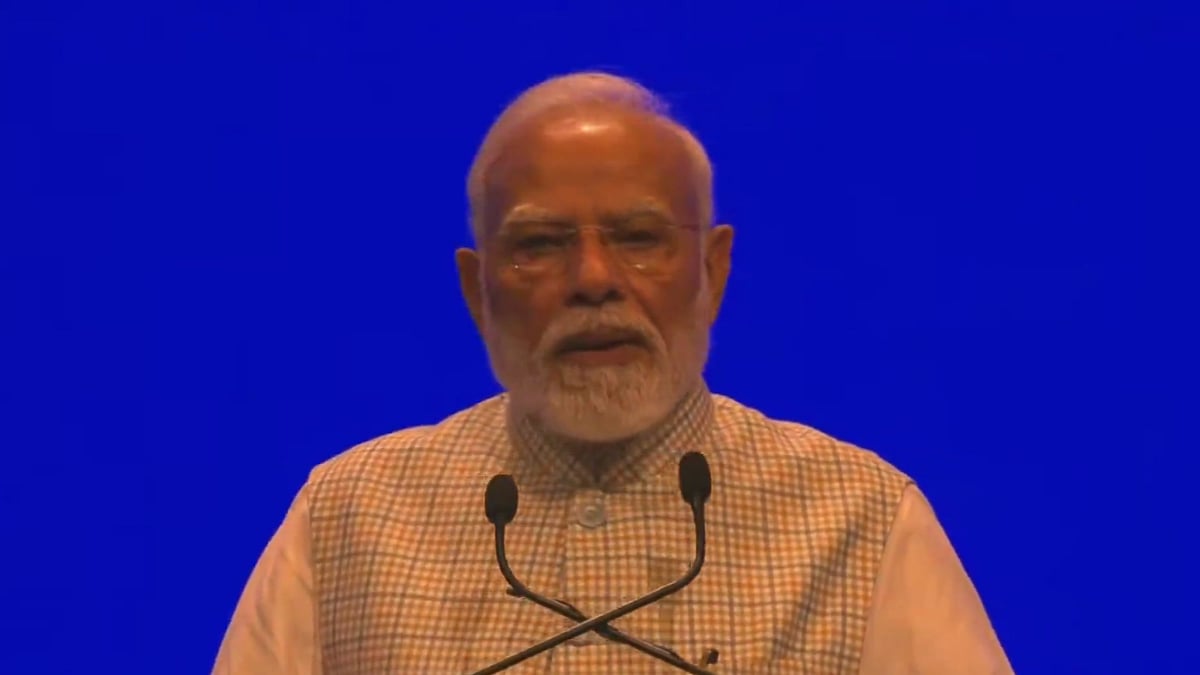
Prime Minister Narendra Modi has called for a global framework to tackle cyber fraud, deepfakes and other technology-driven threats, stressing the need for governments, technology companies, telecom operators and financial institutions to work together to protect citizens.
Speaking at the inauguration of the 10th edition of the India Mobile Congress (IMC) 2026 at Yashobhoomi in New Delhi, Modi said cybercrime does not remain confined to national borders and requires international cooperation.
The Prime Minister also urged technology and telecom companies to strengthen digital security as India’s digital ecosystem continues to expand across banking, education, healthcare and government services.
ALSO READ
Modi calls for global action against cyber fraud
Modi proposed greater cooperation between governments, technology companies, telecom operators and financial institutions to prevent cyber fraud before it reaches citizens.
A key focus of the proposed framework would be tackling AI-generated content, including deepfakes, which are becoming increasingly difficult to distinguish from authentic images, videos and audio.
The Prime Minister said India has gained significant experience in addressing such challenges and is willing to share its approach with other countries.
"Governments, technology companies, telecom operators, and financial institutions—all of them will have to be part of this framework. I also urge the GSMA and telecom operators around the world: let us create a global mechanism that can prevent such fraud from reaching people in the first place. India has learned a great deal from its own experience in this direction," he said.
He also stressed the importance of ensuring that citizens can trust the digital services they use, whether they are receiving calls and messages, making digital payments or sharing personal information online.
According to Modi, the scale of digital technology must be accompanied by public trust and stronger safeguards.
Telecom operators urged to strengthen digital security
Modi highlighted the growing role of telecom operators in securing India’s digital ecosystem.
He noted that mobile phones are no longer used only for communication, but have become an important gateway to banking, education, healthcare and government services.
"The security of our phones and the security of our networks must be a priority for all of us. An ordinary citizen does not think in terms of protocols or architecture. For them, trust is extremely important. When they receive a call on their phone, they should know who is calling. When they receive a message, they should know whether it is genuine or fake. When they make a payment, they should have confidence that their money is safe. And when they provide their data through a phone, they should trust that their data is secure. Friends, technology can achieve scale only when it earns trust. And you all know that cyber fraud and cybercrime do not respect boundaries. They have already crossed those boundaries. A person sitting in one country can commit a crime in a third country with the help of someone in a second country," he urged.
With more citizens, particularly those in villages and smaller cities, gaining access to the internet, the Prime Minister said the expansion of digital connectivity must go hand in hand with stronger security.
India’s telecom growth has also helped extend access to government schemes and digital services to people who were previously unable to benefit from them, he said.
Global cooperation needed as AI risks grow
The Prime Minister’s call comes as the rapid adoption of AI creates new challenges around digital fraud and synthetic media.
Deepfakes can be used to create convincing fake videos, images and audio, raising concerns around fraud, impersonation and misinformation. The increasing sophistication of generative AI tools has made it harder for users to determine whether digital content is genuine.
Modi said addressing these risks will require cooperation across sectors and countries, rather than isolated action by individual governments or companies.
The emphasis at IMC 2026 was therefore not only on expanding digital connectivity, but also on building a secure and trusted digital ecosystem as India and the world move towards an increasingly AI-driven future.
RECENT STORIES
-
-
-
-
-