The Cockroach Janata Party And The Kafkaesque Politics Of Protest, Writes Author R Raj Rao
What triggered the launch of the CJP was an offensive remark made by the Chief Justice of India, Surya Kant, who said, "There are youngsters like cockroaches, who don’t get any employment or have any place in the profession. Some of them become media, some of them become social media, RTI activists and other activists, and they start attacking everyone."

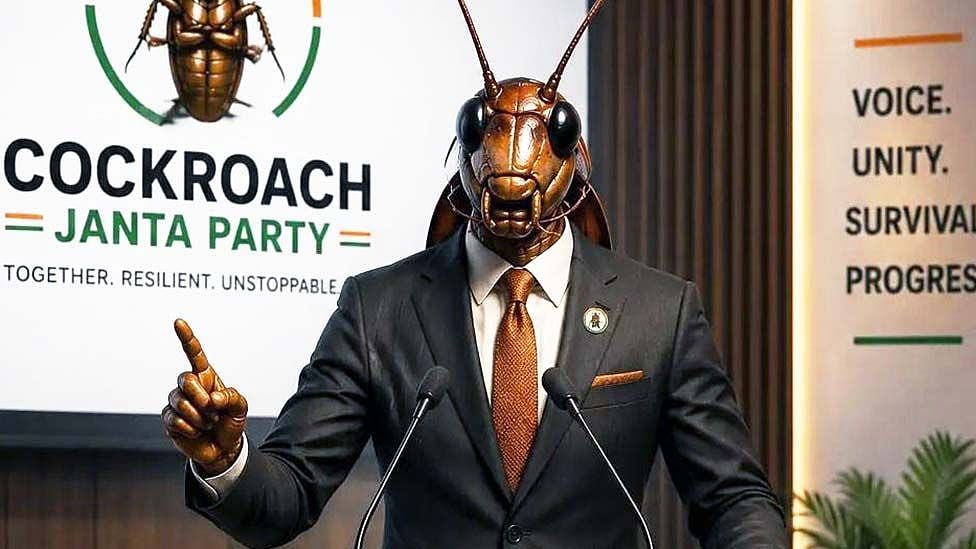
The Cockroach Janata Party And The Kafkaesque Politics Of Protest | File Photo
In Franz Kafka’s 1915 novella 'The Metamorphosis,' Gregor Samsa, a salesman, wakes up one morning to find himself transformed into a huge insect. He and his family struggle to adjust to his transformation, which he initially thinks is temporary. But he is permanently stuck on his back. Unable to leave his bed, Samsa cannot go to work. His employer, the Chief Clerk, whom he thinks of as a despot, lands up to find out why Samsa hasn’t shown up at the office.
In many adaptations of the novella, the insect in question is depicted as a cockroach. One of the profoundest interpretations of 'The Metamorphosis' comes from Russian writer Vladimir Nabokov, who sees it as “the artist’s struggle for existence in a society replete with narrow-minded people who destroy him step by step.”
It is in this Kafkaesque tradition that I wish to see the Cockroach Janata Party (CJP), founded by 30-year-old Abhijeet Dipke.
ALSO READ
Dipke studied Journalism in Pune, and has obtained a degree in Public Relations at Boston University. What triggered the launch of the CJP was an offensive remark made by the Chief Justice of India, Surya Kant, who said, "There are youngsters like cockroaches, who don’t get any employment or have any place in the profession. Some of them become media, some of them become social media, RTI activists and other activists, and they start attacking everyone."
It is easy to see Dipke as a modern-day Samsa, and Chief Justice Surya Kant as the despotic Chief Clerk. Dipke, like Samsa, has transformed into a cockroach. He is the artist struggling for existence in a society full of bigots, who destroy him step by step. The CJP is, thus, literary before it is political. At the end of the day, though, all literature is political.
The CJP is literary in three significant ways. It is, to start with, comically satirical. Its name evokes laughter before anything else, lightening the air. Then, a name like CJP is self-deprecatory, which, again, is a literary strategy. And then, the cockroach as an insect is a metaphor of resilience. In the ongoing 'Life After People' show on National Geographic Channel, the cockroach is said to be one of the few creatures that will continue to happily live long after human beings have been wiped out of the face of the earth.
But there’s a fourth way in which the CJP is literary. This has to do with its name, which has been cleverly chosen. As an acronym, the last two letters of CJP coincide with those of the Bharatiya Janata Party (BJP), while the first two letters are identical to the letters in Chief Justice of India (CJI). One might call this letter-play.
Dipke also has a sense of irony. One of the prerequisites for membership in the CJP, he says, is the ability to rant.
But of course, it is the CJP’s political side that has won it millions of followers in a short span of time, surprising not only Dipke, who started it as a gag, but also Mahua Moitra, Yogendra Yadav, Akash Banerjee, Rajdeep Sardesai, and many others. BBC and Al Jazeera have also taken note of it. Its five-point charter directly hints at the machinations of the BJP. Firstly, it doesn’t want a Rajya Sabha seat for a retiring Chief Justice, which is a direct reference to Ranjan Gogoi, who was given such a seat. Secondly, it wants the Chief Election Commissioner to be accountable under the draconian Unlawful Activities Prevention Act for deleted votes, which is a reference to the recent West Bengal elections in which 27 lakh voter names were allegedly deleted from the electoral rolls. Thirdly, it wants women’s representation in Parliament to be raised to 55%, which, of course, is a take on the BJP’s failed attempt to raise the Lok Sabha seats to 850 via delimitation, under the pretext of reserving seats for women. Fourthly, it wants strict time-bound action against the Election Commission for vote deletion, again a reference to ‘vote chori’ in the context of Assembly elections. Finally, it asks for political literacy and infrastructure for the young, a direct outcome of the CJI’s derogatory cockroach remark.
However, a name like CJP has its flip side, too. Indians who come across the word ‘Cockroach’ in the party’s manifesto are hardly likely to think of Kafka’s novella, of which they’ve never heard. Instead, they’re going to be reminded of the cockroaches in their own kitchens (for which Indian kitchen doesn’t have cockroaches?), whom they get rid of by using Hit, a cockroach spray. So that’s what the ABVP and other like-minded outfits might think of doing to the CJP--hit them till they are exterminated. Already, we hear that the X handle of the CJP has been blocked.
The other thing that Indians do to the cockroaches in their homes, even if they are vegetarians, is make chutney of them with their chappals. The CJP’s enemies may take their cue from this gory act and practice it on members.
When the cockroaches in our homes get out of hand, we call Pest Control. The Pest Control here would be all the agencies of the state that come with handcuffs to arrest CJP members without trial under the Unlawful Activities (Prevention) Act.
The solution, then, is to have an insect-infested nation, where insects rule the roost. When there are enough cockroaches in one part of the country, other Abhijeet Dipkes must emerge in other parts of the country to start, say, a Locust Janata Party, a Mosquito Janata Party, a Honey Bee Janata Party, and so on. These are insects that bite and sting. In time, our nation will be swamped by insects so destructive that they can raze entire structures to the ground. Such insect epidemics have already occurred in Nepal, Sri Lanka, and Bangladesh. They have led to a much-needed dismantling of the status quo. They have spread like wildfire, leading to a conflagration. It is perhaps India’s turn now.
(The writer is a well-known author and former head of the English Department at Savitribai Phule Pune University)
RECENT STORIES
-
-
-
-
-