Metronome: A Journey Through Pune's Past, One Metro Station At A Time
For Ashwin Chitale, Metronome is about more than recounting historical events. "The aim wasn't simply to share historical facts or forgotten stories," he said. "It was to share a perspective. No matter how well you think you know your city, there is always another story waiting to surprise you. The more you continue to explore, the more the city reveals itself."

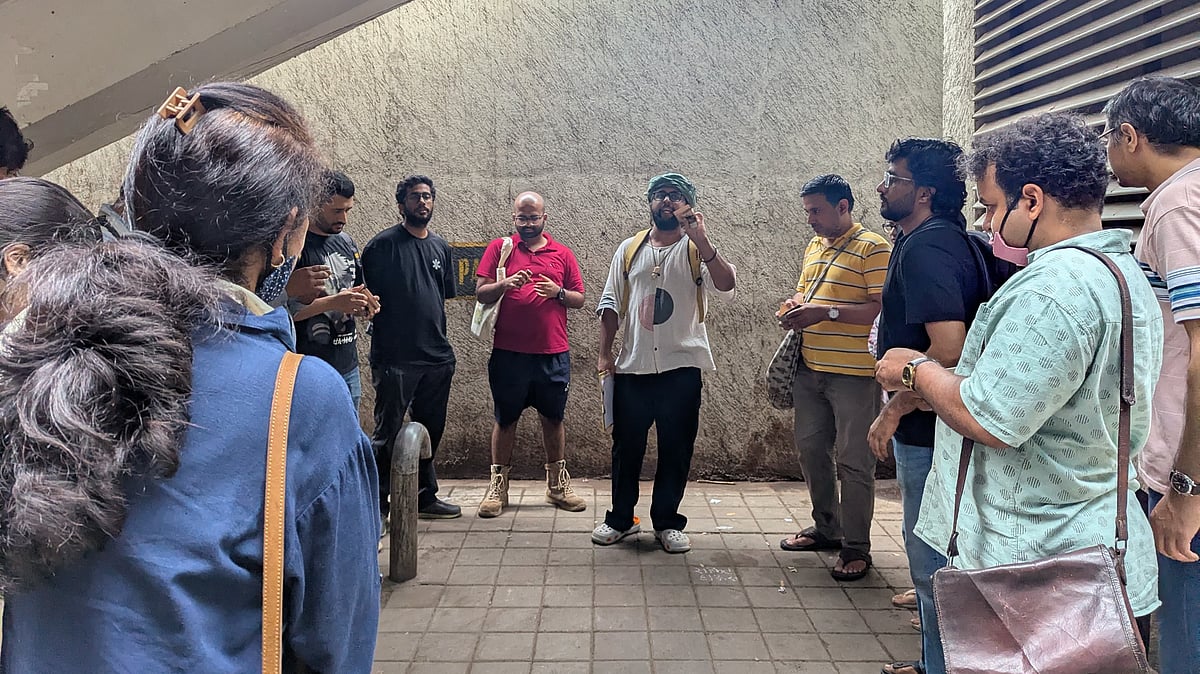
Metronome: A Journey Through Pune's Past, One Metro Station At A Time | Shireen Shaju
Founded in 2017 by actor and storyteller Ashwin Chitale, Aashwin Heritage has been reimagining the way people engage with history through heritage walks, lectures, workshops and curated experiences. Its latest initiative, Metronome, extends that philosophy to the Pune Metro, transforming everyday stations into gateways to the city's layered past.
The heritage walk began at Yerawada Metro Station before participants boarded the train to travel across the city, stopping at Bund Garden, Ruby Hall Clinic, Mangalwar Peth, Civil Court and Kasba Peth stations before concluding with a walking tour through Tambat Ali, Kasba Ganpati and Shaniwar Wada.
"History is often reduced to dates, rulers, battles and dynasties," said Chitale while introducing the walk. "But I aim to present a more detailed and meaningful way of understanding Pune's past through storytelling rather than isolated facts."
At Yerawada, Chitale transported participants to November 5, 1817, reconstructing the events of the Battle of Khadki. "At two in the afternoon, a Maratha emissary arrived at the Sangam Residency demanding that Mountstuart Elphinstone send British reinforcements. He refused. By four o'clock, the Residency had been attacked and burnt. Those few hours changed Pune forever," he said, explaining how the battle marked the beginning of the end of Peshwa rule.
ALSO READ
Speaking about the Aga Khan Palace, he added, "Although many view it as a royal residence, it was built in 1892 by Sultan Muhammed Shah Aga Khan III as a famine relief project that employed nearly a thousand villagers. It later became the place where Mahatma Gandhi, Kasturba Gandhi and Mahadev Desai were interned during the Quit India Movement."
As the Metro rolled towards Bund Garden, the city's timeline stretched back even further. "Most people think Pune's story begins with the Peshwas," Chitale remarked. "But archaeologists from Deccan College discovered Stone Age tools along these riverbanks. Long before kingdoms and empires, humans were already living here." He also explained how the bund, constructed in 1850, transformed the Mula-Mutha River and gave the neighbourhood its name.
The journey continued to Ruby Hall Clinic station, where the focus shifted to Pune's railway heritage. Pointing towards the historic railway station, Chitale recounted how the arrival of the railways in 1858 and the completion of the Bhor Ghat line in 1863 transformed Pune into a major commercial centre. "The station building we see today dates back to 1925, while the Deccan Queen, introduced in 1930, became India's first deluxe electric train," he said.
At Mangalwar Peth, the stories moved to the confluence of the Mula and Mutha rivers and the British Residency at Sangam before the group changed Metro lines at Civil Court and headed towards Kasba Peth.
The final stretch unfolded on foot through the city's oldest quarters. Walking through Tambat Ali, participants paused amid the rhythmic sound of copper being hammered by hand. "For centuries, these craftsmen supplied everything from coins and cannons to ritual objects and household vessels," Chitale said. "Today, fewer than 30 traditional families continue this craft, making Tambat Ali one of Pune's most important examples of living heritage."
The walk culminated near Shaniwar Wada, where Chitale reflected on the philosophy that underpins Aashwin Heritage. "My later studies in philosophy encouraged me to view history and time itself as an interconnected continuum. Coins, languages, inscriptions, architecture, literature, wars and everyday lives all become meaningful when placed within their historical context."
ALSO READ
He added, "Learning history is not about memorising facts. It is about understanding the choices people made in their own time. In that sense, history becomes a bridge connecting two minds separated by centuries."
For Chitale, Metronome is about more than recounting historical events.
"The aim wasn't simply to share historical facts or forgotten stories," he said. "It was to share a perspective. No matter how well you think you know your city, there is always another story waiting to surprise you. The more you continue to explore, the more the city reveals itself."
That philosophy is what distinguishes Metronome from a conventional heritage walk. Rather than treating Metro stations as mere transit points, it transforms them into chapters of Pune's larger story, connecting battlefields, railway heritage, rivers, markets and living traditions through a single journey.
RECENT STORIES
-
-
-
-
-