Indian Knowledge Tradition Has An Ancient Heritage, Says Acharya Shreyas Kurhekar In Jalgaon
The conference was organised by the Indian Humanities Oriental Studies Centre and the Indian Knowledge Tradition Centre of the School of Arts and Humanities at Kavayitri Bahinabai Chaudhari North Maharashtra University on March 4. The programme was chaired by the vice chancellor of the university, V. L. Maheshwari

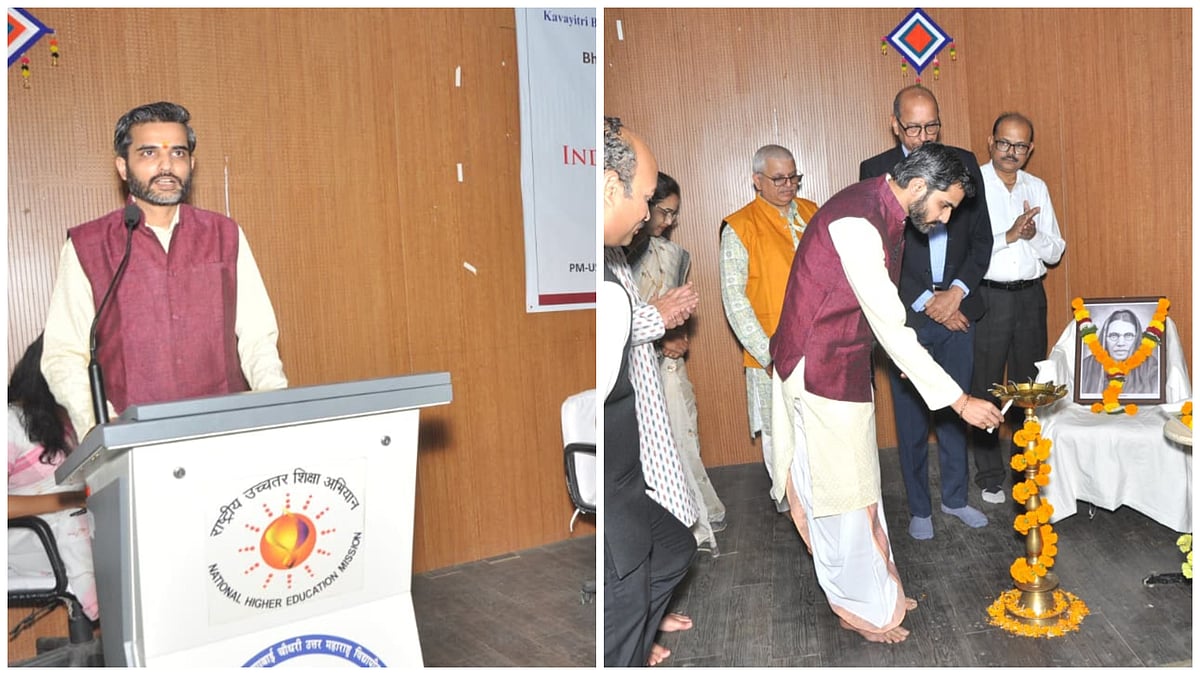
Indian Knowledge Tradition Has An Ancient Heritage, Says Acharya Shreyas Kurhekar In Jalgaon | Sourced
Jalgaon: The Indian knowledge tradition has an ancient and rich heritage, and if it is to make a meaningful impact on the world, efforts must be made to establish its authenticity through evidence, create groups to promote it, and organise guided lectures by experts, said Shreyas Kurhekar while inaugurating a two-day national conference on the topic “Indian Knowledge Tradition and Its Global Impact".
The conference was organised by the Indian Humanities Oriental Studies Centre and the Indian Knowledge Tradition Centre of the School of Arts and Humanities at Kavayitri Bahinabai Chaudhari North Maharashtra University on March 4. The programme was chaired by the vice chancellor of the university, V. L. Maheshwari. Also present on the dais were School Director Rajendra Nannaware, Prof. Ram Bhavsar and conference coordinator Prof. Veena Mahajan.
ALSO READ
The national conference has been organised in collaboration with the PM Usha initiative and the Indian Knowledge Tradition Cell of the Government of India. Delivering the keynote address, Acharya Kurhekar said that the Indian knowledge tradition had a global influence even in the eighteenth century. He highlighted India’s contributions in fields such as Ayurveda, yoga, fort architecture, mathematics, water management and dietetics.
He further stated that it is important to decide whether India will merely speak about the richness of its ancient knowledge tradition or work towards establishing its influence globally. According to him, there is a need for in-depth study of various aspects of Indian knowledge tradition, particularly in the areas of knowledge systems, science and technology, innovation and India’s contribution to global thought.
In his presidential remarks, Vice Chancellor Prof. Maheshwari said that the Indian knowledge tradition has been incorporated into the new National Education Policy. He described it as eternal and said it could help address contemporary challenges such as environmental issues, mental and physical health concerns, rapid technological changes and ethical questions related to artificial intelligence.
ALSO READ
He emphasised that strong evidence and academic research are essential to establish the authority of the Indian knowledge tradition. Conferences like this will play an important role in promoting and disseminating this knowledge on a wider scale, he added.
In the introductory address, management council member Rajendra Nannaware explained the importance of Indian knowledge tradition and also spoke about the Panchapranas presented by the Prime Minister. Prof. Veena Mahajan delivered the vote of thanks.
Following the inauguration, several expert lectures were conducted. Prof. Varadaraj Bapat spoke on “Perspective on Wealth and Value Creation". Prof. Ajay Khare delivered a lecture on “Relationship between Natyashastra and Vastushastra in the Context of the Nataraja Temple". Prof. Malhar Kulkarni spoke on “Paninian Grammar and Its Intrinsic Relationship with Linguistics and the Philosophy of Language".
RECENT STORIES
-
-
-
-
-