Ahilyanagar: Tomb Of Cynthia Farrar, Teacher Of Savitribai Phule, Discovered After More Than 150 Years
American missionary guided Jotiba Phule on girls’ education; historical records document her contribution to the early education movement in Maharashtra

Ahilyanagar: Tomb Of Cynthia Farrar, Teacher Of Savitribai Phule, Discovered After More Than 150 Years | Camil Parkhe
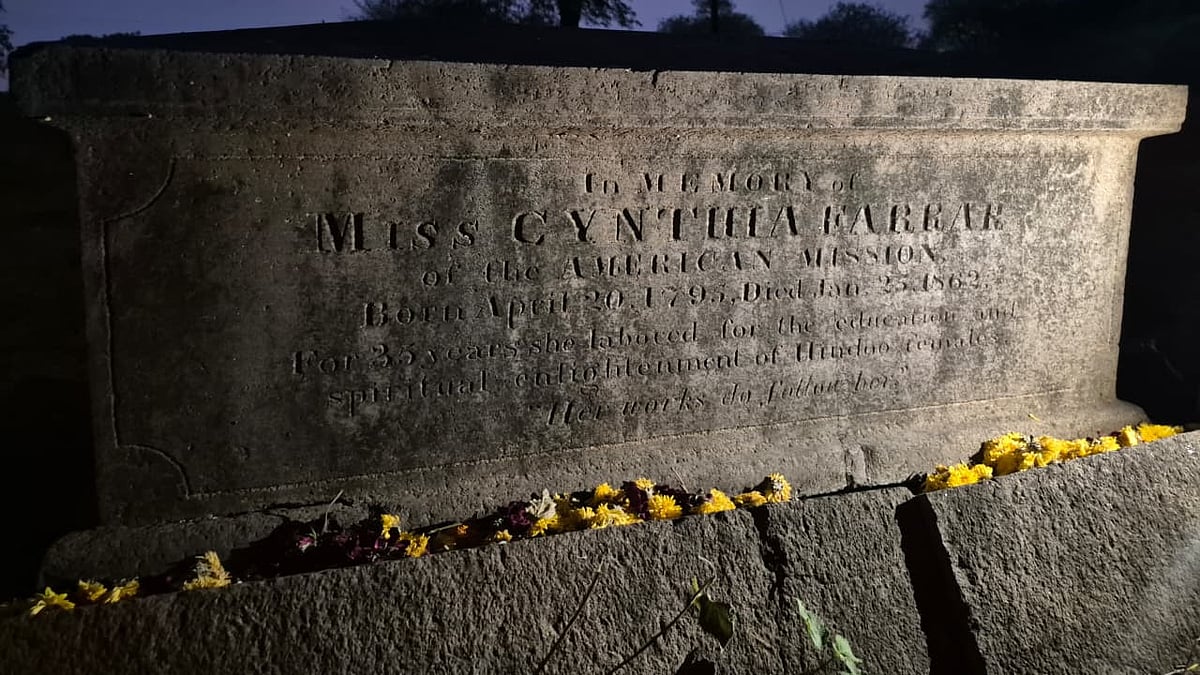
Ahilyanagar: The tomb of Cynthia Farrar, an American missionary who devoted her life to girls’ education in Maharashtra and guided Mahatma Jotiba Phule in his educational work, has been discovered at St Xavier’s Cemetery in Ahilyanagar.
The stone-built tomb had remained unnoticed for more than 150 years. Members of the Ahilyanagar-based Itihas Premi Mandal found it in good condition.
The team comprised engineer Abhijit Eknath Wagh, journalist and former Ahilyanagar Municipal Corporation member Bhairavnath Wakale, and tailor Asif Khan Dule Khan.
Farrar was a pioneer of girls’ education in Bombay and Ahmednagar, now known as Ahilyanagar. Historical records show that she advised Jotiba Phule on establishing and managing girls’ schools. She also trained Savitribai Phule to become a qualified teacher.
The discovery has brought renewed attention to an important but relatively little-known chapter in Maharashtra’s social and educational history.
Farrar’s Connection With The Phule Couple
Until a few years ago, Cynthia Farrar was an unfamiliar name to me, despite her contribution to the history of women’s education in Maharashtra.
My curiosity began when I came across references linking her to Jotiba and Savitribai Phule. I wanted to establish whether Farrar had indeed existed and what role she had played in the educational work of the Phule couple.
I began examining historical records and found several references to Farrar in the annual reports and other documents of the American Marathi Mission. These records provided valuable information about her life and work.
My research eventually led me to write her biography in Marathi, titled Savitribai Phulenchya Shikshika Cynthia Farrar.
Jotiba Phule Acknowledged The Influence Of Missionaries
Jotiba Phule himself acknowledged the influence of Christian missionaries on his work in female education.
In his deposition before the Sir William Hunter Education Commission in Pune on Oct 19, 1882, he recalled that missionaries had established a girls’ school in Pune at a time when no indigenous school for girls existed.
He explained that this experience encouraged him to establish a school for girls with his wife, Savitribai, with whom he worked for many years.
The connection between Farrar and Phule is also documented in the biography written by Dhananjay Keer. According to Keer, Jotiba visited Ahmednagar in 1848 to meet his friend Sadashiv Ballal Govande, who was working there.
During this visit, Jotiba and Govande visited girls’ schools run by the American Mission under Farrar’s supervision. Jotiba was impressed by the manner in which the girls were educated.
After returning to Pune, he started a school for girls from lower castes. The students were taught reading, arithmetic and basic grammar.
The American Marathi Mission’s 1862 report also mentions that Farrar provided advice and assistance to a young man from Pune who was interested in establishing and managing girls’ schools. Although the report does not name him, its account corresponds with the description of Phule’s work.
These historical records help establish the connection between Farrar’s educational work and the efforts of the Phule couple.
Farrar Devoted Her Life To Girls’ Education
Cynthia Farrar was born on Apr 20, 1795. She arrived in Bombay in December 1827 with a group of American missionaries and began working for girls’ education.
She later moved to Ahmednagar, where she continued her work for more than two decades.
Records of the American Marathi Mission describe her efforts to establish and supervise schools for girls at a time when female education faced strong social opposition.
In 1836, Farrar started a girls’ boarding school with 13 students. Mission reports also record her work in Bombay, where she supervised several schools attended by girls from different social backgrounds.
Her work was not easy. Families often withdrew girls from school, while early marriage frequently interrupted their education. Mission records describe how Farrar tried to retain her students and encourage them to continue learning.
She briefly returned to the United States in 1837 because of ill health. She returned to India in 1839 and continued her educational work in Ahmednagar until her death.
Farrar died on Jan 25, 1862, aged 66.
Tomb Carries A Message From 1862
The inscription on Farrar’s tomb records her birth and death dates and recognises her work for women’s education.
It reads: “In the memory of Miss Cynthia Farrar of the American Mission Born April 20, 1795 Died January 25, 1862. For 35 years she laboured for the education and spiritual enlightenment of Hindoo females.”
The inscription ends with the words, “Her works do follow her.”
The same words appeared in the American Marathi Mission’s obituary for Farrar in 1862. The obituary also recorded the respect she received from local women.
According to the mission’s account, hundreds of women attended her funeral. Many had never attended a Christian service before but came to pay their respects to the educator.
The response reflected the regard in which Farrar was held by the local community after decades of work among girls and women.
ALSO READ
School In Ahilyanagar Keeps Her Legacy Alive
Some schools established by Farrar in Ahmednagar became known as the Farrar Schools.
One of the mission’s schools was renamed Clara Bruce Girls School in 1970, after Clara Bruce, who served as its principal during a later period. The school, located near the Maliwada bus stand in Ahilyanagar, continues to function.
The discovery of Farrar’s tomb has also renewed my hope of finding a photograph of the educationist. Despite examining American Marathi Mission reports and other historical books, I have not yet come across a photograph of her.
The discovery offers an opportunity to revisit the history of a woman whose work helped shape the early movement for girls’ education in Maharashtra.
The contributions of Savitribai and Jotiba Phule to social reform are widely recognised. Historical records also remind us of the educators and institutions that influenced their work. Farrar’s story is an important part of that history, and the discovery of her tomb provides another reason to bring her contribution into public memory.
(This article is authored by Camil Parkhe, a senior journalist based in Pune)
RECENT STORIES
-
-
-
-
-