Mumbai's POD Taxi Project Faces Criticism Over High Fares, Safety Concerns And Lack Of Public Consultation After BKC Bhoomipujan
Mumbai’s POD Taxi project in BKC has come under criticism from transport experts over high fares, safety concerns, and lack of public consultation. Questions have also been raised about feasibility and funding clarity despite claims of improved connectivity and reduced congestion.

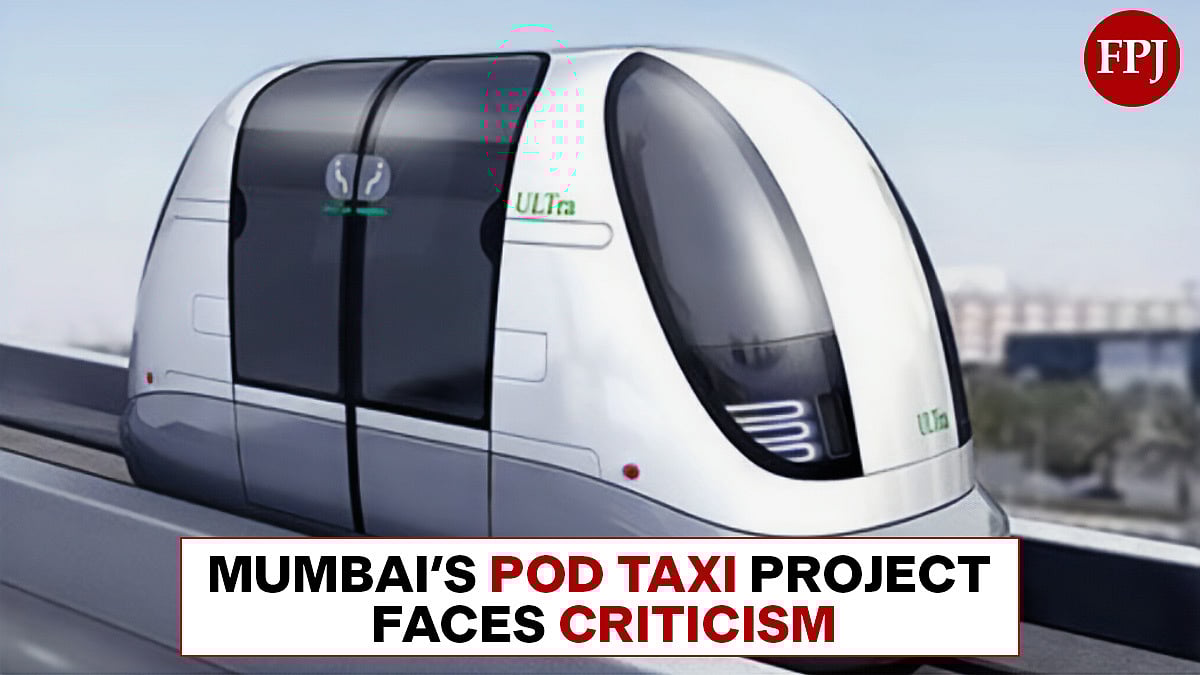
Experts raise concerns over affordability and safety of proposed POD Taxi system in Mumbai’s BKC | FPJ
Mumbai, April 7: Even as the Mumbai Metropolitan Region Development Authority (MMRDA) performed the bhoomipujan for its proposed Personal Rapid Transit (PRT) or “POD Taxi” project in Bandra-Kurla Complex (BKC), transport experts have raised concerns over affordability, feasibility and lack of public consultation.
Project scope and connectivity plan
The Automated Rapid Transit System, spanning 8.85 km with 22 stations, is being pitched as a first- and last-mile connectivity solution linking Bandra and Kurla railway stations with BKC’s commercial hub. Phase I of the project, covering 3.36 km between Kurla and Bandra (East), will include key stops such as LBS Marg, MMRDA Pay & Park, BDB Gate-11 and Kalanagar.
Experts question fare structure and viability
However, experts have questioned the viability of the system, particularly its proposed fare structure. As per earlier estimates, fares are pegged at Rs 21 per kilometre (2022 rates), which they say could make it unaffordable for regular and share auto taxi travellers.
Transport analyst A. V. Shenoy criticised the project and alleged that no public consultation was undertaken before proceeding with the bhoomipujan.
“The authority has gone ahead without taking citizens into confidence. At Rs 21 per km, the system will not be affordable for daily commuters who currently rely on autos and taxis,” he said.
Concerns over global relevance and safety
Shenoy also pointed out that globally, pod taxi systems are typically deployed in limited environments such as at London airport. “In cities like London, pod taxis are used to ferry passengers between airport terminals and nearby hotels. Nowhere in the world are they used as a mass transit system,” he added.
Raising safety and operational concerns, Shenoy questioned the decision to adopt a fully automated, driverless system. “If a pod gets stuck or there is a technical failure, how will evacuation be handled? No detailed contingency or rescue mechanism has been shared so far,” he said.
Call for transparency in PPP model
Another transport analyst, Ashok Dattar, said that while the concept has merit, there must be greater transparency in the project’s financial structure.
“The idea is good. But since this is a public-private partnership project, it should be made clear who is spending how much. It is also important to specify whether the expenditure will be limited to infrastructure such as stations, or will also include procurement of pods. Since public money is involved, clarity must be maintained on all aspects of the project and its funding,” he said.
System features and official stance
The proposed system will feature small, air-conditioned pods carrying up to six passengers, operating at speeds of up to 40 kmph with a headway of 15 seconds. Designed to be AI-based and driverless, the pods will run on battery power and stop only at stations selected by passengers.
MMRDA has maintained that the project, to be implemented under a public-private partnership (PPP) model, will not impose any financial burden on the state while generating revenue.
The authority has also highlighted that the system will integrate with Metro Line 3 at BKC and Metro Line 2B, and is expected to serve over 1.09 lakh daily commuters by 2031.
Officials say the project aims to reduce congestion in BKC, cut travel time and offer an eco-friendly mobility option. A depot is planned at Bandra East to support operations.
Also Watch:
Experts remain sceptical over execution
Despite these claims, experts remain sceptical, arguing that without clarity on pricing, safety protocols and funding structure, the project risks becoming an expensive niche system rather than a viable urban transport solution.
To get details on exclusive and budget-friendly property deals in Mumbai & surrounding regions, do visit: https://budgetproperties.in/
RECENT STORIES
-
-
-
-
-