Mumbai Air Pollution: AQI Drops 43 Points In 48 Hours To 120; Worli, Deonar Among Worst-Affected Areas
Mumbai’s overall AQI fell by 43 points in 48 hours to 120 on Thursday, with Worli recording the worst reading at 164, followed by Deonar at 154 and Navy Nagar-Colaba at 151. The BMC is stepping up hotspot monitoring, construction-site enforcement, road cleaning and pollution-control measures under its 2026 action plan.

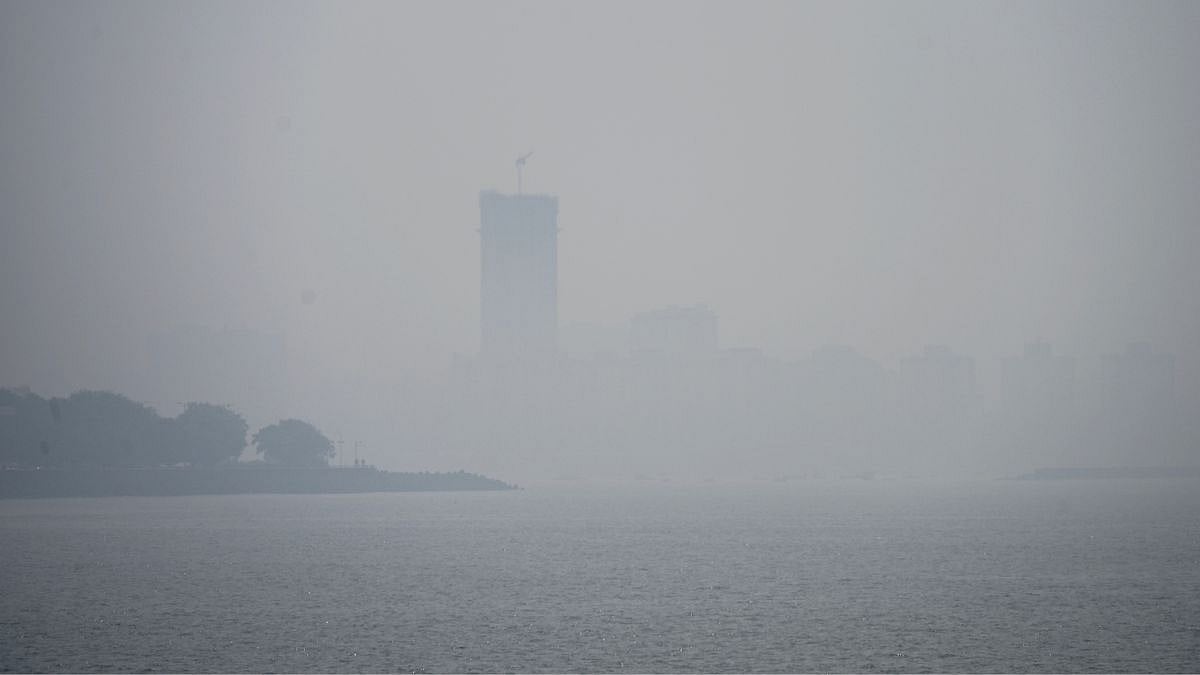
A thick layer of haze engulfs the Mumbai skyline as seen from Marine Drive on Thursday, with high-rise buildings barely visible due to poor air quality | Photo Credits: Vijay Gohil
Mumbai, October 8, 2026: As the weather changes and all construction activities begin in the city, the air quality index (AQI) has started plummeting yet again. On Thursday, the overall AQI of Mumbai was recorded at 120, a 43-point drop within 48 hours. Several areas recorded AQI above 150.
Worst AQI In Worli
As per Central Pollution Control Board (CPCB) data, as of Thursday evening, the areas which recorded the poorest AQI were Worli at 164, followed by Deonar at 154 and Navy Nagar-Colaba at 151. Other areas with the poorest AQI included Bandra East at 147, Mazgaon at 142, Bandra Kurla Complex at 130, Kurla at 128 and Chembur at 126, among others.
As per CPCB's AQI bulletin, only 20 recording stations out of a total of 30 in Mumbai were active on Thursday.
BMC Announces Pollution Action Plan
Considering the poor AQI, the BMC on October 2 announced its ‘Air Pollution Control and Enforcement Action Plan-2026’ to tackle pollution from major sources and step up enforcement against violations across the city.
Under the action plan, at least 10 air pollution hotspots are being identified in every ward, with updated lists and maps prepared for regular monitoring.
Major construction and redevelopment projects, infrastructure works, open waste-burning sites, debris dumping locations and traffic congestion points will be covered under the hotspot mapping exercise, and a designated officer will be made responsible for monitoring each hotspot.
"We are watching if the construction and demolition sites are following 28-point guidelines to mitigate dust pollution, and stringent steps against the violators. First a show cause notice will be issued and despite warning stop work will be issued," an official from BMC Environment department cell said.
Post-Monsoon Cleaning Drive
To tackle accumulated mud, silt and dust after the monsoon, the BMC is also undertaking a Post-Monsoon Deep Cleaning Drive during the first two weeks of October. Major roads, medians, junctions and road edges will receive special attention, with recycled water or misting used for cleaning.
Meanwhile, this year, developers and contractors have been made responsible for maintaining adjoining roads based on the size of their projects to mitigate dust pollution.
Projects up to 4,000 sq m will have to keep 100 metres of adjoining roads clean, those between 4,000 and 10,000 sq m will cover 200 metres, while projects exceeding 10,000 sq m will be responsible for cleaning roads extending up to 500 metres on either side.
Also Watch:
ALSO READ
The BMC will continuously monitor the AQI and implement measures under the Graded Response Action Plan (GRAP) depending on the severity of pollution.
If the AQI at a monitoring station remains above 300 for three consecutive days, the plan provides for suspension of polluting activities like all construction activities, within a 2-km radius of the station.
To get details on exclusive and budget-friendly property deals in Mumbai & surrounding regions, do visit: https://budgetproperties.in/
RECENT STORIES
-
-
-
-
-