Maharashtra To Create Country-Specific Skill Passports, Revamp Training Under Global Workforce Mobility Policy 2026
Maharashtra will prepare country-specific skill passports and update training programmes under its Global Workforce Mobility Policy 2026, Chief Minister Devendra Fadnavis said. The state plans to align ITI courses with global job requirements, improve language training and create secure recruitment systems.

Maharashtra To Create Country-Specific Skill Passports, Revamp Training Under Global Workforce Mobility Policy 2026 |
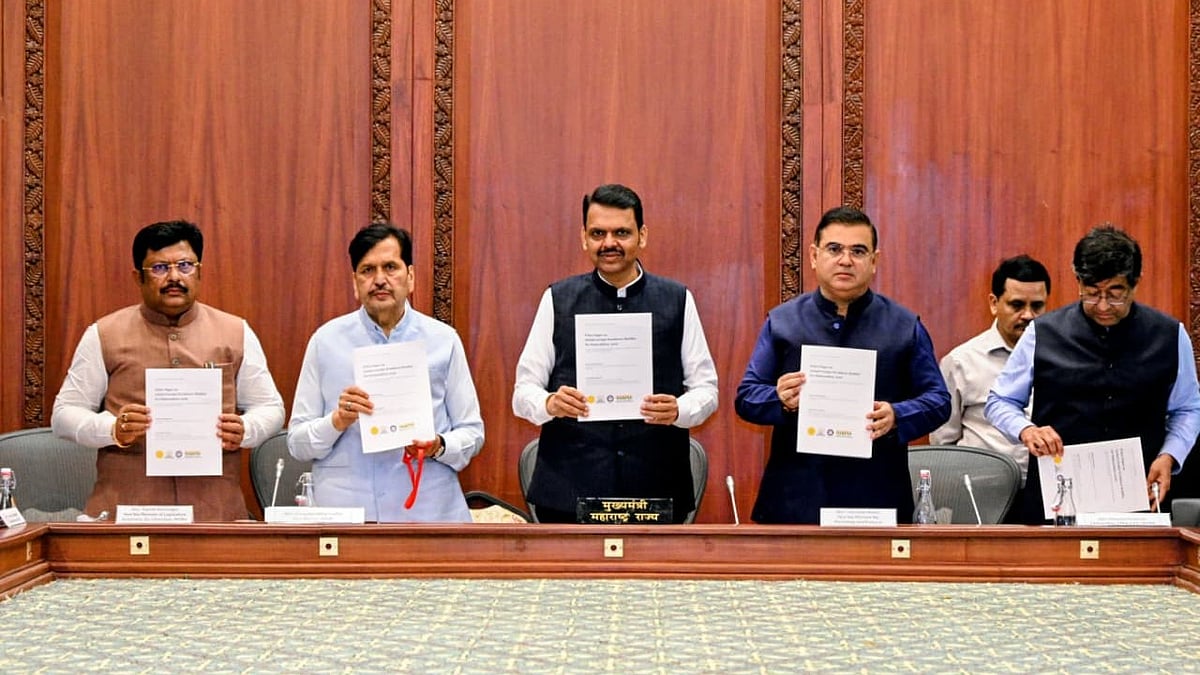
Maharashtra will prepare country-specific ‘skill passports’ for its workforce and overhaul training programmes to match the changing requirements of overseas job markets under the state’s Global Workforce Mobility Policy 2026, Chief Minister Devendra Fadnavis said on Monday.
Officials Asked to Map Global Skill Requirements
Fadnavis directed officials to identify the skilled manpower requirements of different countries, update curricula at Industrial Training Institutes (ITIs) and other training institutions, and develop a secure recruitment system for Maharashtra’s youth seeking employment abroad.
He was speaking at a day-long high-level conference on international labour mobility held at Sahyadri Guest House. The conference was jointly organised by the Maharashtra Institution for Transformation (Mitra), Protocol Department, Skill Development, Employment, Entrepreneurship and Innovation Department, and the Maharashtra Agency for Holistic International Mobility and Advancement (Mahima).
Policy Focuses on Global Demand for Skilled Workers
Fadnavis said changing demographics and ageing populations globally were driving a sharp increase in demand for skilled manpower. India’s large young workforce provides an opportunity to effectively match available skills with international demand, thereby strengthening the concept of “circular mobility of talent”, he said.
Agreements with 28 countries
India has entered into labour mobility agreements with around 28 countries, where there is significant demand for skilled workers in engineering, healthcare, construction and various technical sectors, Fadnavis said.
Referring to the World Economic Forum’s Future of Jobs Report 2025, he said around 170 million new jobs are expected to be created globally by 2030, while nearly 92 million jobs could be displaced. Maharashtra would take the lead in developing international workforce mobility, he said.
Fadnavis directed officials to use the experience of recruitment agencies to convey information about manpower requirements in different countries to training institutions. He also called for a combination of digital and classroom-based training, structured online language courses with defined timelines and minimum assessments, and the use of digital translation and interpretation tools.
The state’s policy framework prioritises skill development, training aligned with global demand, language training, certification, documentation assistance and pre-departure orientation. The government will also focus on connecting skilled workers returning from abroad with industries in Maharashtra, Fadnavis said.
MoU for language training
An MoU was signed between the Union government’s Digital India Bhashini, Mitra and Mahima to facilitate overseas employment opportunities for Maharashtra’s youth and address language barriers.
Under the pilot project, candidates will receive free and accessible training in foreign and business-specific languages through translation technology. Students of ITIs and polytechnics will benefit from the initiative.
ALSO READ
Protocol Minister Jaykumar Rawal said international labour mobility was not merely a process of workforce migration but an economic partnership connecting skills, investment, the overseas Indian community and global markets. Maharashtra would leverage Mumbai’s network of foreign consulates and coordinate with industries, universities and skill development institutions to connect local talent with global opportunities, he said.
Skill Development, Employment, Entrepreneurship and Innovation Minister Mangal Prabhat Lodha said the government was focusing not only on skills and language training required for overseas employment but also on helping students understand and adapt to the local culture of destination countries.
Workers travelling abroad would also act as ambassadors strengthening ties between Maharashtra and their destination countries, Lodha said.
German Consul General Christoph Hellier, Japan’s Sato Hitomi, France’s Patrick Livérino, Russia’s Yvon Petisov, UK representative John Nickely, Mitra vice-president Rajesh Kshirsagar, Chief Executive Officer Praveen Pardeshi, Additional Chief Secretary of the Union Skill Development Department Niranjan Kumar Sudhanshu, National Skill Development Corporation CEO Arun Kumar Pillai, Commissioner Dr Amit Saini, Protocol Department Secretary Rajesh Gawande, Mitra joint secretary Aman Mittal and representatives of international employment organisations attended the conference.
To get details on exclusive and budget-friendly property deals in Mumbai & surrounding regions, do visit: https://budgetproperties.in/
RECENT STORIES
-
-
-
-
-