Doctors, Chemists And PCD Pharma Nexus Under Scanner Over High-Cost Medicine Sales
Healthcare activists have raised concerns over an alleged nexus involving doctors, chemists and PCD pharma firms that may be promoting costly branded medicines despite cheaper alternatives being available. They have called for stricter regulation, greater transparency in prescribing practices and stronger oversight of monopoly-based medicine distribution networks.

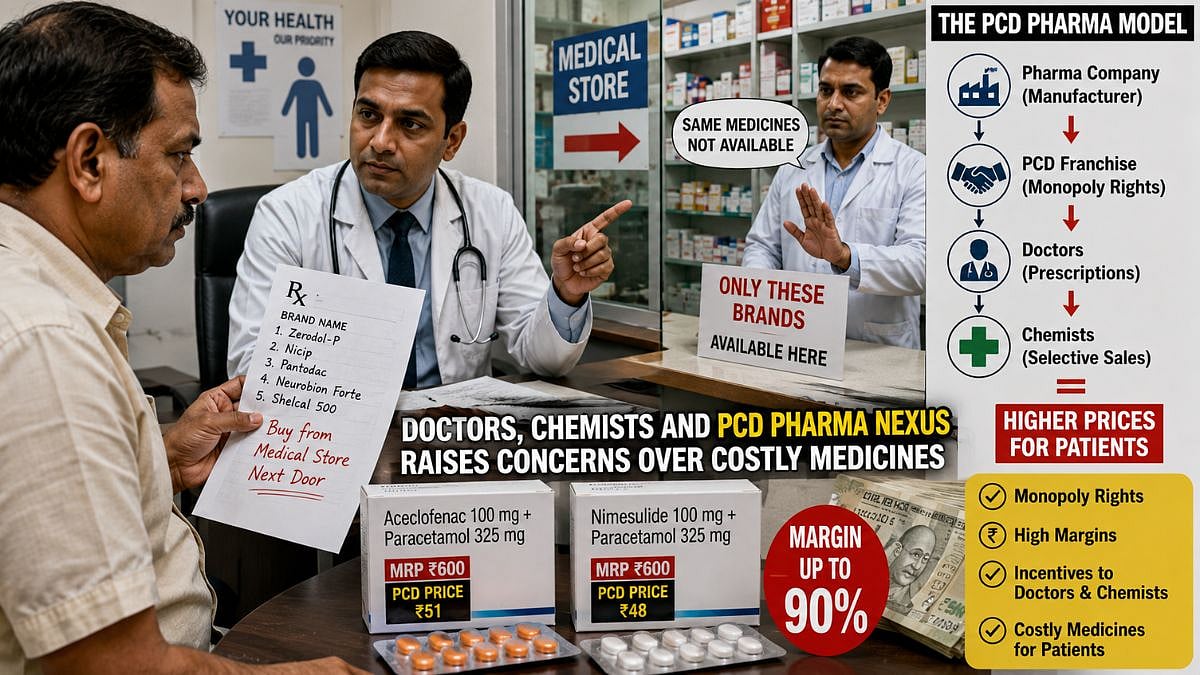
Healthcare activists have raised concerns over alleged links between doctors, chemists and PCD pharma firms influencing medicine prescriptions and pricing | AI Generated Representational Image
Mumbai, June 9: When 58-year-old Santosh Patil stepped out of a private clinic in Andheri in Mumbai, he was directed to purchase medicines from a chemist shop located beside the doctor’s clinic.
However, when he later tried to buy the same medicines from a pharmacy near his home, he was told that the prescribed brands were unavailable in the open market.
Patil later discovered that the medicines were costly branded generics distributed through a restricted supply network. A local pharmacist informed him that medicines with the same composition were available at nearly one-third the price under different brand names. Despite this, the doctor had allegedly insisted on specific brands stocked only at the clinic-linked pharmacy.
PCD pharma model and restricted distribution
Healthcare activists claim such practices are increasingly linked to the Propaganda Cum Distribution (PCD) pharma model. Operating widely from pharma hubs such as Chandigarh, Panchkula, Mohali, Ambala in Haryana, as well as Thane, Nashik and Pune in Maharashtra, the PCD system functions through franchise-based distribution networks.
The Free Press Journal contacted at least 10 PCD companies based in Chandigarh, Panchkula, Mohali, Ambala, Thane and Nashik. Several firms claimed they were ready to offer monopoly rights for medicines even on purchases worth Rs 5,000, provided the buyer possessed a valid drug licence. Sources said margins generally range from 60 per cent and can go as high as 90 per cent for certain medicines.
Price manipulation and high margins
An Ambala Cantt-based pharmaceutical company allegedly offered margins of up to 90 per cent on commonly prescribed medicines. A price list shared by the company showed that a box containing 10 strips of 10 tablets of Aceclofenac 100 mg + Paracetamol 325 mg was priced at just Rs 51, despite carrying an MRP of Rs 600. Similarly, a box containing 20 strips of 10 tablets of Nimesulide 100 mg + Paracetamol 325 mg was reportedly available for only Rs 48 against an MRP of Rs 600.
This translates to a cost of merely Rs 2.40 per strip. However, the same strips are often sold in the retail market at prices ranging between Rs 30 and Rs 65. Both medicines are commonly prescribed painkillers.
Sources further claimed that medicines related to neurology, gynaecology, fertility enhancement and other specialised treatments are also being marketed under monopoly-based distribution arrangements.
Incentives and doctor-chemist nexus
Abhay Pandey, national president of the All Food and Drug Licence Holder Foundation (AFDLHF), said Maharashtra alone has nearly 800 to 1,000 PCD companies.
According to him, these firms market medicines manufactured by third-party units and allegedly depend on incentives to doctors and chemists to boost prescriptions and sales.
Industry estimates suggest that the Chandigarh-Haryana pharma belt has emerged as one of India’s largest PCD hubs, with nearly 3,000 pharma franchise and PCD firms operating across Chandigarh, Panchkula and Mohali, while Haryana hosts hundreds of additional pharmaceutical marketing companies.
Pandey alleged that some PCD firms provide gifts or sponsor programmes for doctors in exchange for prescriptions. Their products are often sold primarily through nearby chemist shops, sometimes at significantly higher prices than comparable medicines from established pharmaceutical companies. Patients are occasionally told that substitutes would be ineffective, he claimed.
He further alleged that some healthcare professionals and senior medical representatives later establish their own companies, using long-standing relationships with doctors and chemists to market products through exclusive distribution channels.
Also Watch:
ALSO READ
Calls for regulation
Chetan Kothari, a Mumbai-based health activist, has demanded tighter regulation of doctor-linked medicine sales, mandatory generic prescribing, transparent disclosure of commercial relationships between doctors and distributors, and stronger scrutiny of monopoly-based medicine supply chains.
To get details on exclusive and budget-friendly property deals in Mumbai & surrounding regions, do visit: https://budgetproperties.in/
RECENT STORIES
-
-
-
-
-