Ashok Kharat Money Laundering Case: ED Says 'Bhondu Baba' Built Spiritual Empire Despite Having No Formal Astrology Or Numerology Training
The ED's prosecution complaint alleges that the self-styled godman admitted he had no formal qualification in astrology or numerology and acknowledged buying several properties in his family members' names using his own funds. The agency also alleged that over Rs 5 crore, or about 44% of the purchase value of nine properties, was paid in cash.

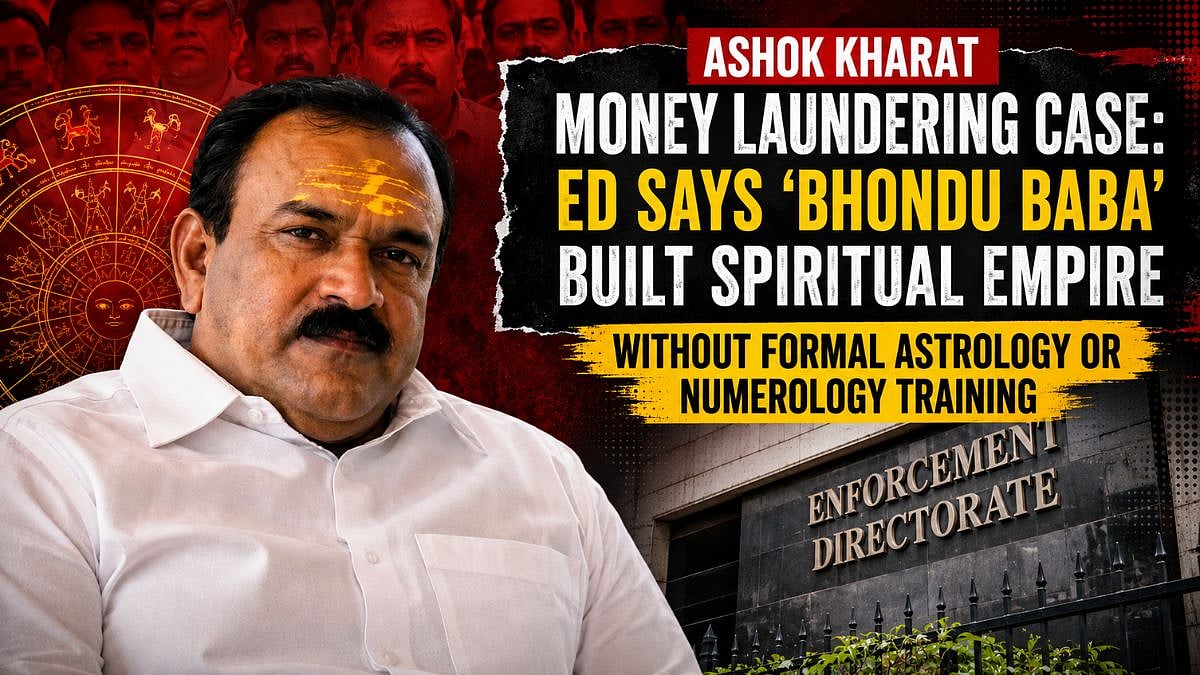
The Enforcement Directorate has cited statements by Ashokkumar Eknath Kharat in its prosecution complaint filed in the alleged ₹42.88 crore money laundering case | AI Generated Image
Mumbai, July 23, 2026: Self-styled godman Ashokkumar Eknath Kharat alias Bhondu Baba, accused in a Rs 42.88-crore money laundering case, admitted to the Enforcement Directorate (ED) that he had never received any formal education or recognised qualification in astrology or numerology, despite spending nearly two decades cultivating an image as a spiritual adviser whose predictions and rituals attracted businessmen, politicians and other influential personalities.
The admission, contained in Kharat's statement recorded during the Prevention of Money Laundering Act (PMLA) investigation, forms a key part of the ED's prosecution complaint filed before the Special PMLA Court in Mumbai. According to the agency, the statement chronicles Kharat's transformation from a retired Merchant Navy employee into one of Nashik's most influential self-styled godmen, attracting businessmen, politicians and other prominent personalities who allegedly sought his blessings and performed 'Avatar Pooja' in the belief that it would bring spiritual powers, success and political advancement. The ED alleges that Kharat later leveraged this influence to build a money laundering network involving benami bank accounts, cooperative credit societies and investments in immovable properties.
ED Details Rise To Influence
According to the ED, Kharat served in the Merchant Navy between 1984 and 2004. After returning to Nashik, he began offering numerology and spiritual consultations from a small office at Canada Corner. During questioning, he allegedly admitted that he had never undergone formal training in astrology or numerology and possessed no recognised qualification in either field. Despite this, investigators said he gradually built a large following through word-of-mouth, with devotees approaching him for solutions to personal, financial and health-related problems through spiritual guidance, rituals and numerological advice.
The agency alleged that Kharat's influence expanded significantly after establishing the Ishaneshwar Temple and Shree Shivnika Sansthan at Mirgaon. According to the ED, the institution became the focal point of a network of devotees that included businessmen, politicians and other influential persons from Maharashtra and beyond.
Kharat admitted that, as president of Shree Shivnika Sansthan, he personally handled virtually every important decision relating to the trust, including its financial affairs. During the investigation, the ED confronted him with statements recorded from several trustees, including Nationalist Congress Party (NCP) leader and former Maharashtra State Commission for Women (MSCW) Chairperson Rupali Chakankar, Nandkishore Tulsidas Katore and Lalit Prakash Pophale. According to the agency, the trustees stated that they had been inducted into the trust at Kharat's request but had no role in its day-to-day administration or financial management. The ED has relied on these statements to allege that Kharat exercised complete control over the trust and its finances.
Properties Under Scrutiny
Another significant admission cited by the agency relates to Kharat's family's assets. He acknowledged that several immovable properties standing in the names of his wife, daughters and mother had, in fact, been purchased using his own funds. He also admitted that none of them had any independent source of income capable of acquiring such assets. Kharat attributed the purchases to agricultural income, property transactions and earnings from his numerology and spiritual consultancy business, but allegedly failed to produce records supporting the claims. The ED alleges these statements support its case that family members were used as name-lenders for properties allegedly acquired from proceeds of crime.
The ED alleged that its analysis of nine immovable properties found that more than Rs 5 crore, around 44 per cent of the total purchase consideration, was paid in cash. When confronted with the findings, Kharat allegedly accepted that the cash payments had been made and attributed the source broadly to his agricultural income and earnings from his numerology practice since 2004-05. However, he allegedly did not explain the source of each individual cash transaction. The ED contends that his responses reveal a pattern of acknowledging ownership and cash payments while avoiding detailed explanations regarding the origin of funds, which the agency suspects were proceeds of crime generated through the alleged extortion of devotees.
Farmhouse And Financial Transactions
The ED has also linked the alleged proceeds of crime to the construction of Kharat's farmhouse near the Ishaneshwar Temple. According to the agency, Kharat admitted that Pune-based businessman and politician Rajendra Jasud spent more than Rs 3 crore on constructing the farmhouse. Investigators, however, found that invoices for the construction had been raised in Jasud's name and that of his company instead of Kharat's. When questioned about the arrangement, Kharat allegedly claimed he did not know why the invoices had been issued in that manner and denied instructing anyone to prepare them. The ED has alleged that Jasud was among the devotees kept under Kharat's influence by instilling in him a fear of death, which was allegedly exploited to obtain financial benefits.
According to the complaint, Kharat admitted that a Mercedes-Benz, purchased by Jasud, was subsequently transferred to his name without any payment. He also acknowledged that Jasud financed nearly 10 foreign trips undertaken by him and bore the expenses of his overseas medical treatment. Kharat maintained that these were voluntary acts of devotion by a follower and denied that they represented illegal gratification.
The agency also scrutinised Kharat's 2023 purchase of agricultural land measuring 1 hectare and 67 R at Nighoj village. According to the ED, Kharat stated that the property was jointly purchased in his and his wife's names for Rs 8.82 crore, of which Rs 5.52 crore was paid through banking channels and reflected in the registered sale deed, while the remaining Rs 3.30 crore was allegedly paid in cash on the day of registration. Since his wife was unavailable on the rescheduled registration date, Kharat allegedly executed a General Power of Attorney in favour of his associate Arvind Bawake to complete the registration. The ED confronted Kharat with an FIR in which the original landowner, Raosaheb Nanasaheb Gondkar, alleged that he had approached Kharat for a Rs 3-crore loan but was fraudulently induced into transferring the land. Kharat denied the allegation.
ED Alleges Extortion Network
To explain the source of funds used to purchase agricultural land at Nighoj village, Kharat told the ED that he had borrowed Rs 2.53 crore from Lalit Pophale and received Rs 4.25 crore through RTGS from Harshad Pophale as financial assistance. However, according to the ED, both men later alleged that they transferred the money under fear and pressure after Kharat allegedly warned them of adverse spiritual consequences if they failed to comply with his demands. While Kharat described the transactions as genuine loans, the ED has relied on their statements to allege that the transactions were not genuine loans but funds obtained through extortion disguised as religious and spiritual obligations, an allegation that Kharat has denied.
The ED also questioned Kharat over bank transactions involving several crores. According to the agency, he attributed the credits to agricultural income, onion and soybean trading, property transactions, loans extended to relatives and repayments from acquaintances. However, investigators alleged that he failed to produce loan agreements, sale records, agricultural income documents, receipts or bills to substantiate these claims. The agency contends that the absence of supporting evidence, coupled with the financial trail uncovered during the investigation, indicates that the movable and immovable assets were acquired using proceeds of crime.
Also Watch:
ALSO READ
The allegations form part of the ED's prosecution complaint, which accuses Kharat of laundering Rs 42.88 crore generated through the alleged extortion, cheating and criminal intimidation of devotees by exploiting their faith. The agency alleges that the proceeds were layered through multiple bank accounts before being invested in land, residential properties, luxury vehicles, jewellery and other assets, many of them held in the names of close family members. Kharat has denied coercing followers and has maintained that all donations, gifts and financial assistance received from devotees were voluntary acts of faith.
To get details on exclusive and budget-friendly property deals in Mumbai & surrounding regions, do visit: https://budgetproperties.in/
RECENT STORIES
-
-
-
-
-