'My Canvas Has Never Been Limited To A Gallery Space': Prof. Samir Parker
From chawl rooftops to shared visual canvases, the Rooftop Rangoli Project is reimagining Mumbai’s overlooked urban spaces through collective creativity, participation, and tradition reworked with digital design

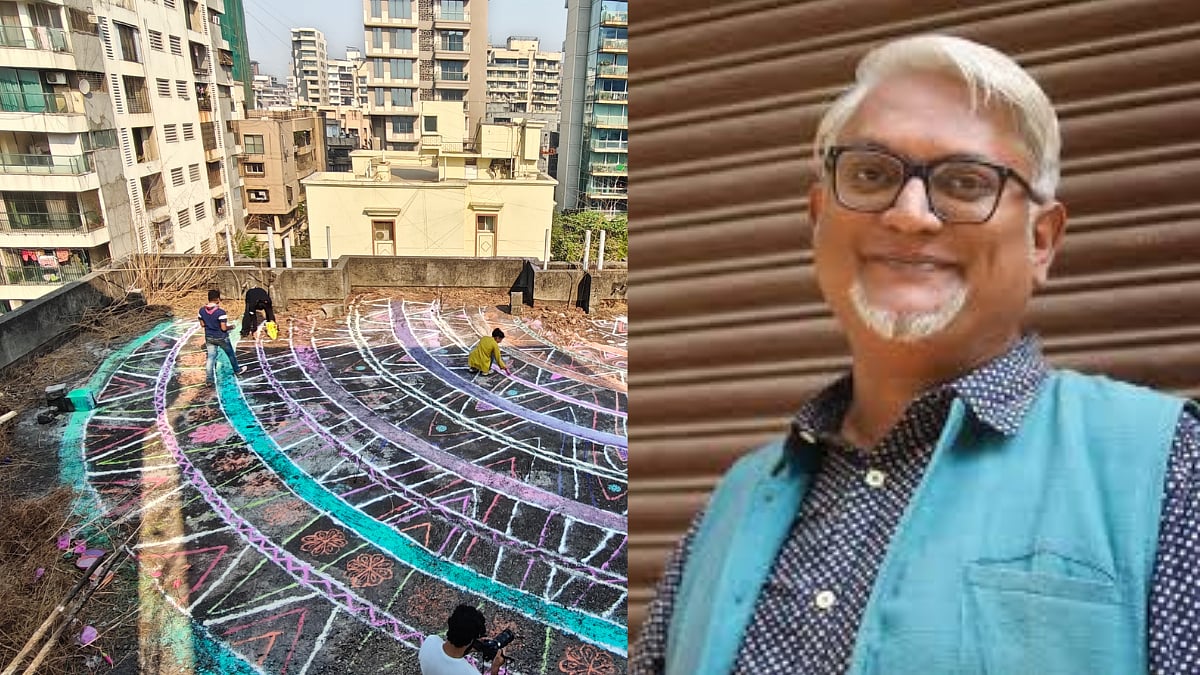
As Mumbai’s everyday spaces evolve, art is becoming part of how the city is lived and seen. Prof. Samir Parker shares with The Free Press Journal how the Rooftop Rangoli Project is bringing people together in unexpected ways.
Excerpts from the interview:
What inspired you to bring art onto Mumbai’s chawl rooftops, and how did the idea for the Rooftop Rangoli Project come about?
My artistic practice has always been shaped by the many unseen spaces of possibility that exist within the city. Mumbai is full of surfaces and spaces that we pass by every day without really noticing them, and I have always been interested in working with these overlooked parts of the urban environment. In that sense, my canvas has never been limited to a gallery space, it extends from the rooftops of irregular settlements to autorickshaws, spaces and surfaces that are both iconic and shared by the city.
The idea for the rooftop initiative came from this larger interest in visibility and identity. Rooftops in chawls are often purely functional spaces, and at the same time, these neighbourhoods are frequently ignored or looked at with a certain bias. I was interested in what would happen if these very spaces, which are literally and figuratively overlooked, could become sites of colour, creativity, and collective participation.
The Rooftop Rangoli Project emerged from this thought, not as a standalone artwork, but as a way of bringing people together to create something collectively, and in the process, giving the place a new visual identity. When seen from above, the rooftops transform into a large shared canvas, and the artwork becomes visible at the scale of the neighborhood rather than the individual home.
Community art is still unfamiliar to many. How would you explain its significance in transforming urban neighborhoods?
As an artist I firmly believe that any form of community art, to feel authentic, has to involve the people who live within that space. Without their participation and their understanding of life, it risks becoming something imposed rather than something that truly belongs.
For me, community art is less about creating a finished visual outcome and more about creating a shared process where people come together, contribute, and see themselves reflected in what is being made.
I don’t necessarily claim that such interventions can transform a city in a dramatic or immediate way, or completely change how people perceive their surroundings. But what they can do is introduce a meaningful counterpoint to the limited and often one-dimensional narratives of urban development, where spaces are defined purely by infrastructure, economics, or real estate value.
Community art allows for a different kind of narrative to emerge one that is rooted in participation, memory, and collective identity. It shifts the focus, even if momentarily, from what a neighborhood lacks to what it is capable of creating. And that, in itself, is significant.
Rangoli is a traditional practice. How do you combine it with digital planning, and what does that add to the artwork?
Rangoli is traditionally a very intimate and handmade practice, usually created at the threshold of a home and often existing only for a short period of time. In this particular context, many of the residents come from South India, where rangoli is not just occasional but an everyday cultural practice, deeply embedded in daily life.
What interested me was the possibility of taking something so personal and ephemeral and reimagining it at a much larger, collective scale. This is where the digital process becomes important.
Digital tools allow us to visualise the design, helping us think through scale, geometry, circles, and colour in a way that would be difficult to achieve otherwise especially when multiple rooftops come together to form a single, continuous surface.
However, once the planning is done, the execution remains entirely handmade and is carried out with the community. This relationship between digital planning and manual making is important to me because it reflects the reality we live in today where technology and tradition are not separate worlds, but are constantly interacting with each other.
Your work emphasizes collaboration over authorship. How do you encourage participation from residents who might not see themselves as artists?
In public space, the work is never about one person — it is always about the collective effort of many unique individuals coming together. When we begin working in a neighbourhood, we don’t approach it with the idea that we are the artists and the residents are participants. Instead, the idea is to create a space where everyone feels comfortable contributing in their own way, whether that is through drawing, filling colour, suggesting patterns, or simply helping organise the process.
What is always surprising and encouraging is how many people already have an artistic bent of mind but may have never had the opportunity or the platform to express it. Once the process begins, hesitation slowly disappears, and people start taking ownership of the work. Someone who initially says, “I am not an artist,” is often the same person who later starts suggesting colours or patterns or helping guide others.
Creative energy, I have realised, is very infectious. When people see others around them participating, they naturally want to be part of it too. And at that point, the project stops being “my work” or “our team’s work”, it truly becomes the community’s work. That shift is very important, because the moment people feel that sense of ownership, the space and the artwork begin to mean something more to them.
Can you share a moment when a resident’s creativity surprised or changed the direction of a project?
There have been many such moments, but one that I remember very clearly is when one of the key contributors to the project, Ritesh, who sells vegetables for a living, came up with an idea that completely changed how we were looking at the artwork. In the middle of the process, he had a moment of inspiration and suggested using shards of shattered glass as part of the design.
It was not something we had originally planned, but when we began incorporating the glass pieces into the artwork, it introduced a completely new visual quality. The surface began to catch and reflect light differently, and the work suddenly had a new dynamism that we had not anticipated in the original design.
What was important about that moment was not just the material change, but the shift in authorship. It was a reminder that the role of the artist in a community project is not always to lead every decision, but sometimes to step back and allow the work to be shaped by the people who are part of it. Ritesh may sell vegetables for a living, but in that moment, he was thinking like a designer experimenting with material, texture, and light.
How do these rooftop interventions comment on visibility in the city, who gets seen and who remains peripheral?
The commentary is not so much about what you see, but how you see it. A city like Mumbai carries multiple personalities, and the divide between growth and development is often stark.
This intervention begins from that lens. Slums have long been portrayed in popular media through a narrow frame, one that attaches sadness to their existence and often invites pity. In that portrayal, the people and the place are collapsed into a single narrative of deprivation. What gets missed is the life, agency, and community that exist within these spaces.
The reason I returned to this neighborhood for the rangoli project was precisely because of its people. There is a remarkable strength of community here, a sense of participation and collective energy that is rare in many parts of the city.
As a designer, I believe one of our responsibilities is to bring forward communities that have historically remained at the margins of visibility. Much of the art world can be quite exclusionary, even snobbish at times. The experience economy, which increasingly shapes how cities are consumed and represented, has largely bypassed spaces like these settlements. This project attempts to challenge that absence.
I had previously done a tarp installation in the same area, and the energy and enthusiasm of the residents left a deep impression on me. The rooftop interventions build on that experience. Through these interventions, the aim is to shift the gaze.
Have you noticed any lasting effects on the community, whether in how residents view their neighbourhood or in fostering collective pride?
The larger effects of such projects will always take time to fully understand and study, so I would be cautious about making very big claims about transformation. These are small interventions in a very large and complex city. But even within that, there are certain shifts that you begin to notice.
One of the most visible changes is the sense of shared creativity that emerges during and after the project. When people work together on something like this, the space is no longer just a functional area it becomes a place associated with a shared experience. People start pointing it out, talking about it, showing it to visitors, and in subtle ways, it begins to change how they relate to their own neighbourhood.
I think collective pride does not always come from large-scale development or big infrastructure; sometimes it comes from small moments of collaboration where people feel they have created something together. That sense of “we made this” is very important.
What’s the most memorable or heart-warming feedback you’ve received from participants?
What stays with me is the sheer joy and sense of affirmation people feel when something they have helped make is seen and recognized by others. The most memorable part of these projects is often not the final artwork, but the reactions of the people who participated in creating it.
For many participants, this is not just about contributing to an artwork; it is about the validation of their creativity, their skills, and in many ways, their way of living, thinking, and working. Many of the patterns, colour choices, and methods they use come from their own customs and everyday practices, which are rarely seen as part of what we traditionally call “art.” But when these elements become part of a larger public artwork, and when people from outside the neighbourhood come to see it or talk about it, there is a visible sense of pride.
I think what is heart-warming is that moment when people realise that something from their everyday life — something they did not necessarily consider special — can have a larger audience and be appreciated by others. That recognition is very powerful.
Mumbai’s urban landscape is rapidly changing. How can community art influence conversations around redevelopment or urban planning?
Mumbai is a city that is constantly being rebuilt, and most conversations around redevelopment tend to focus on infrastructure, real estate, and efficiency. While these are important, they are not the only things that define a city. What often gets overlooked in these discussions is that every location has a unique character shaped by the people from different part of the country, who live and work there.
Where we begin to recognise that neighbourhoods are not just pieces of land waiting to be redeveloped, but places with memory, identity, and culture. When a community comes together to create something collectively, it makes visible the social fabric of that place, something that is otherwise very difficult to quantify in plans and drawings.
Looking ahead, are there new ideas or neighbourhoods you dream of bringing community art to next?
With projects like this, you need to have a certain amount of craziness and a sense of the absurd, because many of these ideas sound impossible at first. But what is amazing is when you begin to find other people who share the same zeal and are willing to experiment and participate. That is usually how the next project begins through conversations, collaborations, and people coming together around an idea.
What I am really interested in is continuing to explore the city through these collaborative art practices whether that is on rooftops, in public spaces, on vehicles, or in other shared urban surfaces that we encounter in everyday life but rarely think of as spaces for art.
RECENT STORIES
-
-
-
-
-