FPJ 98th Anniversary: How Maharashtra Is Scaling Early Childhood Development Through ICDS And Community Systems
From Aarambh to Anganwadi networks, a grassroots model is transforming the first 1,000 days of child development

The first thousand days of a child's life—from conception until the age of two—represent one of the most critical windows for brain development, nutrition, emotional bonding and lifelong health. While scientific evidence has long highlighted the importance of this period, translating research into large-scale community action has remained a challenge. Maharashtra, however, is demonstrating that with by strengthening existing government systems, early childhood development (ECD) can be integrated into routine public service delivery at scale.
The Aarambh model
At the heart of this transformation is Aarambh, an innovative parenting program being implemented by the Government of Maharashtra with support from UNICEF and the Mahatma Gandhi Institute of Medical Sciences (MGIMS), Sevagram. Rather than creating new or parallel structures, Aarambh works through the Integrated Child Development Services (ICDS), the health system and community institutions to ensure that every child receives nurturing care during the earliest years of life. The model is rooted in the WHO-UNICEF Nurturing Care Framework and recognizes that good nutrition alone is not enough; children also require responsive caregiving, early learning opportunities, health services and safety to reach their full developmental potential.
Convergence at the grassroots
The strength of Maharashtra's approach lies in its emphasis on convergence. Anganwadi workers, Accredited Social Health Activists (ASHAs), Auxiliary Nurse Midwives (ANMs) work together at the grassroot level, enabling them to deliver consistent messages to parents and families. Instead of treating nutrition, health and child development as separate programmes, Aarambh integrates them into a unified package of care centred on the family.
Pilot to statewide programme
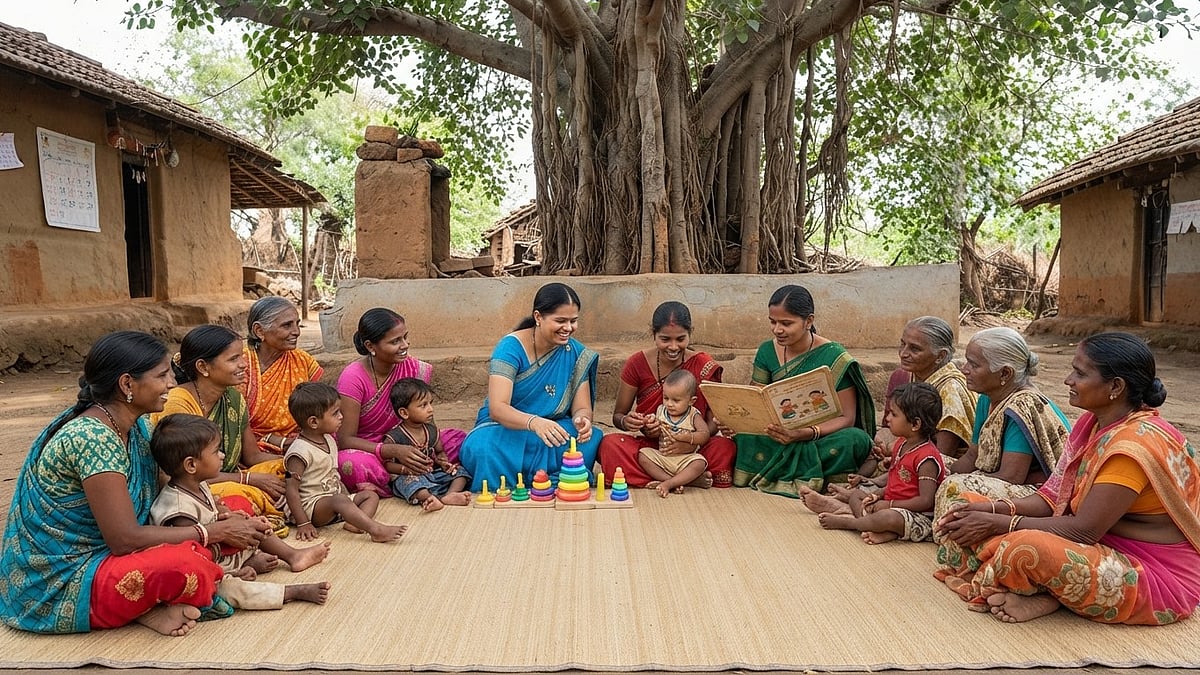
This whole of society based approach was first piloted in Yavatmal and Aurangabad districts, where frontline workers were trained to deliver nurturing care through experiential sessions involving interactive demonstrations, role plays and participatory learning methods instead of conventional classroom trainings. Stories and Simple games like the ‘Brain wiring game’ helped not only helped to simplify the science and explain the ‘why’ these nurturing care interventions were needed but also made it easier for the frontline functionaries to unpack the science and explain it to the caregivers. The frontline workers restructured the existing platforms of home visits, mother’s meetings and community based events to deliver the messages to parents and other caregivers. Caregivers were encouraged not only to feed children adequately but also to touch, talk, sing, play and respond to their babies from birth. Fathers and grandparents—often overlooked in child development programmes—were brought into conversations on nurturing care, making early childhood development a shared family responsibility rather than solely a mother's role. The way in which all the relevant stakeholders collaborate to organize the Palak Melawa in their community is truly heart-warming and laudable.
The results of these pilots generated confidence among policymakers. Rather than remaining a successful local innovation, Aarambh evolved into a state-led programme. Today, Maharashtra is scaling the initiative across all districts by utilizing the existing workforce and infrastructure of ICDS and the Department of Health, demonstrating that meaningful innovation does not necessarily require new institutions or significant additional expenditure. (aarambhforecd.com)
Community systems driving behaviour change
One of the most significant lessons from Maharashtra is that community systems matter as much as technical interventions. Behaviour change cannot be achieved through one-time awareness campaigns. It requires repeated engagement, reinforcement, supportive home visits and trusted relationships between frontline workers and families. Aarambh equips Anganwadi workers and ASHA with practical skills that help caregivers understand why simple daily interactions like hugging a child closely, understanding the hunger and satiety cues of the child and responsive feeding, speaking loving to children and allowing the children to explore and play - are essential for healthy brain development.
Importantly, the initiative has shifted the narrative from asking, "Is the child malnourished?" to a broader and more meaningful question: "Is the child thriving?" This subtle but powerful change encourages a holistic understanding of child development, encompassing physical growth, emotional security, cognitive stimulation and responsive caregiving.
Technology supporting nurturing care
Technology and social behaviour change communication have also strengthened the programme's reach. Creative community campaigns, digital content and the child mascot "Tara" have helped communicate complex scientific concepts in simple, culturally relevant ways. Families increasingly recognise that nurturing care begins during pregnancy and continues into early childhhod. These communication efforts complement routine services delivered through Anganwadi centres and village platforms, making early childhood development a visible community priority.
Building institutional ownership
Another defining feature of Maharashtra's model is institutional ownership. While UNICEF and MGIMS Sevagram have provided technical expertise, evidence generation and capacity building, implementation is embedded within government departments. This creates sustainability because knowledge and leadership remain within the public system. Master trainers developed through the programme continue to build the capacity of thousands of frontline workers, ensuring that quality improves alongside expansion.
The experience has attracted attention beyond Maharashtra. Other states have begun exploring the Aarambh model as they seek practical ways to strengthen early childhood development through existing public systems. This growing interest reflects the programme's greatest achievement not merely improving services in one state, but demonstrating a scalable framework that can be adapted across diverse settings.
Investing in India's future
As India seeks to improve human capital and achieve the Sustainable Development Goals, investments in early childhood development will determine the nation's future health, educational attainment and economic productivity. Maharashtra's experience illustrates that scalable solutions emerge not from isolated projects but from strengthening institutions, empowering frontline workers and placing families at the centre of care.
Path forward
The success of Aarambh is ultimately a reminder that every interaction during a child's earliest years matters. By leveraging ICDS, health services and community participation, Maharashtra is showing how existing government systems can become powerful platforms for nurturing the next generation. It is a model built not only on innovation but also on trust, collaboration and the belief that every child deserves the best possible beginning in life.
(Dr Abhishek Raut, Professor, Community Medicine · Mahatma Gandhi Institute of Medical Sciences)
RECENT STORIES
-
-
-
-
-