Water On Paper, Dry On Ground - Indore’s Water Stress Is No Longer Visible Only In Official Figures — It Is Starkly Evident On The Ground
Indore faces worsening water stress as lakes record critically low levels despite the monsoon. Chhoti Bilawali and Limbodi have dried up, while Badi Bilawali remains severely depleted. October temperatures touched 36.3°C, the highest in nine years. Water shortages are also reshaping rabi crop plans, with farmers increasingly preferring gram over water-intensive wheat cultivation.

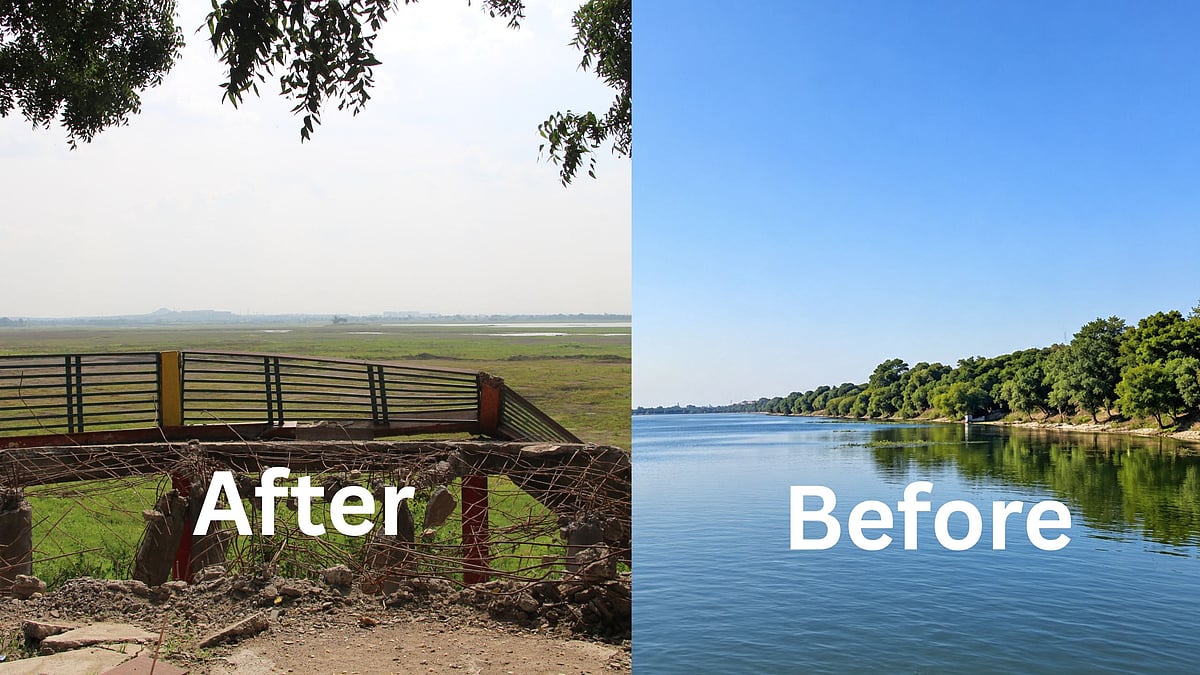
Indore (Madhya Pradesh): Indore’s water stress is no longer visible only in official figures — it is starkly evident on the ground. At Badi Bilawali, the Indore Municipal Corporation (IMC) has recorded a water level of 12.1 ft against a full level of 34 ft, but large portions of the lakebed are already exposed and water is confined to a relatively small stretch.
The contrast underlines a crucial point: recorded water depth does not necessarily indicate the actual volume of usable water available in a lake.
Badi Bilawali stood at 10.2 ft at the end of summer and rose to 12.1 ft after the monsoon. Yet, despite the increase on paper, the present spread of water remains limited, raising concern over how much usable storage the lake actually holds.
The situation is equally worrying at several other city water bodies. Chhoti Bilawali and Limbodi are at zero level, while Pipliyapala stands at only 7.1 ft against its 22-ft full level. Bada Sirpur is at 11 ft against 16 ft. Only Chhota Sirpur, at 13.7 ft against 14 ft, is close to its full level.
Yashwant Sagar, meanwhile, remains comparatively better placed at 17.2 ft against its 19-ft full level.
The concern comes after deficient rainfall in western Madhya Pradesh and unusually high October temperatures. Indore recorded 36.3°C on Wednesday, 3°C above normal, while afternoon humidity dropped to 27%.
The IMC figures show water depth, but the ground situation at several lakes presents a more troubling picture — shrinking water spread, exposed lakebeds and limited post-monsoon reserves.
TABLE WATER BODIES WATER LEVEL
Water body
Capacity
Current level
Water left
Depleted
Yashwant Sagar
19 ft
17.2 ft
90.5%
9.5%
Badi Bilawali
34 ft
12.1 ft
35.6%
64.4%
Chhoti Bilawali
12 ft
0 ft
0%
100%
Bada Sirpur
16 ft
11 ft
68.8%
31.2%
Chhota Sirpur
14 ft
13.7 ft
97.9%
2.1%
Pipliyapala
22 ft
7.1 ft
32.3%
67.7%
Limbodi
16 ft
0 ft
0%
100%
THIS IS WATER LEVEL RECORDED BY IMC FOR WATER BODIES, BUT THE REAL SITUATION OF WATER BODIES IS VERY CRITICAL
Oct’s scorch blight breaks 9-yr barrier
Heat made a sharp comeback in Indore on Wednesday, with the mercury touching 36.3°C — the city’s highest October temperature in nine years.
The maximum was 3°C above normal and only 2.7°C below Indore’s all-time October high of 39°C. Historical records show the 39°C mark was touched in October 2018.
The latest reading underlines an unusually hot start to the month. Between 2016 and 2025, October’s highest day temperature remained below 36°C in all but one year. In 2017, the highest was 35.6°C, while in 2023 it touched 35.1°C.
Wednesday’s heat was accompanied by very dry conditions, with humidity dropping to 27% by 5.30 pm. Nights, however, remained relatively cool, with the minimum settling at 17.2°C.
With the monsoon withdrawn from Madhya Pradesh, no rain is expected in Indore over the next few days. While a cyclonic circulation may bring showers to eastern districts, western Madhya Pradesh is likely to remain dry.
Clear skies, low humidity and strong sunshine could keep daytime temperatures elevated over the next few days.
Indore in Octobers
Year
Rainfall
Highest day temperature
Lowest night temperature
2016
1.5 in
32.6°C
14.6°C
2017
0.9 in
35.6°C
15.1°C
2018
0.1 in
39.0°C
16.2°C
2019
1.0 in
32.6°C
17.0°C
2020
1.7 in
34.3°C
15.8°C
2021
2.1 in
34.0°C
14.1°C
2022
1.8 in
34.0°C
16.0°C
2023
Nil
35.1°C
16.6°C
2024
1.0 in
34.2°C
16.8°C
2025
5.1 in
34.1°C
14.0°C
2026
—
36.3°C
17.2°C
October in Indore
Year October rainfall (inches) Highest day temperature Lowest night temperature
2016 1.5 32.6°C (17 Oct) 14.6°C (30 Oct)
2017 0.9 35.6°C (2 & 4 Oct) 15.1°C (31 Oct)
2018 0.1 39.0°C (11 Oct) 16.2°C (30 Oct)
2019 1.0 32.6°C (15 Oct) 17.0°C (13 Oct)
2020 1.7 34.3°C (13 Oct) 15.8°C (28 Oct)
2021 2.1 34.0°C (9 Oct) 14.1°C (30 Oct)
2022 1.8 34.0°C (1 Oct) 16.0°C (24 Oct)
2023 Nil 35.1°C (9 Oct) 16.6°C (28 Oct)
2024 1.0 34.2°C (26 Oct) 16.8°C (25 Oct)
2025 5.1 34.1°C (16 Oct) 14.0°C (12 Oct)
2026 — 36.3°C (7 Oct) 17.2°C
Water crunch rejigs rabi crop plans
Deficient rainfall ahead of the rabi sowing season has begun influencing crop choices in Indore district, with farmers increasingly planning cultivation according to irrigation availability.
Farmers with assured access to wells and tube-wells are expected to continue with water-intensive wheat, while those facing limited irrigation are considering gram, which requires comparatively less water.
Poor rainfall has also raised concerns over garlic and onion sowing. Farmers say water availability, rather than crop prices, has become the biggest factor in deciding what to sow. In several villages, sowing is being delayed as farmers assess soil moisture and available irrigation.
Around 2.40 lakh hectares of land in the district is under cultivation. Agriculture experts say the final sowing pattern will become clearer as the season progresses.
Meanwhile, rising gram prices are adding to farmers’ interest. Dollar gram has climbed from around Rs 8,000 per quintal to above Rs 10,000 in the past three weeks, while desi gram has risen from around Rs 6,500 to nearly Rs 7,500 per quintal.
Traders attribute the rise to stronger demand, tighter arrivals and changing market sentiment ahead of the festival season.
Farmers, however, remain cautious. They fear prolonged water shortage could hit yields and have urged the administration to assess irrigation availability and consider relief measures in affected areas.
Water availability becomes key
Nearly 2.40 lakh hectares are under cultivation in Indore district. Wheat remains dependent on assured irrigation, while gram is emerging as a lower-water alternative.
Crop trend
Indicator
Current trend
Agricultural area
Around 2.40 lakh hectares
Dollar gram
Rs 8,000+ to above Rs 10,000/quintal
Desi gram
Rs 6,500 to around Rs 7,500/quintal
Wheat
Dependent on assured irrigation
Garlic & onion
Sowing may decline due to water concerns
Why gram is gaining preference
Gram is emerging as a safer option in water-stressed areas because of its lower irrigation requirement. A sharp rise in prices over the past three weeks is also encouraging farmers to consider increasing its acreage.
ALSO READ
RECENT STORIES
-
-
-
-
-