Cold Storage Alone Can't Stop India's Food Loss Crisis: IIM-I Study
The findings have significant implications for policymakers, agri-businesses and rural development agencies. Instead of standalone investments, the researchers recommend integrated strategies that simultaneously strengthen infrastructure, technology, market connectivity and institutional coordination.

Cold Storage Alone Can't Stop India's Food Loss Crisis: IIM-I Study | Filr pic
Indore (Madhya Pradesh): India's battle against massive post-harvest food losses cannot be won by building more cold storage facilities alone, according to a new study by researchers at the Indian Institute of Management (IIM) Indore.
The study argues that food waste in the country's agricultural supply chains is driven by a complex mix of operational, technological and institutional challenges that require coordinated solutions rather than isolated investments.
Published in the journal Business Strategy and Development, the study, Identifying Necessary and Sufficient Conditions for Food Loss and Waste Reduction in Agricultural Perishable Food Supply Chains, was conducted by Prof Rohit Kapoor and Palash Kumar Ghosh, an EFPM-2020 participant at IIM Indore.
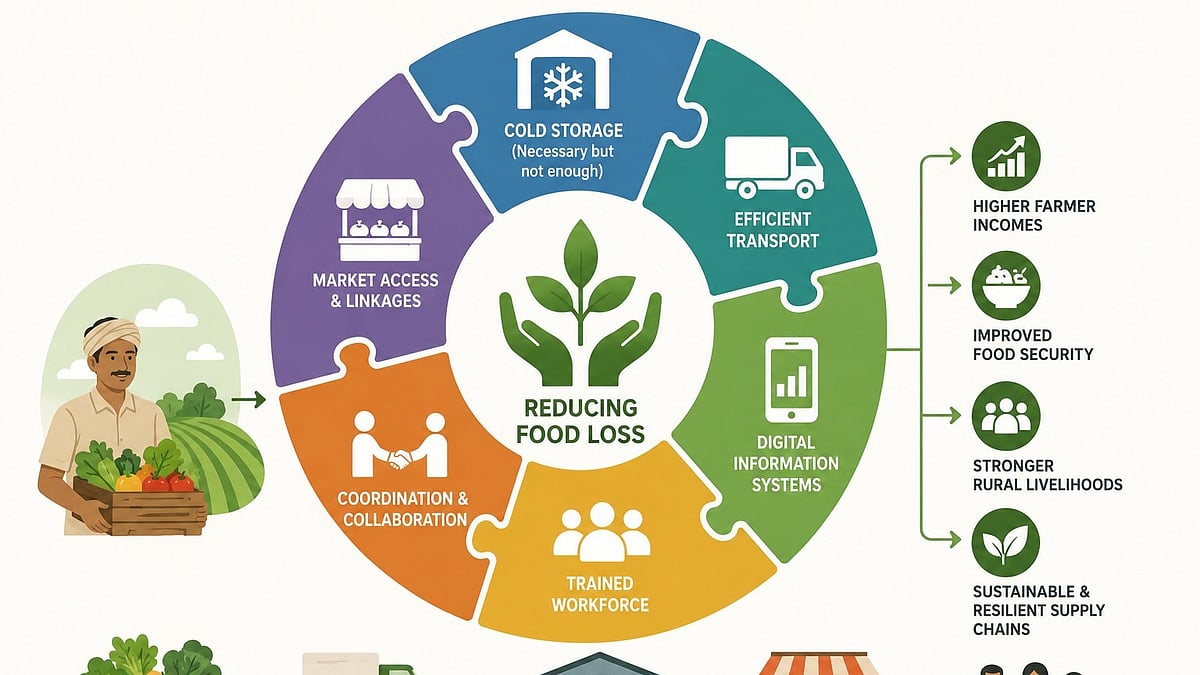
The findings challenge the conventional policy focus on expanding cold chain infrastructure, revealing that while cold storage is essential, it is not sufficient to significantly reduce food loss unless supported by digital systems, stronger market linkages, skilled manpower and better coordination among supply chain stakeholders.
The researchers surveyed 333 stakeholders across India's agricultural ecosystem, including farmers, wholesalers, processors, distributors and cold storage operators, to examine food losses involving highly perishable commodities such as fruits, vegetables and dairy products.
Using structural equation modelling, necessary condition analysis and fuzzy-set qualitative comparative analysis, the study found that food loss stems from multiple capability gaps that vary across regions and institutional settings.
Among the major contributors to food waste are inadequate cold chain infrastructure, fragmented market networks, weak digital information systems, poor workforce training and limited collaboration among supply chain participants.
The study concludes that investing in any one of these areas alone delivers limited results.
"Food loss and waste emerges from interdependent and context-specific capability gaps rather than isolated weaknesses," the researchers noted.
Based on the Contingent Resource-Based View (CRBV) framework, the study argues that the effectiveness of any intervention depends on how resources interact with local institutions, organisational relationships and minimum capability thresholds.
The findings have significant implications for policymakers, agri-businesses and rural development agencies. Instead of standalone investments, the researchers recommend integrated strategies that simultaneously strengthen infrastructure, technology, market connectivity and institutional coordination.
The study offers a practical roadmap for reducing post-harvest losses, improving farmers' incomes, strengthening food security and building more resilient agricultural supply chains.
With post-harvest losses continuing to cost the country billions of rupees annually while affecting food availability and environmental sustainability, the researchers believe their findings can help shape more effective policies to address one of Indian agriculture's most persistent challenges.
RECENT STORIES
-
-
-
-
-