Centuries-Old Sanja Mata Tradition Thrives In Indore As Unmarried Girls Pray For Ideal Life Partners
Unmarried girls in Indore are keeping the centuries-old Sanja Mata tradition alive during Pitru Paksha, worshipping the deity at dusk for suitable life partners and marital well-being. In Shankarganj Colony, the ritual blends prayers and folk songs with intricate wall art made from cow dung, clay, flowers, paper and mirrors.

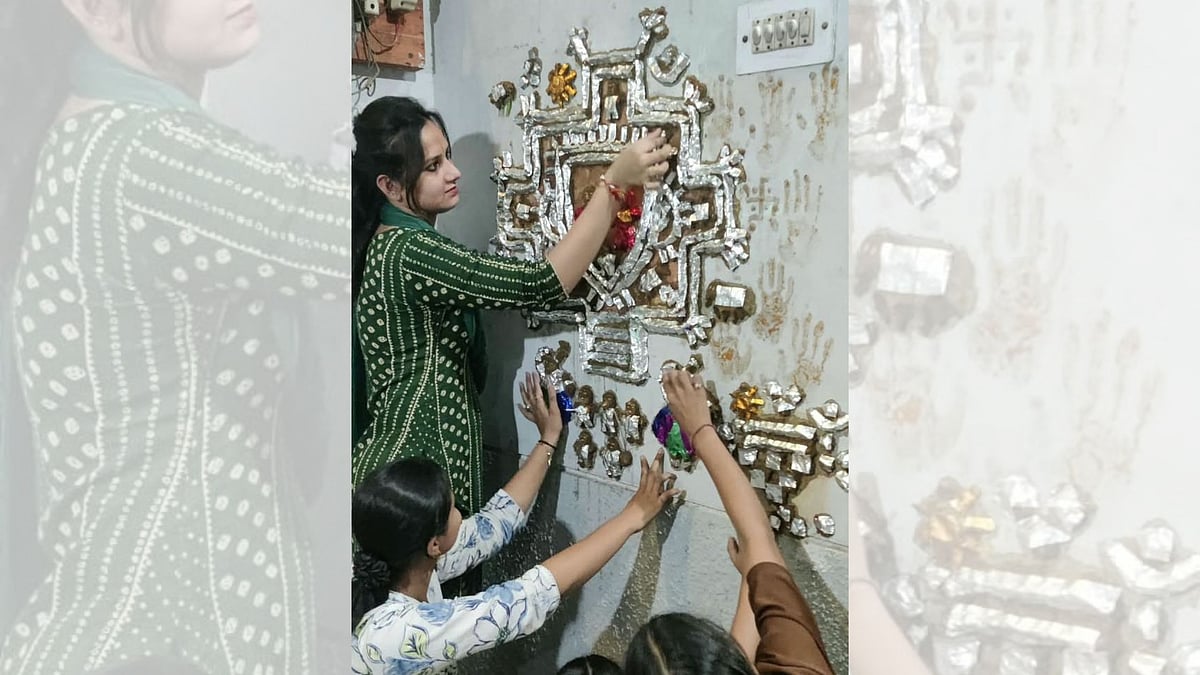
Centuries-Old Sanja Mata Tradition Thrives In Indore As Unmarried Girls Pray For Ideal Life Partners | FP photo
Indore (Madhya Pradesh): As dusk falls each evening during Pitru Paksha over the narrow lanes of Shankarganj Colony in Jinsi, young women gather with brass 'thalis' and folk songs to keep alive a centuries-old cultural tradition that anchors female camaraderie and traditional art across Central India.
With the fortnight drawing towards its final days, unmarried girls in Shankarganj Colony and across the region continue their daily rituals dedicated to Sanjhi Mata, popularly known as Sanja or Sandhya Mata, praying for a suitable life partner and a prosperous married life.
While rapid urbanisation has dimmed many domestic folk customs, the practice remains vibrant throughout the Malwa region, as well as parts of Rajasthan, Haryana, Punjab, and Uttar Pradesh.
In Shankarganj Colony, advocate Aishwarya Naival (Namdev) spends four hours carefully crafting intricate Sanja images on her home wall using traditional motifs.
Surrounded by family and neighbours, she leads the evening 'aarti', sings time-honoured folk hymns handed down through generations, and distributes 'prasad'.
Krishna Mishra, a 'pandit', said that mythological tradition holds that Sandhya Mata manifested at twilight, which is why the rituals are strictly performed during 'Godhuli Bela', the dusk hour when the sun sets.
Historically, this timing allowed young girls in traditional households to complete their daily chores before gathering at sunset to sing, create art, and pray together.
The festival carries deep religious significance, drawing parallels with Goddess Parvati's severe penance as a maiden to win Lord Shiva as her husband. Devotees revere Sanja Mata as the epitome of virtue, seeking her blessings for moral strength and future domestic well-being.
Beyond its spiritual dimension, the ritual acts as a living canvas for indigenous folk art.
Using simple materials such as cow dung, clay, flower petals, colourful paper, and mirror shards, young girls craft elaborate wall depictions of Sanja Mata, complete with intricate ornaments and celestial symbols of the sun and moon.
RECENT STORIES
-
-
-
-
-