Supreme Court Flags Stray Cattle Menace, Urges Centre And States To Compensate Road Accident Victims
The Supreme Court urged the Centre and States to strengthen measures against stray cattle, create a compensation mechanism for road accident victims and enforce existing laws. It also awarded Rs 15 lakh compensation to a woman whose husband died after a stray bull attack in Punjab in 2007.

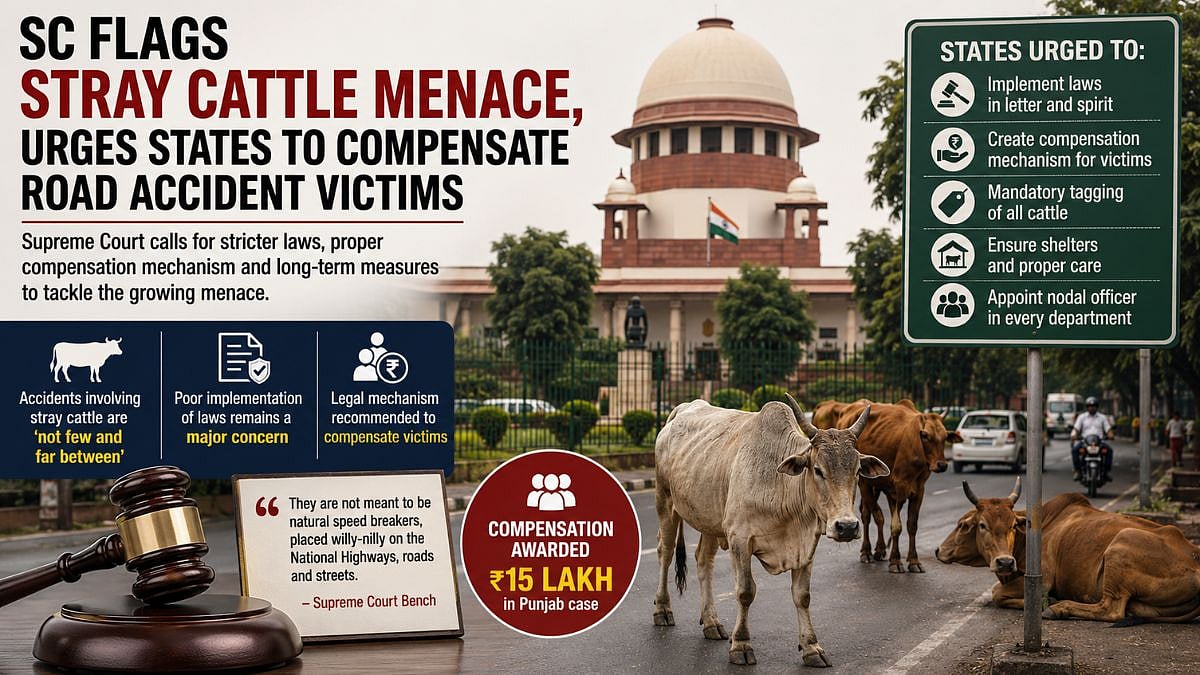
Supreme Court called for stricter action against the stray cattle menace and urged governments to compensate road accident victims | AI Generated Representational Image
New Delhi, July 31, 2026: The Supreme Court on Friday expressed serious concern over the increasing number of road accidents involving stray cattle, saying the problem can no longer be treated as an isolated issue.
Stressing that wandering cattle pose a serious risk to both human and animal life, the court urged the Centre and State governments to ensure stricter implementation of existing laws, create a proper compensation mechanism for victims and adopt long-term measures to tackle the problem.
A Bench of Justice Sanjay Karol and Justice N. Kotiswar Singh made the observations while allowing an appeal filed by Nisha, whose husband, Vijay Kumar, died after being attacked by a stray bull in Sangrur, Punjab, in 2007.
The court also awarded her Rs 15 lakh as lump sum compensation, holding that forcing the family into a civil suit after nearly two decades would leave them "remediless", Live Law reported.
Not Just A Traffic Problem
The Bench observed that accidents involving stray cattle are "not few and far between" and criticised the presence of cattle on roads and highways. "They are not meant to be natural speed breakers, placed willy-nilly on the National Highways, roads and streets," the court remarked.
Referring to official data showing more than 1,300 deaths every year in recent years due to animal attacks, the court said the issue demands a coordinated policy response instead of being viewed as individual incidents. The observations reflect the court's view that governments can no longer ignore a problem that affects public safety across the country.
The Bench also examined the legal framework governing animal welfare, including Article 48 and Article 51A(g) of the Constitution, the Prevention of Cruelty to Animals Act, 1960, the Cattle Trespass Act, 1871 and various State laws dealing with cattle preservation, gaushalas and animal shelters.
While acknowledging that many States already have laws to regulate stray cattle and establish shelters, the court said poor implementation remains a major concern.
Responsibility Beyond Utility
The court identified the abandonment of cattle after they stop being economically useful as one of the main reasons behind the growing stray cattle menace. It observed that animals reared for farming or dairy purposes are often left to fend for themselves once their productivity declines, eventually ending up on roads and highways.
While recognising that many farmers and dairy owners face financial difficulties in maintaining all their animals, the Bench said anyone choosing to rear cattle has a responsibility to care for them throughout their lives. It said abandoned or infirm cattle should be transferred to authorised shelters instead of being left to roam freely.
The court also remarked that in a "deeply flawed, human world", animals are abandoned once their utility diminishes, even as society finds it objectionable when they are used for food, calling this contradiction one of the reasons behind the present situation.
Court Suggests Measures
To address the issue, the Supreme Court suggested several measures for the Centre and State governments. It asked States with cattle-related laws to ensure their immediate implementation in letter and spirit.
It also recommended creating a legal mechanism to compensate victims of accidents involving stray cattle, whether pedestrians or motorists.
The court further suggested mandatory tagging of all cattle to improve tracking, veterinary care and vaccination records. It said owners abandoning animals should be held responsible for ensuring their safe transfer to authorised shelters, with shelters issuing receipts and updating digital records.
It also recommended appointing a nodal officer in every corporation or department to oversee tagging, digitisation and the functioning of shelters.
The Bench directed that a copy of its judgment be sent to the Chief Secretaries of all States, Administrators of Union Territories and Member Secretaries of the State Legal Services Authorities for appropriate action on its recommendations.
Compensation Awarded
In the case before it, the Supreme Court reversed the Punjab and Haryana High Court's decision that had set aside an earlier compensation order on the ground that disputed facts should be decided by a civil court.
Also Watch:
The Supreme Court noted that the authorities had never disputed the occurrence of the incident and awarded Nisha Rs 15 lakh, directing that the amount be paid within four weeks. However, it clarified that the compensation was granted in the peculiar facts of the case and should not be treated as a precedent.
To get details on exclusive and budget-friendly property deals in Mumbai & surrounding regions, do visit: https://budgetproperties.in/
RECENT STORIES
-
-
-
-
-