Centre Clarifies Passport Is Not Sole Proof Of Indian Citizenship
The Centre has clarified that an Indian passport is a travel document, not conclusive proof of citizenship, reaffirming an established legal position under the Citizenship Act, 1955. The clarification, backed by court rulings, has sparked political debate, with the Opposition warning of potential implications for citizenship verification and voting rights.

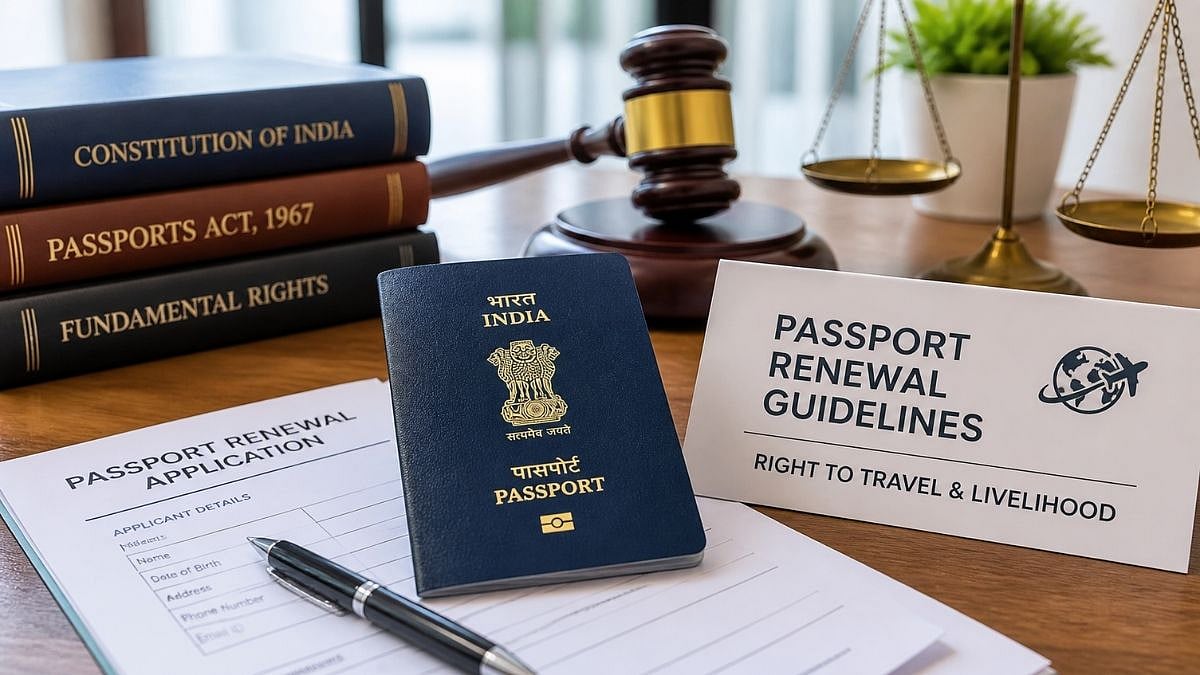
Centre Clarifies Passport Is Not Sole Proof Of Indian Citizenship | AI Generated Representational Image
Mumbai: The government confirmed that passports are not proof of Indian citizenship. The affirmation came after an MEA official stated on Passport Seva Divas, which was held on Wednesday, that a “passport remains a travel document and not a document of citizenship, as it attests to the nationality of Indians when they are abroad.”
While the government has not officially responded to the MEA official’s statement, tweets by a senior BJP leader clarified that what he had said was indeed true. Senior BJP leader Amit Malviya stated that the MEA was not announcing a new policy but simply reiterating a “settled legal position.” Writing on X, he said. “Indian courts have repeatedly held that a passport is not conclusive proof of citizenship.” Malviya then cited legal precedent for the statement.
“The Bombay High Court made this clear in 2013 and reaffirmed the principle subsequently: citizenship is determined under the Citizenship Act, 1955, based on eligibility and supporting evidence, not by the mere possession of a single document.”
Government rules point out that passports are issued under the Passports Act, 1967, while citizenship is governed separately under the Citizenship Act, 1955. For Malviya the route to establishing one's citizenship is “through a combination of records, including birth certificates, parents’ citizenship records (where relevant), school records, electoral roll entries, government service records, land and residence records, passports, and other contemporaneous official documents.”
ALSO READ
This explanation has not assuaged some political leaders from the Opposition. Lawyer and Rajya Sabha MP Kapil Sibal pointed to the dangerous implications if this rule was strictly followed. “A passport is a travel document and not a document of citizenship.” Which document then is proof of citizenship? BLO (Booth Level Officer) can doubt my citizenship Deprive me of my vote. Result BJP wins the election. Over to Supreme Court!"
The government, however, cites provisions of the Passport Act, 1967, to make its claim. Section 20 of the Passports Act says a passport can be given to a non-citizen by the Indian government if the government deems it to be in the public interest. “Notwithstanding anything contained in the foregoing provisions relating to the issue of a passport or travel document, the Central Government may issue, or cause to be issued, a passport or travel document to a person who is not a citizen of India if that Government is of the opinion that it is necessary so to do in the public interest.” If, therefore, the passport can be awarded to non-Indians, it cannot be seen as sole proof of Indian citizenship.
Court rulings have also played a part here. The Bombay High Court, in a ruling in 2013, stated that Indian passports, Aadhaar cards, and birth certificates were not enough to prove citizenship. This ruling came in the case of four persons who were accused of being illegal immigrants. The accused had submitted these documents stating that this qualified them to be Indian citizens. In his ruling, Justice Chandiwal not only said that Indian passports, Aadhaar cards, and birth certificates were not enough as proof; he added that being an Indian citizen depended on when the person had been born and where his or her parents had been born.
ALSO READ
Under the Citizenship Act, 1955, those born before July 1, 1987, in India are generally considered to be Indian citizens by birth. Those who are born afterwards would have to show documentation that at least one of their parents was an Indian citizen at the time of birth.
Justice Chandiwal’s ruling has been followed by other justices around the country when it has come to the issue of citizenship. In 2020, the Guwahati High Court under a Division Bench of Justice Manojit Bhuyan and Justice Parthivjyoti Saikia ruled that the accused Jabida Begum had failed to prove her Indian citizenship.
The accused pointed out that she was an Indian citizen and argued that her parents' and grandparents' names were on the 1966 electoral roll, and she had later appeared in electoral rolls after her marriage. She also produced documents such as Land Revenue Paying Receipts, a Gaon Bura certificate certifying that she was a permanent resident of Village No. 2 Dongergaon, Ration Card, Bank Passbook, and PAN card. The court ruled against her, stating that "the petitioner failed to prove her linkage with her projected parents and her projected brother. Therefore, we find that this writ petition is devoid of merit, and accordingly, we dismiss the same.”
ALSO READ
These court rulings show that the statement made by the MEA official is legally correct. Former foreign secretary Nirupama Rao believes that law and public understanding are not always the same things. “The passport is the most authoritative document the Republic issues,” she says. “It bears the name of the Republic of India, carries the holder’s identity, and is accepted around the world because foreign governments trust that India has verified the bearer’s nationality before issuing it.”
Rao believes more nuance needs to be used in the ongoing debate. “India’s systems of civil registration developed unevenly over many decades. Millions of older Indians were born when birth registration was incomplete. Names were recorded differently across school certificates, land records, and electoral rolls,” she said. “The painful experience of the Assam NRC showed how documentary inconsistencies can create profound hardship when citizenship itself becomes the subject of legal scrutiny.”
Finally, the former foreign secretary believes that the MEA statement, while not wrong, created panic, and a necessary explanation along with the statement would have eased tensions. “A better way of putting it might have been this: A passport is issued only after the government has verified that the applicant is an Indian citizen,” she said. “While citizenship itself is governed by the Citizenship Act, the passport remains the Republic’s most trusted document for international travel and, in ordinary life, the clearest evidence of Indian nationality. That is both legally accurate and reassuring.”
To get details on exclusive and budget-friendly property deals in Mumbai & surrounding regions, do visit: https://budgetproperties.in/
RECENT STORIES
-
-
-
-
-