BRICS New Delhi Declaration 2026: From Pahalgam Terror Attack To Charting Path For Fairer Global Order; Read Full Text Of 140-Point Document
The declaration also sought reforms of global institutions and greater representation for emerging markets and developing economies in international decision-making.

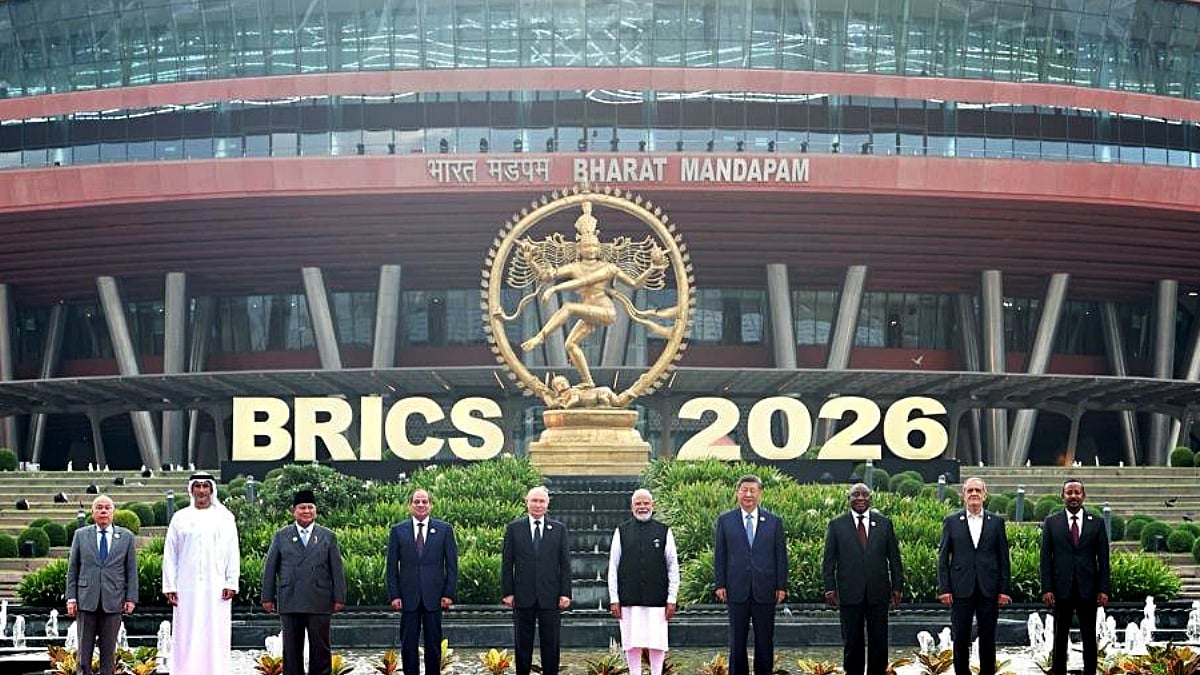
BRICS-group-photo | PTI
New Delhi: Leaders of the BRICS countries on Saturday adopted the New Delhi Declaration at the 18th BRICS Summit, marking two decades of the grouping and setting out an expansive agenda for cooperation among its members and partners.
The declaration strongly condemned the April 22, 2025 terrorist attack in Pahalgam, Jammu and Kashmir, which claimed 26 lives, and called for stronger international cooperation to combat terrorism, terrorist financing, networks and safe havens.
Held under the theme “Building for Resilience, Innovation, Cooperation and Sustainability,” the summit comes at a time of profound geopolitical, economic and environmental change. Against this backdrop, the declaration reaffirms the BRICS commitment to mutual respect, sovereign equality, solidarity, inclusiveness and consensus, while calling for a stronger and more representative multilateral system.
Greater representation in global institutions
A central message of the declaration is the demand for a more representative and equitable international system. BRICS leaders reiterated their support for reforming global governance institutions and strengthening multilateralism and multipolarity.
The declaration calls for greater participation of emerging markets and developing economies in international decision-making, including within the United Nations and other global institutions. BRICS also renewed its call for comprehensive reform of the UN Security Council and greater representation for developing countries. China and Russia reiterated support for Brazil and India playing a greater role in the UN system, including the Security Council.
The leaders also highlighted what they described as the growing importance of the Global South in shaping responses to geopolitical tensions, economic disruptions, technological change, protectionism, migration and climate change.
Economic reform remains a priority
The declaration places strong emphasis on reforming the international financial architecture. BRICS members called for changes to the IMF and World Bank to better reflect the changing weight of emerging and developing economies.
The group reiterated its support for greater voting and quota representation for emerging markets and developing economies and called for more transparent and inclusive leadership-selection processes at major international financial institutions.
BRICS leaders also backed reform of the World Trade Organization and reaffirmed support for an open, predictable and rules-based multilateral trading system. They expressed concern over rising tariffs, non-tariff barriers and protectionist measures, warning that such policies could disrupt global trade and supply chains.
Focus on AI and digital infrastructure
Technology has emerged as another major pillar of the New Delhi Declaration. BRICS countries recognised artificial intelligence as a potentially transformative force for economic growth and sustainable development. At the same time, they stressed the need for AI to be safe, secure, inclusive, reliable and trustworthy.
The leaders also committed to implementing the BRICS Leaders' Statement on the Global Governance of Artificial Intelligence, while emphasising greater access to AI resources and international cooperation, particularly for countries of the Global South.
The declaration also supports deeper cooperation on digital public infrastructure, digital skills, cybersecurity and future communications networks. BRICS countries are considering a digital public infrastructure repository and pilot projects that could help members share technological solutions and experience.
Health cooperation gets wider mandate
Healthcare features prominently in the declaration, with BRICS leaders calling for stronger cooperation on universal health coverage, disease surveillance, medical research and access to healthcare.
Tuberculosis has been identified as a critical global health challenge requiring greater investment, research cooperation and technology sharing. The declaration also supports stronger early-warning and response mechanisms for infectious diseases, including the establishment of a dedicated BRICS sub-working group on an integrated early-warning system.
The group also wants to strengthen medical-product regulation, digital healthcare and local production of medicines, vaccines, diagnostics and therapeutics.
Food security moves up agenda
With BRICS countries accounting for a significant share of global agricultural production, food security has received particular attention.
The declaration supports continued work on a proposed BRICS Grain Exchange, which could eventually expand beyond grain to other agricultural products and commodities. Leaders also highlighted the importance of resilient supply chains, national food reserves and climate-adaptive seeds in dealing with supply disruptions and food-price volatility.
The declaration also establishes the BRICS AGRIN network, designed as a collaborative and farmer-centric platform covering agro-inputs, genetic resources and information. A Global Forum on Farmers' Rights in Seed Systems is also welcomed.
Energy security and cleaner technologies
BRICS leaders have linked energy security directly with economic development and national security.
The declaration recognises that fossil fuels will continue to have a role, particularly for emerging and developing economies, while simultaneously supporting more orderly, equitable and inclusive energy transitions.
It also highlights renewable energy, nuclear power, hydrogen, hydropower, energy storage and other low-carbon technologies as part of a diversified energy mix. Cooperation on hydrogen standards and value chains is another area identified for further work.
The leaders further emphasised the importance of secure and sustainable critical-mineral supply chains, recognising their importance for clean-energy technologies and energy security.
Start-ups, MSMEs and industrial innovation
The declaration gives significant attention to entrepreneurship and industrial transformation.
BRICS members welcomed initiatives including the BRICS Incubator Network, further consideration of a potential BRICS Startup Innovation Fund, and continued development of the BRICS Startup Knowledge Hub and Startup Forum.
The grouping also wants deeper cooperation among start-ups and small and medium-sized enterprises, particularly in areas connected with Industry 4.0, advanced manufacturing and technology transfer.
Youth are also positioned as important participants in this innovation ecosystem, with BRICS encouraging greater engagement of young researchers and entrepreneurs through initiatives such as the Young Scientists Forum and Young Innovators Prize.
Climate resilience and disaster preparedness
Climate change and disaster resilience form another important component of the declaration.
BRICS leaders called for stronger national disaster-risk reduction systems, improved early-warning mechanisms and greater access to financing for resilient infrastructure. The declaration welcomes guidelines on disaster-management data integration and voluntary principles for climate-resilient urban infrastructure.
The declaration also recognises that developing economies face particularly serious climate-related financing challenges, including large gaps in funding for adaptation.
Financial resilience and development finance
BRICS is also seeking mechanisms that could make development projects more attractive to private investors.
The declaration welcomes progress on the BRICS Multilateral Guarantees initiative, which leaders say could help mobilise private capital, improve creditworthiness and lower financing costs for development projects across BRICS and the wider Global South.
The declaration additionally supports continued work on the BRICS Contingent Reserve Arrangement as a financial safety net and efforts to improve its operational resilience during periods of economic stress.
Security, conflicts and counter-terrorism
On international security, BRICS leaders stressed dialogue, diplomacy and peaceful settlement of disputes.
The declaration expresses concern over growing geopolitical polarisation, conflicts and rising military spending, while calling for greater emphasis on conflict prevention and mediation.
The leaders also strongly condemned terrorism and specifically condemned the April 22, 2025 Pahalgam terrorist attack in Jammu and Kashmir, which killed 26 people. They called for stronger international cooperation against terrorism financing, terrorist networks and safe havens.
RECENT STORIES
-
-
-
-
-