50 Million Indian Children Lacked School Sanitation Services In 2025: WHO-UNICEF Report
Around 50 million Indian children lacked sanitation services at school in 2025, the highest number recorded for any country, according to a WHO-UNICEF report. India also had around 12 million children without school drinking-water services, while about 20 million lacked hygiene services. Globally, WASH progress remains off track for 2030.

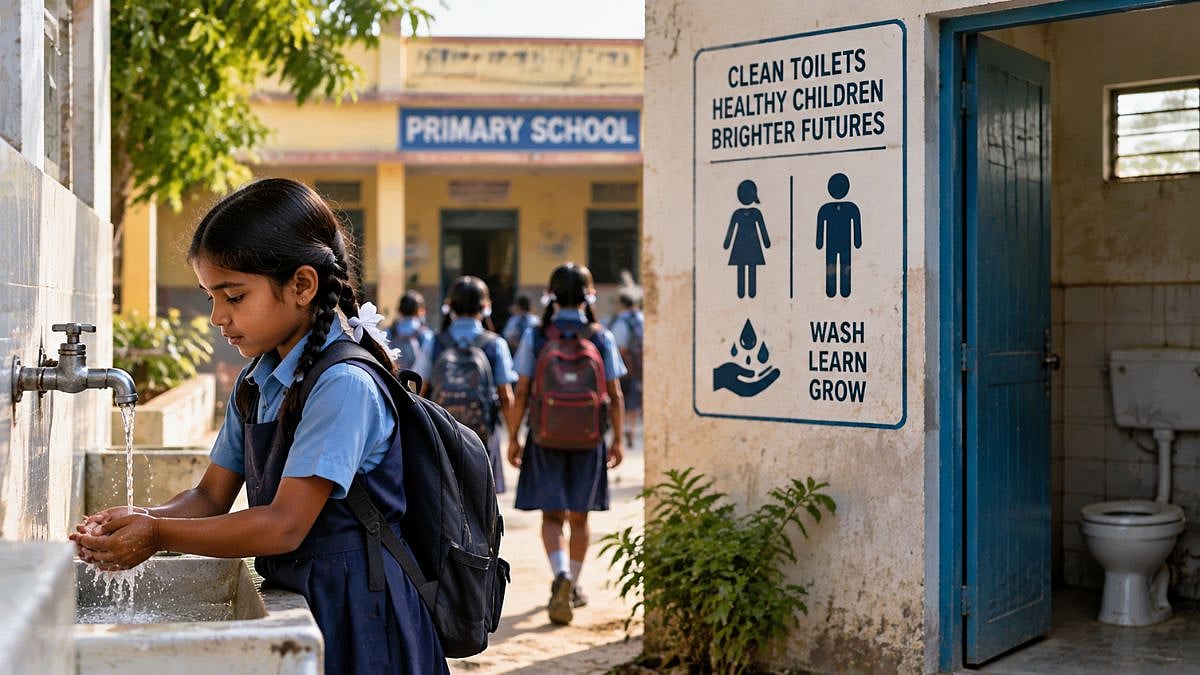
A WHO-UNICEF report highlights persistent sanitation gaps affecting millions of Indian children in schools | AI Generated Representational Image
New Delhi, September 28, 2026: India accounted for 50 million of the 244 million children worldwide who lacked sanitation services at school in 2025, according to the WHO-UNICEF Joint Monitoring Programme (JMP) report.
Nearly one-fifth of the children without access to school sanitation services were in India, the highest number for any country, the report, Progress on Drinking Water, Sanitation and Hygiene in Schools 2015-2025, noted.
The report said India recorded a 14% reduction in the number of schools without sanitation services during the period assessed.
The World Health Organization (WHO) and the United Nations Children’s Fund (UNICEF) joint monitoring programme produces internationally comparable estimates on progress in drinking water, sanitation and hygiene (WASH). It is also responsible for global monitoring of the Sustainable Development Goal (SDG) targets related to WASH.
Global Goals For Water, Sanitation And Education
The 2030 Agenda for Sustainable Development includes global goals covering water, sanitation and education. Goal 4 seeks to ensure "inclusive and quality education for all and promote lifelong learning" and includes targets to build and upgrade education facilities that are child-, disability- and gender-sensitive, while providing safe and effective learning environments for all.
This includes ensuring that schools have access to electricity, computers, the internet, adapted infrastructure and materials for students with disabilities, as well as basic WASH services.
Goal 6 aims to "ensure availability and sustainable management of water and sanitation for all" and includes targets for universal access to safe drinking water, sanitation and hygiene.
India’s Sanitation And Hygiene Gaps
"In 2025, despite progress, 244 million children still had no sanitation service at their school," the report said.
India accounted for 50 million of these children, followed by Nigeria with 34 million, Ethiopia with 26 million, the Democratic Republic of the Congo with 11 million and Indonesia with 8 million.
For SDG monitoring, a basic drinking water service means schools have access to a functioning improved water source. A basic sanitation service means schools have improved sanitation facilities that are single-sex and usable. A basic hygiene service means schools have handwashing facilities with soap and water available at the time of the survey.
Hygiene remains a concern, with around 20 million Indian children lacking hygiene services at school. However, the JMP said insufficient recent data meant it could not generate hygiene coverage estimates for India and the Central and Southern Asia region beyond 2024.
Drinking Water Access Better, But Global Targets Off Track
"India performed comparatively better on school drinking-water access. In 2025, around 12 million Indian children lacked drinking-water services at school, accounting for roughly one in every 20 children globally without such services."
India is among 28 of 62 countries considered on track to achieve universal basic drinking-water coverage in schools by 2030. Its basic drinking-water coverage increased by more than 4 per cent annually during the period assessed, it said.
The monitoring report said the world was not on track to achieve universal access to basic WASH services in schools by 2030, with only five years remaining until the end of the SDG period.
"Achieving universal coverage will require a fourfold increase in the current rate of progress on basic drinking water, a fivefold increase in progress on basic sanitation, and a fourfold increase in progress on basic hygiene."
Also Watch:
Based on current trajectories, around 84 per cent of schools will have basic water services, 81 per cent will have basic sanitation services and only 79 per cent will have basic hygiene services in 2030.
"At the end of the SDG period, 10 per cent of schools will still have no water service, 7 per cent will have no sanitation service and 12 per cent will have no hygiene service," it said.
To get details on exclusive and budget-friendly property deals in Mumbai & surrounding regions, do visit: https://budgetproperties.in/
RECENT STORIES
-
-
-
-
-