SpiceJet's Fall: From One of India's Early Listed Airlines To A Penny Stock
SpiceJet shares have reportedly plunged over 68% in 2026 amid financial difficulties, flight cancellations and mounting creditor disputes. The airline has faced repeated crises since its ModiLuft days, including ownership changes, aircraft groundings and pandemic losses. Despite previous recoveries, continuing operational challenges have raised concerns about its financial stability

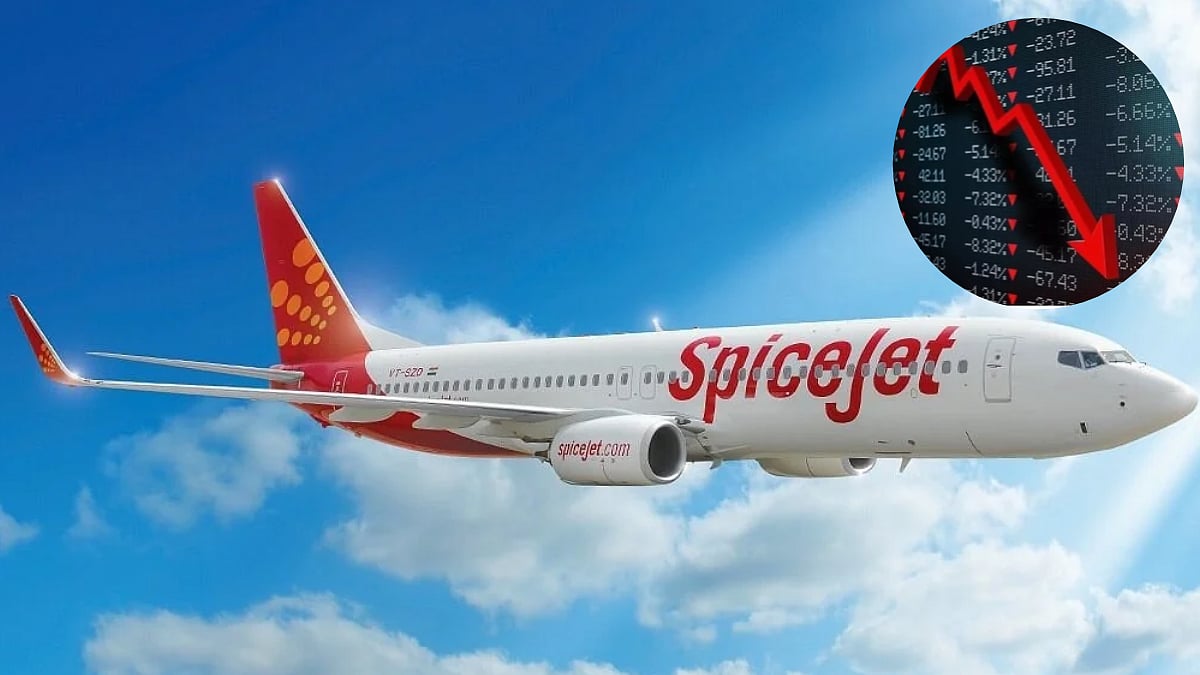
Several of SpiceJet's scheduled flights have reportedly been cancelled this month amid mounting financial challenges. But this is not the first time the airline has faced the threat of a shutdown.
SpiceJet's long-standing troubles have been marked by repeated ownership changes, a near-collapse in 2014-15, a prolonged legal dispute with former promoter Kalanithi Maran, and continuing payment disputes with aircraft lessors and other creditors.
This has also affected the company's performance in the equities market. From once being one of the first listed aviation companies in the country, SpiceJet's shares now trade on the bourses as penny stocks.
ALSO READ
Among the first listed aviation majors of India
The airline was incorporated in 1984 as a private company and promoted by S.K. Modi of the Modi Group. It was renamed MG Express in 1993. Between 1993 and 1996, ModiLuft, a venture involving the Modi Group and Lufthansa, operated in India.
ModiLuft was listed in 1995, becoming one of the first Indian aviation companies to go public. However, a legal dispute with Lufthansa led to the company's shutdown just five years later.
As a result, the stock lost 63% of its value between 1995 and 2000. The year 1996 was the worst, as the stock declined by over 82%, sliding from Rs 19 to just Rs 3.40 apiece.
In 2005, the company was renamed Royal Airways and subsequently SpiceJet Ltd. The rebranded aviation firm began commercial operations on May 23, 2005.
The revival infused some confidence among investors and pushed the stock up by 157% in the same year.
During the first five years of the last decade, the company again faced turbulence, including an ownership change, as Kalanithi Maran and his company, KAL Airways, acquired control of SpiceJet from its previous promoters, including Ajay Singh and Bhupendra Kansagra.
Despite this, the airline ran into a severe cash crunch in 2014. It struggled to pay aircraft lessors, suppliers and other vendors. Several aircraft were grounded, while the airline faced difficulties meeting its operating expenses.
This again affected the stock's performance as the company slipped into losses. The stock declined by over 70%, from Rs 58.40 to Rs 17.20 apiece.
Fortunes turned
The fortunes turned the following year, as Maran and KAL Airways agreed to transfer ownership, management and control to Ajay Singh.
After Singh took control, SpiceJet began rebuilding its operations. It renegotiated payments with lessors and vendors, improved its fleet utilisation and expanded its network. The airline returned to profitability in FY16.
The stock jumped over 731%, from Rs 17.55 to Rs 145.95 apiece, between 2015 and 2017. This proved to be the stock's peak performance, as successive challenges battered the company.
First, the grounding of 13 Boeing 737 MAX aircraft in 2019 and the Covid-19 pandemic the following year squeezed SpiceJet's revenue.
Repeated blows to business
While the company was able to reach a settlement with Boeing and the 737 MAX lessors over past lease rentals, the relief was short-lived, as 50% of its flights were grounded following restrictions imposed by the DGCA after a series of technical incidents in 2022.
From 2020 to 2022, SpiceJet's stock declined by almost 70%. Given the company's financial situation, lenders reportedly classified their exposure to SpiceJet as high risk.
In the subsequent years, the company's stock delivered negative returns, barring 2023.
The current year has also not gone well for the aviation operator. The company is facing insolvency proceedings, has delayed salary payments and is losing market share, which now stands at less than 1%.
The latest blow came when several of its flights had to be cancelled due to non-payment of various dues.
In 2026 so far, SpiceJet's stock has declined by over 68%, from Rs 29.74 to Rs 9.50 apiece.
The latest cancellations have renewed concerns about SpiceJet's ability to stabilise operations.
Its future performance will depend on resolving financial obligations, maintaining aircraft availability and restoring operational stability.
RECENT STORIES
-
-
-
-
-