Noise Isn’t Knowledge; The Bill Always Arrives
From West Asia to emerging mkts, including India, the world spent the week paying for decisions made long ago.

There is a famous scientific principle that every action produces a reaction. In physics, it is a law. In economics, it is a warning. In history, it is a certainty.
Last week offered another reminder. A conflict in West Asia moved oil markets across continents. Diplomatic signals shifted currencies. Investor sentiment swung between optimism and anxiety.
A missile launched in one region altered calculations in another. Even India, thousands of kilometres away, felt the tremors through energy prices, capital flows and market sentiment. Greed chased opportunity. Fear chased safety. Markets rose and fell. The reactions were not always equal, but they were inevitable.
An old satire tells of a magnificent lamp towering above a crowd. The people gathered beneath it admired its brilliance and sought a share of its rewards. Few paused to ask who built it, what sustained it, or whether its foundations were strong enough to survive the next storm.
In an age of instant information and perpetual distraction, societies often become fascinated by the light while neglecting the structure that holds it aloft. The confrontation between the United States and Iran entered its 106th day. Traders watched the Strait of Hormuz as ancient mariners once watched darkening horizons. Oil prices rose and fell with every diplomatic whisper. Markets celebrated peace in the morning and feared escalation by evening. Governments measured risks. Investors measured opportunities. Everyone searched for meaning in the light.
Yet history rarely changes because of what dominates the headlines. More often, it changes because of what quietly unfolds beneath them.
The true story of June 8–14 was not merely the movement of crude oil or the choreography of diplomacy. It was the widening divide between nations that react to events and nations that prepare for them. We are living through an age of fragmentation. Trade routes are being redrawn. Supply chains are shifting. Energy security has become a strategic weapon.
Artificial Intelligence is reshaping industries. The old certainties of globalisation are giving way to a world where resilience matters more than efficiency and preparation more than prediction.
Viewed through that lens, India’s quieter developments deserve attention. Narendra Modi became the country’s longest continuously serving elected PM. Headline inflation remained below 4%. Foreign-exchange reserves stayed above $680 billion. Bank credit crossed ₹215 trillion while deposits exceeded ₹260 trillion. The RBI's FCNR(B) measures and a strengthened export-credit framework reflected a simple but profound principle: the strongest umbrellas are purchased before the rain begins.
There is another challenge confronting modern societies. Ignorance can be corrected, but half knowledge often becomes conviction. A headline becomes a conclusion. A temporary market movement becomes a prophecy. Yet economies are ecosystems, not slogans.
ALSO READ
The greatest mistakes in public policy, investing and governance are often committed not by those who know too little, but by those who believe they know enough.
The laws of physics govern matter. The laws of economics govern incentives. The laws of history govern memory. Ignore any of them long enough and the reaction eventually arrives.
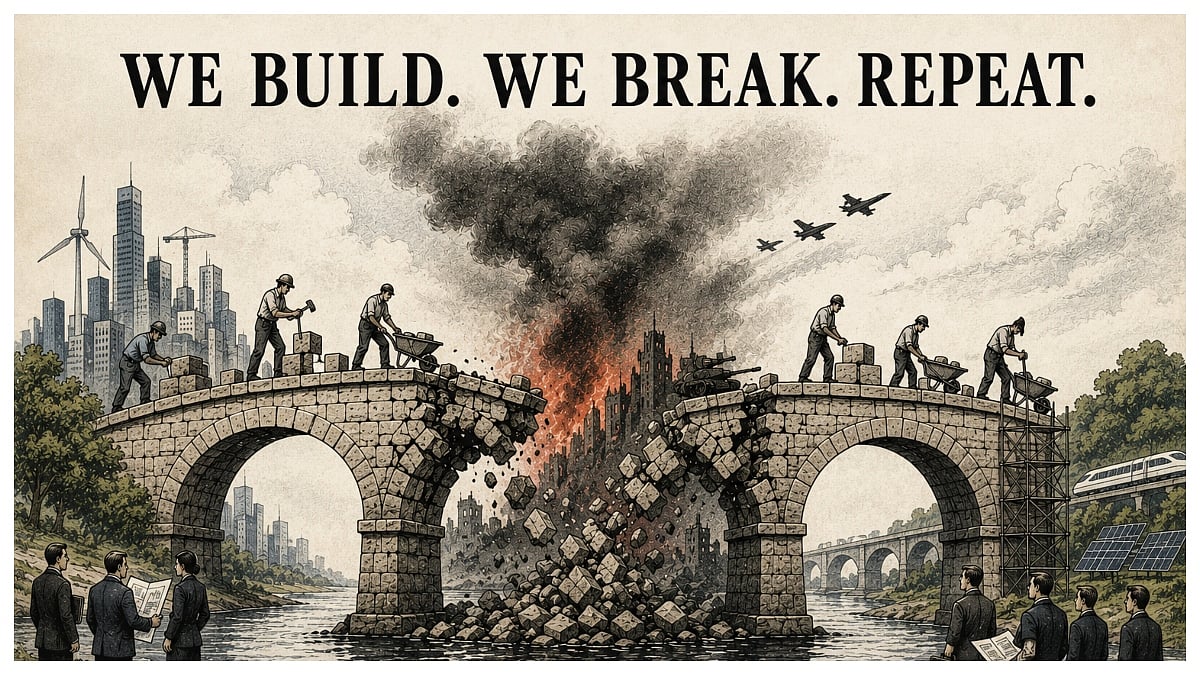
One day the flames of today's conflicts will fade. Oil prices will settle. Markets will move on. What will remain are the foundations.
We build. We break. We repeat. The future belongs to those who learn before the reaction arrives.
THE WEEK IN HARD NUMBERS
(June 8–14)
$76–78: Brent crude eased to around US$76–78 a barrel as hopes of diplomatic progress reduced supply concerns.
411,000 bpd: OPEC+ continued with previously announced production increases of roughly 411,000 barrels per day.
2.5% & 6.6%: The World Bank cut its 2026 global growth forecast to 2.5% and warned it could drop to 1.3% in a severe geopolitical shock. While developing economies are expected to grow 3.6%, India’s FY27 growth forecast was raised to 6.6% and FY28 to 7.2%, supported by resilient domestic demand.
25 bps: The European Central Bank raised its three key interest rates by 25 bps. From June 17, the deposit facility rate will rise to 2.25%, the refinancing rate to 2.40%, and the marginal lending rate to 2.65%.
World's first trillionaire: History’s biggest IPO ($75 bn) turned Elon Musk into the world's first trillionaire (from $28 bn in 2020 to $1.11 tn networth in 2026).
19%: SpaceX shares surged 19% on their Nasdaq debut on June 12, reflecting strong investor appetite for technology, AI and space-related businesses.
4,399 days: Narendra Modi became India’s longest continuously serving elected Prime Minister.
$65-75 bn: RBI’s FCNR(B) measures could attract fresh foreign-currency deposits of up to $75 billion. Some banks raised FCNR(B) deposit rates to as high as 7.1%.
₹$270 bn: Market gurus unofficially estimate Tata Sons’ enterprise value at about $275 billion. Any future IPO could rank among India’s largest listings and broaden public participation in one of the country’s most influential business groups.
* The week’s facts and figures revealed a world balancing between conflict and confidence, disruption and preparation. From Mideast battlefields and Europe’s central bankers to Silicon Valley’s ambitions and India’s institutions, one lesson echoed across continents: every action creates consequences, but nations that strengthen their foundations are best placed to withstand the reaction.
RECENT STORIES
-
-
-
-
-