Costly Dependence: Oil Built Power, Future Demands Change
From Edwin Drake’s 1859 strike to Iran and Arab Gulf oil wealth, history fuels power—now war disrupts supply, shaking economies worldwide.

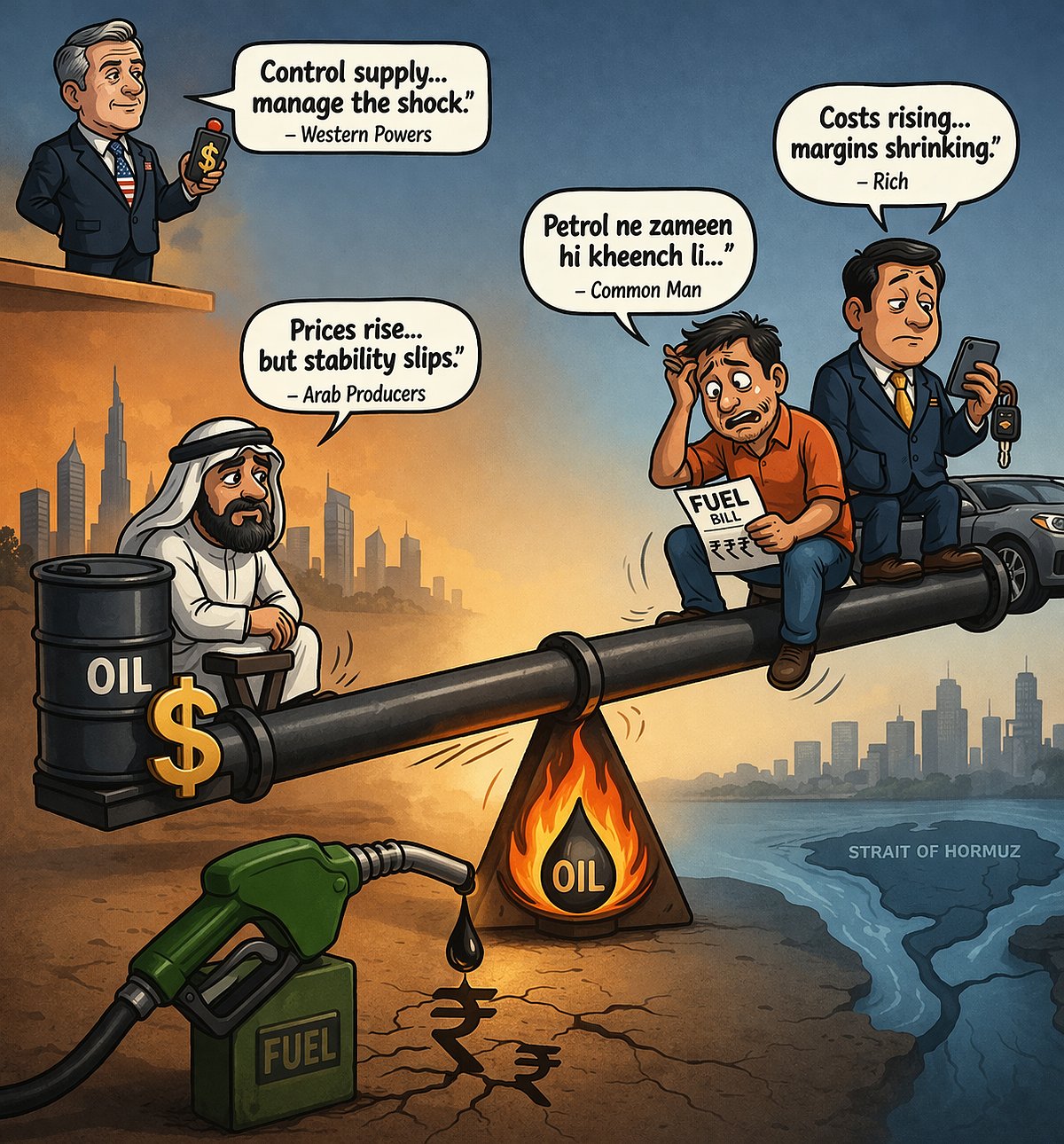
From Edwin Drake’s 1859 strike to Iran and Arab Gulf oil wealth, history fuels power—now war disrupts supply, shaking economies worldwide. |
Mumbai: Fuel costs are no longer an abstract economic variable—they are a daily test of endurance for millions. Across India, at fuel stations and kitchen tables alike, the rising price of energy is quietly rewriting the arithmetic of life. For now, state-owned oil companies have held prices steady despite the intensifying West Asia conflict, offering brief relief. Yet private retailers have already begun edging prices upwards—a signal of what may follow. Every increase travels swiftly: into food, transport, and the fragile balance of household budgets. Crude has moved; the burden is only delayed.
Oil has always been more than fuel—it is power, history, and control. From Edwin Drake’s first well in 1859 to the rise of Baku, Southeast Asia, and later the North Sea, oil shaped modern economies. After the Second World War, its pricing aligned with the US dollar, forming the petrodollar system—binding energy trade to American financial dominance and compelling nations like India to maintain vast dollar reserves.
India’s own journey has been marked by promise, but not sufficiency. From Digboi to Bombay High, domestic production never matched demand. Today, over 80 per cent of crude is imported, leaving the economy exposed to distant conflicts and decisions beyond its control.
Nowhere has oil’s power been more visible than in the Middle East. Discoveries across Iran, Iraq, Kuwait, and Saudi Arabia transformed deserts into financial centres. Wealth surged, infrastructure rose, and influence deepened. Yet prosperity came with concentration—of power, of control, and of vulnerability. For India, dependence took a dual form: energy imports and labour exports. Millions of Indian workers sustain Gulf economies, even as India relies on their remittances and the oil those regions supply.
Oil and conflict have always travelled together. From the Iran–Iraq War to Iraq’s invasion of Kuwait, history shows oil is not merely fuel—it is motive. Prices reflect this volatility. From below $10 per barrel in the 1980s, crude surged to a record $147 in 2008, before settling into cycles.
Today, the pattern sharpens. The 2026 Iran war, now past its fifth week, has choked the Strait of Hormuz—artery to nearly a fifth of global supply—pushing crude beyond $100 and towards a perilous $150–$190 range. Even as Iranian oil reaches India and select sea lanes hold, risks to shipping remain acute. Tehran’s central military command has rejected the US President’s 48-hour ultimatum, hardening the standoff. Oil is no longer merely priced—it is risked, and with every unresolved hour, markets add a fresh premium to the barrel.
For consumers, the consequences are immediate. Inflation rises, purchasing power shrinks, and financial pressure deepens—quietly but relentlessly. Yet beneath this strain, a shift is underway. Global reserves may last only a few decades at current consumption. Renewable energy, electrification, and technological change are steadily eroding oil’s dominance. Ironically, the very conflicts that elevate oil prices are accelerating the transition away from it.
A defining question now emerges: can oil-dependent economies secure stability without reducing reliance? Oil powered civilisation—but exposed its limits. It created wealth, fuelled inequality, and provoked conflict. Above all, it revealed a truth: when wealth outruns wisdom, it binds more than it liberates. For consumers, the message is stark. The future will belong not to those who depend on energy—but to those who redefine it.
RECENT STORIES
-
-
-
-
-