Bitcoin's Big Bet, Can Indian Investors Afford The Risk?
BitSave's Shiv Ram Pande explains Bitcoin's investment risks, high taxation, security concerns and why disciplined investing with limited exposure matters for Indians.

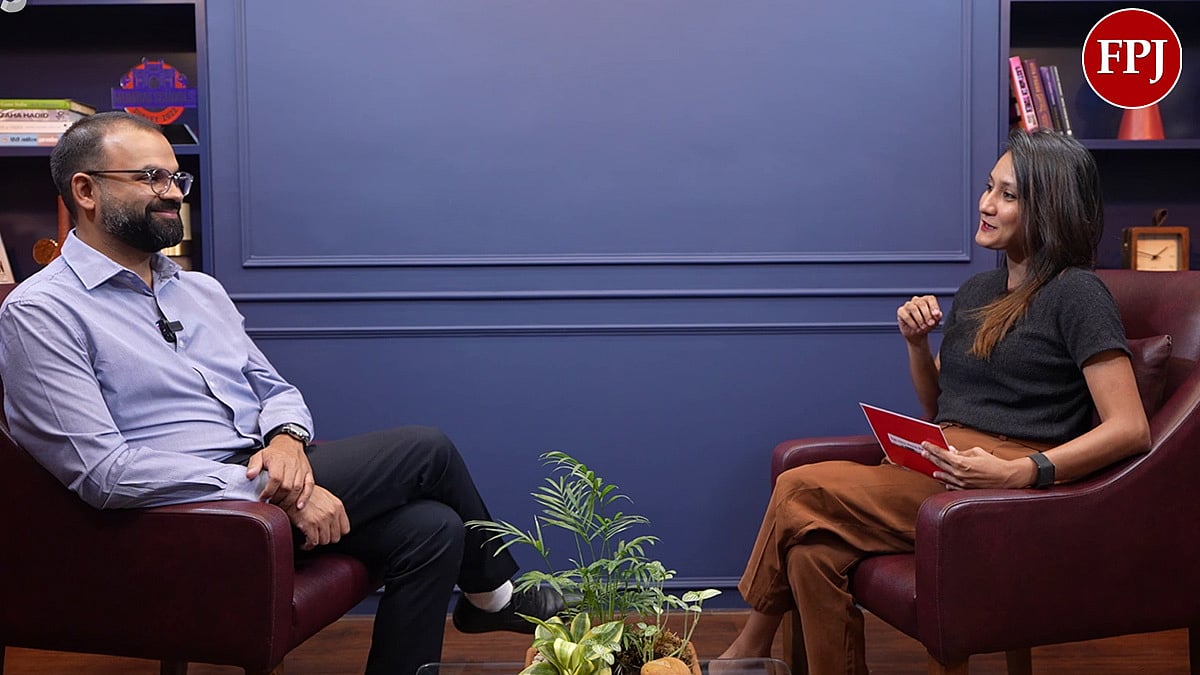
BitSave's Shiv Ram Pande explains Bitcoin's investment risks, high taxation, security concerns. |
Bitcoin's growing institutional acceptance has renewed interest among Indian investors, even as sharp price swings, high taxation and security concerns remain significant challenges. Shiv Ram Pande, Founding Member and Chief Business Officer at BitSave, believes disciplined investing, institutional custody, and limited portfolio exposure as part of an overall diversified portfolio can help investors navigate risks generally associated with investing in Bitcoin & other crypto assets. In an exclusive conversation with Sheryll D'Souza of The Free Press Journal, Shiv discusses investment strategies, regulatory uncertainty, custody solutions and Bitcoin's long-term prospects.
Bitcoin has witnessed extreme volatility and sharp corrections. Why should investors consider it?
Bitcoin is the world's first purely digital asset, launched on 3 January 2009. Its defining features are decentralisation, limited supply and global transferability.
Unlike traditional financial assets, Bitcoin operates through a growing worldwide computer network that anyone can join, without a central authority controlling its rules.
Its maximum supply is capped at 21 million coins, with rate of new issuance of new Bitcoins coming into circulation halving approximately every four years.
Volatility arises because supply follows a predetermined schedule while demand changes considerably. Although this creates short-term risks, Bitcoin's scarcity has attracted investors seeking alternative stores of value.
How does Bitcoin compare with traditional assets such as gold, equities and bonds?
Bitcoin combines scarcity with digital portability and transparent verification through blockchain technology.
Unlike physical assets, it can be transferred internationally without conventional intermediaries.
Within a traditional investment portfolio, Bitcoin belongs in the alternative asset category.
Global financial institutions, including BlackRock, Morgan Stanley Fidelity and Franklin Templeton, have increasingly participated in cryptocurrency markets through investment products and related services.
Studies show that I believe a modest allocation of approximately 2–4% as part of a diversified portfolio can provide exposure without creating excessive concentration risk.
Given India's high cryptocurrency taxation and regulatory uncertainty on investments in Bitcoin & crypto, how should retail investors approach it?
India classifies investing in Bitcoin & other cryptos cryptocurrencies as Virtual Digital Assets (VDA) under Income Tax laws virtual digital assets rather than as legal tender.
Investors have face a 30 percent tax on applicable gains, alongside 1 percent Tax Deducted at Source (TDS) tax deducted at source on transfers specified transactions. Restrictions on adjusting losses further complicate investment decisions.
These factors make frequent trading particularly challenging.
My suggestion is to approach investing in Bitcoin & other crypto assets as a long-term portfolio allocation investment while respecting domestic laws and understanding the applicable tax implications.
ALSO READ
Regulatory clarity would also help strengthen investor confidence and encourage responsible participation.
What differentiates BitSave from conventional cryptocurrency exchanges?
Our approach focuses on structured index based, large-cap Bitcoin & crypto investing only rather than offering access to thousands of digital tokens.
BitSave provides only three investment products: a crypto index replicating the Bloomberg Galaxy Crypto Index (BGCI) through a licensed arrangement, a combination of Bitcoin, Ethereum and tokenised gold, and a dedicated Bitcoin product.
We aim to simplify investment decisions through an index-based model.
Instead of encouraging speculative trading, our focus is on helping customers accumulate digital assets systematically over longer periods as part of an overall diversified portfolio.
Are Indian investors comfortable investing systematically in such a volatile asset class?
Interestingly, around 60 percent of our customers invest through Systematic Investment Plans systematic investment plans, starting from just Rs 1,000.
SIPs allow investors to spread purchases across different market conditions rather than attempting to identify the perfect entry point.
We have observed stronger buying activity during sharp corrections, while redemption pressure generally increases during recoveries.
The mutual fund industry's contribution to improving investor understanding of volatility and disciplined investing has been significant.
This experience is increasingly influencing cryptocurrency investment behaviour while investing in Bitcoin & other crypto assets as well.
Security breaches remain a major concern. How can investors safeguard their digital assets?
The distinction between blockchain security and the security of platforms holding these Virtual Digital Assets digital assets is extremely important.
Many cryptocurrency losses in Bitcoin & crypto arise from compromised storage systems or exposed private keys rather than attacks on the blockchain, Bitcoin's underlying network.
Investors generally have three custody choices: exchanges, personal hardware wallets and institutional custodians.
At BitSave, we use institutional custody arrangements that are used by the likes of Bitcoin ETFs in the US, for 100 percent of customer assets, where sensitive credentials are protected through distributed offline storage mechanisms.
Investors must carefully evaluate custody practices because compromised credentials can lead to irreversible losses.
Does BitSave provide additional support to investors unfamiliar with cryptocurrency markets?
Yes. Every individual registering with BitSave is assigned a human representative who can be contacted through WhatsApp, irrespective of whether they eventually invest.
We also maintain an investor community where customers can raise questions directly.
Investing in Bitcoin & crypto Cryptocurrency can remain unfamiliar to many people, particularly those entering the market for the first time.
We believe personal interaction, transparency and education are essential for helping investors understand market risks and make informed decisions.
Finally, is this an appropriate time for Indian investors to enter Bitcoin?
Bitcoin has historically experienced approximately four-year market cycles, characterised by substantial appreciation followed by corrections.
We believe recent market movements do could indicate the beginning of another accumulation phase, although historical patterns cannot guarantee future performance.
Rather than focusing exclusively on prices, investors should understand the asset's characteristics and assess their financial capacity to absorb losses.
My preference is for gradual accumulation through disciplined investments, with exposure limited to a small proportion of the overall diversified portfolio.
The objective should be long-term participation without allowing crypto’s inherent volatility to undermine broader financial stability.
Level up your brain the fun way. Play daily games and quizzes on FPJ Smart!
RECENT STORIES
-
-
-
-
-