India–Israel Relations In Focus: PM Modi’s Israel Visit Sparks Strategic Debate Amid West Asia Tensions
Prime Minister Modi’s upcoming Israel visit has sparked debate within India’s strategic community. He will meet Netanyahu and Herzog to review ties in defence, trade and technology, and address the Knesset. Analysts differ on whether India is pivoting toward Israel amid West Asia tensions or maintaining balance, as defence cooperation and regional realignments reshape diplomacy.

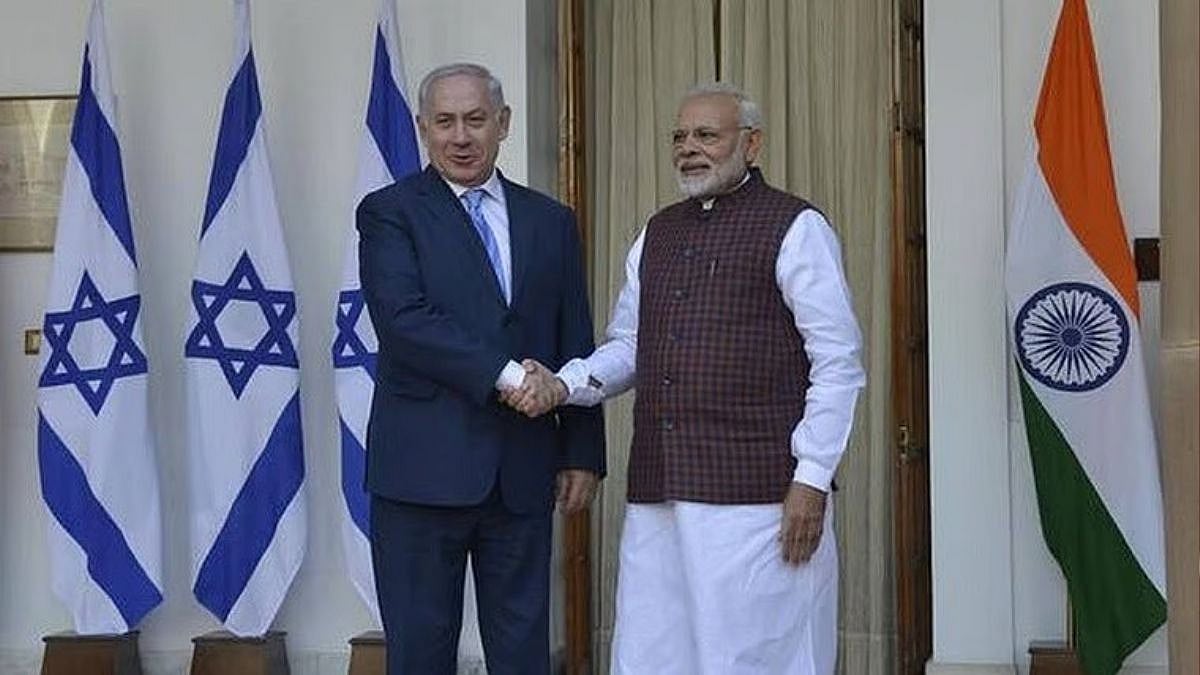
India–Israel Relations In Focus: PM Modi’s Israel Visit Sparks Strategic Debate Amid West Asia Tensions | File Photo
New Delhi: Prime Minister Modi’s scheduled visit to Israel has caused varied reactions within India’s strategic community. According to an MEA release, the visit, which is the prime minister’s second visit to the country, will see him call on Israeli Prime Minister Benjamin Netanyahu and President Isaac Herzog. It states that Modi will hold extensive talks with Netanyahu to review the India-Israel Strategic Partnership, and the areas discussed include defence and security, science and technology, trade and economy, and agriculture, among others.
About The Visit
The visit, which comes during political unrest within Israel and a possible imminent attack on Iran by the United States, has had analysts wondering if now was the best time to visit and whether the prime minister is going too far in his outreach to Israel. During the visit the prime minister is expected to address the Knesset – a first for any Indian prime minister – raising questions as to whether India is deviating from its traditional policy of balance in West Asia.
Former ambassador and West Asia expert Talmiz Ahmad believes these questions are redundant, as one is now looking at a new West Asia post the Iran attack, which he believes will happen. “Today we are in a completely new world order—one which I call the order of uncertainty. The Arab world is in total disarray, the Global South is in total disarray, and the Western alliance is in total disarray. So there will be fresh alignments, where the past does not matter at all.”
Coming to India, he adds. “The Prime Minister’s own engagement is part of this fresh alignment. And to my mind, the most important alignment that India is looking at is the alignment with the UAE and Israel.”
Ambassador Ahmad’s views are shared by other members of the strategic community. Senior ambassadors believe that India has already begun its pivot in West Asia by scaling down its oil supplies from Iran and moving towards shutting down its Chabahar port project. President Trump granted India a six-month sanctions waiver on October 30, 2025, giving India sanctions relief only till April this year, a move some analysts interpreted as giving India time to wind down the project. While New Delhi has not formally announced the end of the project, the MEA did say in February this year that it has paid up $120 million to Iran for the Chabahar port, a signal some say that New Delhi is closing the chapter on the project.
Others believe that India has not shed its traditional policy towards balance in West Asia. The visit of the Arab foreign ministers to New Delhi last month, along with the visit of Secretary General of the Gulf Cooperation Council (GCC) Jassim Mohammad Al Budewi to New Delhi on Tuesday, suggests that India is maintaining its traditional stance of remaining a friend to all in West Asia.
As strategic thinker Brahma Chellaney states. “By traveling to Israel just four weeks after hosting Arab foreign ministers in New Delhi, Modi is effectively restoring equilibrium in India’s Middle East outreach — stabilizing ties with Israel after a year of delays and ensuring critical defense and technology projects remain on track.”
Ambassador Ahmad disagrees with this contention and states that the GCC Secretary General’s visit has more to do with the fallout of events post the US attack on Iran. “There is a deep-seated concern that possibly post following the breakdown of talks on Thursday there will be an American attack on Iran,” he says. Ahmad adds. “Iran is likely to target the countries of the Gulf, and large numbers of Indians may be killed in that attack. So basically this visit is to seek India’s support to agitate for a constructive approach both in Tehran and in Washington.”
Both Prime Ministers Modi and Netanyahu have specific objectives that they want to fulfill in this visit. For India, defence sales will be on top of the list. According to the Stockholm International Peace Research Institute (SIPRI) India has been Israel’s largest defence customer for years, accounting for 34% of total sales between 2020 and 2024.
On Israel’s side, analysts say that Prime Minister Netanyahu wants to use Modi’s visit to project that he has friends on the international stage. But the Israeli prime minister’s message also bears closer listening. Netanyahu recently issued a statement where he spoke about creating a “hexagon of allies” to combat what he called a “radical Shia axis” and an “emerging radical Sunni axis” in West Asia.
Decoding the Israeli prime minister’s words, Ambassador Ahmad states that the main focus for the Israeli leader is India, the UAE, and Israel with some additional nations. “What he is talking about in the hexagon is Tel Aviv, Addis Ababa (capital of Ethiopia) Harjesa (largest city in Somaliland) New Delhi, and Abu Dhabi. UAE is the one that took Israel into Somaliland and they are building up ties with Ethiopia.”
ALSO READ
He adds. “Ethiopia is very, very insecure. It is facing threats from Egypt on the one hand and is looking at war with Eritrea on the other. Yes. It is also very concerned about Somalia and sees Somalia as the source of Islamic extremism.”
Coming to the Sunni nations, analysts say post-Iran Netanyahu is looking at the alliance, which he defines as Turkey, Saudi Arabia, and Pakistan, who are believed to be in the process of inking a defence agreement. Diplomats say the Israeli leader sees them as the next threat to Israeli hegemony in the region and is looking for allies to counter them. India, with its animosity towards Turkey, Pakistan and radical Islam, could play a role here.
RECENT STORIES
-
-
-
-
-