Why Are Afghan Women Being Called 'Bibi', 'Goat' And 'Cow'? Taliban's Latest Directive Sparks Outrage
The reported directive, issued in Balkh in May 2026, has raised concerns over women's identity and access to healthcare. Activists warn that replacing real names with generic labels could lead to medical record mix-ups, while degrading terms allegedly used for women point to a wider pattern of dehumanisation under Taliban rule.

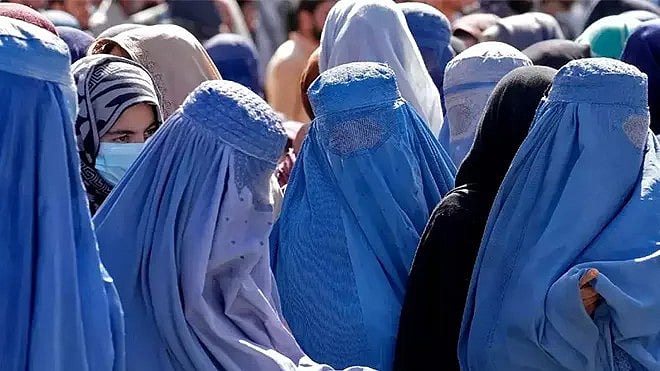
In another reported move restricting women's identity and autonomy in Afghanistan, the Taliban has instructed public employees and healthcare workers in the northern province of Balkh to stop using women's real names in official documents, medical records and prescriptions, according to reports.
Instead, women are reportedly being identified using the generic term “Bibi”. Activists have also raised concerns over instances in which women were allegedly referred to using degrading animal-related terms such as “goat” and “cow”.
The directive, reportedly issued by agents of the Ministry for the Propagation of Virtue and the Prevention of Vice in May 2026, came to light through a joint investigation by Afghan outlet Zan Times and The Guardian. The investigation, published in November, reported that hospitals, private clinics and other facilities in Balkh had been instructed not to record women's actual names, including on medical prescriptions.
Why Are Women Being Called 'Bibi'?
“Bibi” is a traditional form of address in Afghanistan, used in Dari and Pashto and commonly associated with an older woman or grandmother. The term has historically been used in some communities where publicly mentioning a woman's first name was considered improper or disrespectful to family honour.
However, activists say the reported practice goes beyond traditional forms of address. According to El País, some women have also been referred to using animal-related terms such as “goat” and “cow”.
Lalah Osmany, a Germany-based activist known for the earlier “Where Is My Name?” campaign, described the practice as part of a “systematic process of dehumanisation”, arguing that it reduces women to property or biological beings rather than recognising them as individuals with identities.
Medical Records, Prescriptions Raise Concerns
The reported directive has also raised practical concerns, particularly in healthcare facilities where accurate patient identification is essential.
Activists have warned that recording several women under the same generic name, or identifying them only through numbers, could lead to confusion in medical records, prescriptions, diagnoses and treatment.
These concerns come amid wider restrictions on women's access to healthcare in Afghanistan. The Taliban's policies have limited women's ability to work and train in the medical sector, while restrictions on male doctors treating female patients have further complicated access to healthcare.
Part Of Wider Restrictions On Afghan Women
The reported instruction is part of a broader pattern of restrictions imposed on women since the Taliban returned to power in 2021. Measures have increasingly curtailed women's access to education, employment, public spaces, mobility and other basic rights.
Women's names have historically been omitted from certain social and cultural settings in Afghanistan, including wedding invitations and gravestones, with women sometimes identified as the wife or daughter of a male relative. However, activists say the reported instruction to remove women's actual names from official and medical records marks a further step towards institutionalising the erasure of their identities.
ALSO READ
No Confirmed Nationwide Order So Far
The reported directive appears to be limited to Balkh province, with no confirmed evidence of a nationwide order so far. Some local accounts have also indicated that the instruction has been ignored or resisted in certain places.
No independently verified copy of a formal written decree has been widely made public. The available reporting is based primarily on investigations and testimonies from people inside Afghanistan, where independent journalism faces significant restrictions.
Activists have warned that even local measures could eventually be extended to other parts of the country, pointing to the gradual expansion of restrictions imposed on Afghan women under Taliban rule.
RECENT STORIES
-
-
-
-
-