US Military Nearly Intercepted Chinese Ship After AI-Generated Intelligence Error: Report
The US military reportedly nearly intercepted a Chinese vessel after an AI-assisted intelligence report falsely claimed it carried components linked to a nuclear weapons programme. Officials discovered the error shortly before the planned operation. The episode has raised concerns over AI reliability and human oversight in high-stakes military decisions.

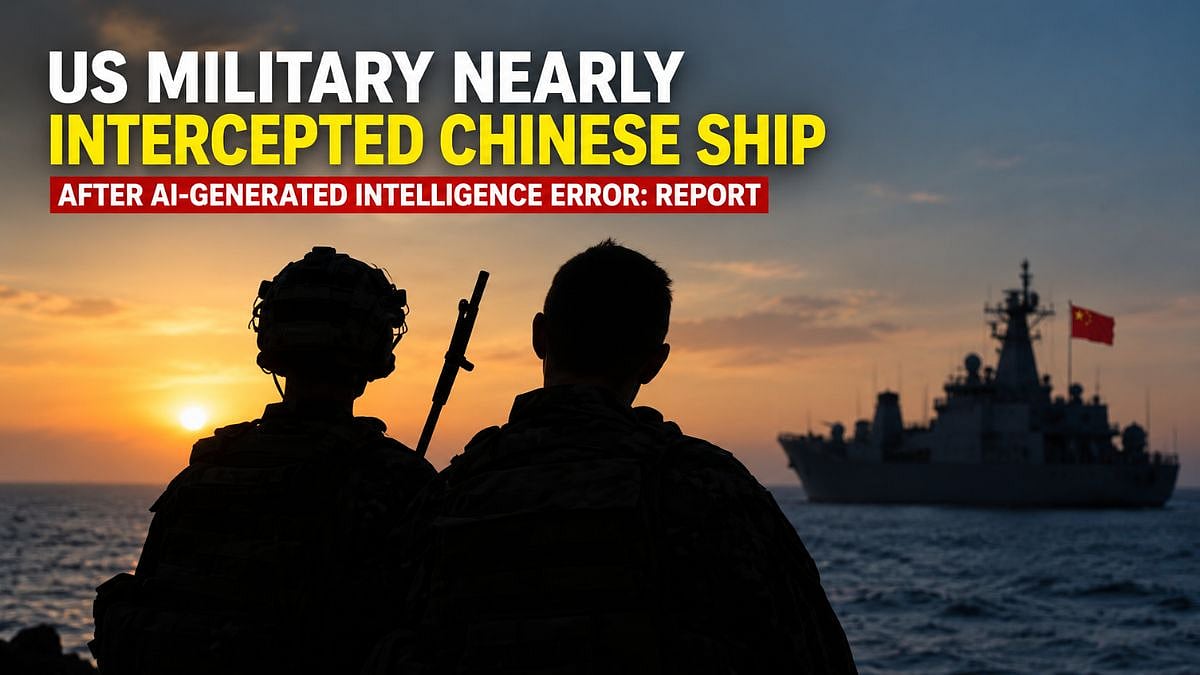
A reported AI-assisted intelligence error nearly triggered a US military operation against a Chinese vessel in the Middle East | AI Generated Image
The US military came close to intercepting a Chinese vessel in the Middle East after acting on an intelligence report that wrongly claimed the ship was carrying components linked to a nuclear weapons programme, according to four sources familiar with the episode.
The incident took place this spring during the war with Iran. The US military began planning an operation to intercept the vessel, while armed personnel prepared to board it, according to two sources. Military aircraft were also in the air, according to sources familiar with the incident, CNN reports.
AI Error Discovered Just In Time
Officials examined the intelligence more closely shortly before the planned operation and discovered that the report had been prepared with the help of artificial intelligence (AI). A chatbot used by a special operations command analyst had incorrectly identified the material aboard the Chinese ship.
CNN could not determine what the ship was actually carrying. One source described the intelligence report as “entirely false” and said it “almost started a war”. Any US action against a Chinese vessel could have risked escalating tensions into an armed confrontation between the two countries.
How The False Report Was Created
The analyst had used a chatbot to examine intelligence concerning the ship’s manifest. The original reporting came from US Special Operations Command Pacific, which is based in Hawaii. It remains unclear whether the chatbot was a commercially available system or a US government product.
“The internal tools are mostly just copies of the commercial stuff wearing lipstick,” a former senior US official familiar with AI systems used by military and intelligence analysts said.
The chatbot combined open-source intelligence with classified signals intelligence held by the government before reaching the incorrect conclusion about the ship’s cargo.
The analyst then used AI again to turn the findings into a standard intelligence report, a format routinely relied upon by military officials, before circulating it.
US Special Operations Command Pacific and the Pentagon did not respond to requests for comment.
AI Moves Deeper Into Military Operations
The episode comes as the US military and intelligence community increasingly use AI for tasks ranging from analysing vast quantities of raw intelligence and selecting potential strike targets to managing budgets, logistics and supply chains.
Supporters of rapid AI adoption within the military argue that the technology can speed up battlefield decisions, including determining which targets to strike and where military assets should be deployed. Officials have said the US cannot afford to fall behind in AI development if it eventually faces China or another technologically advanced adversary.
But the Chinese ship episode illustrates the other side of that speed. Faster intelligence processing offers little advantage if incorrect information moves through military systems before it is properly checked. In a crisis involving armed forces from major powers, an AI-generated error can carry consequences far beyond an ordinary technical failure.
Hegseth Pushed Faster AI Adoption
In January, Defense Secretary Pete Hegseth announced the department’s Artificial Intelligence Acceleration Strategy, aimed at speeding up the military’s adoption of AI.
“We will unleash experimentation, eliminate bureaucratic barriers, focus our investments and demonstrate the execution approach needed to ensure we lead in military AI,” Hegseth said while announcing the strategy.
The strategy called for wider use of AI across the military and sought to put advanced models directly into the hands of the department’s three million civilian and military personnel at different classification levels.
However, multiple US officials said the effort remains decentralised. Different parts of the government use different AI tools under varying instructions and safety standards, and there is no single set of standards governing how AI-generated information should be verified.
As a result, the reliability and capabilities of AI systems used across the military and intelligence community can vary considerably.
Human Decisions Remain The Critical Risk
The incident has emerged amid a broader debate in Washington over the dangers of artificial intelligence. Some Silicon Valley engineers and technology executives have warned about the possibility of advanced AI systems escaping human control, potentially with catastrophic consequences.
The Chinese ship episode points to a more immediate concern: people making high-stakes decisions based on inaccurate or misleading information produced by AI or other automated systems.
Sources said the military is increasingly using AI to assist with targeting, an area where mistakes can have fatal consequences.
“AI in targeting is definitely something that is ramping up and there is no real guidance for how having a human in the loop will prevent civilian casualties or fratricide,” a source familiar with current military policies said.
‘AI Allows You To Get To A Bad Idea Faster’
The false conclusion about the Chinese vessel was an example of what is commonly called an AI “hallucination”, in which an AI system generates inaccurate information. According to one source, such errors have not been isolated incidents since AI tools began spreading through the US intelligence community.
Some older intelligence officials, including those who broadly support using AI in the military, are concerned that the technology has increased pressure on analysts to produce and circulate intelligence more quickly. Several sources said younger analysts, who are more accustomed to using such tools, may also be more likely to trust their output without sufficient scrutiny.
Also Watch:
ALSO READ
The incident therefore raises a fundamental question about the military’s accelerating use of AI: speed can improve decision-making only when the information being processed is reliable and independently checked. Human oversight remains especially important when an incorrect conclusion could influence decisions involving military force.
As one source put it, “AI allows you to get to a bad idea faster.”
To get details on exclusive and budget-friendly property deals in Mumbai & surrounding regions, do visit: https://budgetproperties.in/
RECENT STORIES
-
-
-
-
-