UN Sounds Climate Alarm, Calls For 18% Cut In Global Carbon Emissions By 2030 To Avert Severe Crisis
The United Nations Environment Programme warns global emissions must fall 18% by 2030 and 45% by 2045 to limit warming to 1.7°C. Its latest assessment says the 1.5°C threshold will likely be exceeded, while existing policies could cause 2.8°C warming. UNEP urges stronger climate action and methane reductions worldwide.

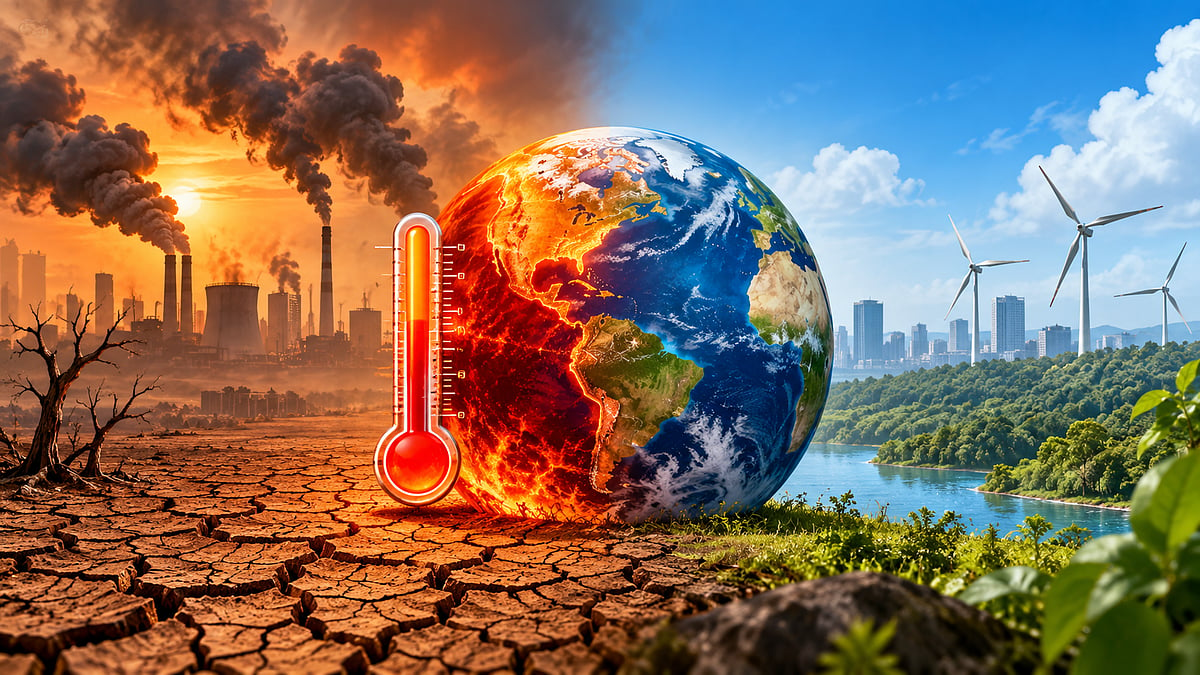
UN Sounds Climate Alarm, Calls For 18% Cut In Global Carbon Emissions By 2030 To Avert Severe Crisis | AI Representational Image
The world must reduce greenhouse gas emissions by 18% over the next four years and by 45% by 2045 to prevent global temperatures from exceeding international climate targets by a dangerous margin, the United Nations Environment Programme (UNEP) has warned.
In its latest report on the gap between climate commitments and actual policies, UNEP said the opportunity to limit global warming to 1.5°C above pre-industrial levels had effectively closed. However, countries could still prevent temperatures from rising far beyond that threshold by taking immediate action.
The report found that governments were failing to convert their long-term climate commitments into effective short-term measures, despite the rapid expansion of renewable energy.
Global Emissions Remain High Despite Renewable Energy Growth
Global greenhouse gas emissions showed little change in 2025 compared with the previous year. However, UNEP analysts cautioned against interpreting the figures as evidence that emissions had peaked, citing geopolitical uncertainties and continued dependence on fossil fuels, The Guardian reports.
According to the report, reducing emissions by 18% by 2030 and 45% by 2045 would provide a reasonable chance of limiting global warming to 1.7°C above pre-industrial levels.
Although such warming would still make extreme weather events, including the record heatwaves witnessed in recent months, more frequent, it could prevent their impacts from becoming substantially worse.
UNEP Executive Director Inger Andersen said governments had repeatedly been warned about the urgency of reducing emissions but had failed to act decisively.
“[We used to say] there’s still an opportunity if we make this herculean effort [to stay within the 1.5C limit],” she said. “It’s now clear the herculean effort was not made. We procrastinated, and now we are saying this window has closed.”
Despite the setback, Andersen urged countries not to abandon the 1.5°C target, which remains central to the Paris climate agreement.
“We can make the overshoot as brief and as short as possible. It’s not time to throw in the towel and give up. This is about how to find our way back, as shortly and quickly as possible.”
US Withdrawal And Weak Climate Pledges Raise Concerns
The report comes amid growing concerns over the impact of US climate policies under President Donald Trump.
The US, the world’s second-largest greenhouse gas emitter after China, has withdrawn from the Paris climate agreement and is threatening to reverse its long-standing decline in emissions.
Bill Hare, chief executive of the think tank Climate Analytics, criticised major fossil fuel producers, including the US and Saudi Arabia, which together account for 20% to 25% of global fossil fuel production.
“All governments have a job to do, but in particular it is time for major fossil fuel producers such as the US and Saudi Arabia, which produce 20-25% of fossil fuels globally, to stop playing politics and face the scientific reality. Right now they are looking at the fire, denying it exists and pouring more petrol on it, while their own citizens increasingly face searing heat, wildfires and other impacts.”
According to UNEP, the climate commitments submitted by governments last year were significantly weaker than required.
At the 30th Conference of the Parties (COP30) climate summit in Brazil in November 2025, countries were expected to announce stronger emissions reduction commitments under the Paris Agreement. However, the pledges fell considerably short of what scientists say is necessary.
UNEP estimates that even if governments fully implement their updated commitments, global temperatures could rise by 2.6°C above pre-industrial levels.
Under existing government policies, the projected increase is even higher at 2.8°C, posing serious risks to populations and ecosystems worldwide.
The report also warned that every five years of emissions at current levels could increase projected global warming by another 0.1°C. Scientists fear that exceeding the 1.5°C threshold by a greater margin could increase the risk of triggering irreversible changes in the climate system.
Scientists Warn Political Inaction Is Holding Back Climate Progress
Mohamed Adow, director of the think tank Power Shift Africa, said technological advances in renewable energy had outpaced government efforts to reduce dependence on fossil fuels.
“The tragedy is that we have the solutions within our grasp. Solar and wind power are growing far faster than anyone expected, yet governments are still failing to move away from fossil fuels quickly enough. The technology is racing ahead while political leadership is dragging its feet.”
Under the Paris Agreement, countries are expected to review and strengthen their climate commitments through a process known as the global stocktake, with the next assessment scheduled for 2028.
However, uncertainty has emerged over whether governments will have access to the latest scientific findings before that review.
This week, the UN’s Intergovernmental Panel on Climate Change (IPCC) failed to finalise a timetable for publishing its next major assessment ahead of the global stocktake.
The delay could make it more difficult for governments to evaluate their progress against the latest scientific evidence.
Johan Rockström, director of the Potsdam Institute for Climate Impact Research, warned that disagreements over the timing of IPCC reports should not delay climate action.
“If all current national commitments are implemented, global emissions are projected to reach approximately 50 gigatonnes of carbon dioxide equivalent annually by 2035, when they should be below 35 gigatonnes. The science is already clear. Closing that gap is a question of political action, not a lack of scientific evidence,” he said.
Also Watch:
Cutting Methane Emissions Could Help Limit Global Warming
UNEP also identified reducing methane emissions as an important measure to slow global warming in the near term.
Methane is a powerful greenhouse gas with a warming effect around 80 times greater than carbon dioxide over a shorter timescale.
Reducing methane emissions could therefore help countries limit temperature increases while pursuing broader reductions in greenhouse gas emissions.
The report underlined the urgency of strengthening climate policies and translating existing commitments into concrete action to minimise the extent and duration of global temperature overshoot.
RECENT STORIES
-
-
-
-
-