Pakistan Calls On Muslim Nations To Join Saudi-Turkey Defence Pact, Form ‘Islamic NATO’
Pakistan Defence Minister Khawaja Asif urged Muslim nations to join the Mecca Joint Defence Agreement signed by Pakistan, Saudi Arabia and Turkey. He said the pact should expand beyond a limited group and follow a NATO-like model. The agreement includes a mutual defence clause, with further details on cooperation still being developed.

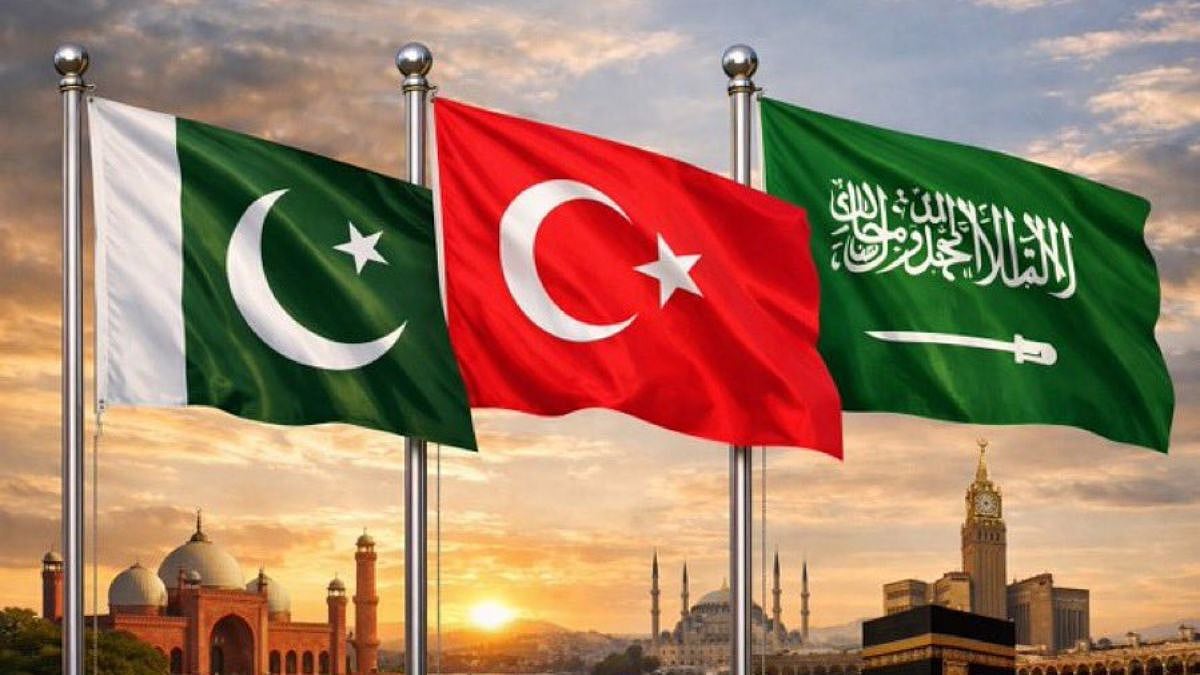
Pakistan Calls On Muslim Nations To Join Saudi-Turkey Defence Pact, Form ‘Islamic NATO’ | X
Pakistan has urged Muslim nations to set aside their differences and join its defence arrangement with Saudi Arabia and Turkey, seeking to develop a military alliance modelled on the North Atlantic Treaty Organisation (NATO).
Pakistan Defence Minister Khawaja Asif told Geo News that the Mecca Joint Defence Agreement should not remain an exclusive grouping and called on other Islamic nations to join the pact.
"The doors really cannot be closed to other countries. This should not be an exclusive club -- this is my personal opinion. It should expand," Asif said.
"I think that, along the lines of NATO, Muslim countries should put their own differences aside--the transactional issues or bilateral disputes they have with one another -- and stand together on this one platform," he added.
Pact Modelled On Collective Defence
Saudi Crown Prince Mohammed bin Salman, Turkish President Recep Tayyip Erdogan and Pakistani Prime Minister Shehbaz Sharif signed the Mecca Joint Defence Agreement on Friday.
The agreement comes amid heightened tensions between the US and Iran and concerns over a wider regional conflict after Iranian missile fire reached Gulf oil-exporting countries.
The pact builds on a defence agreement signed by Pakistan and Saudi Arabia a year ago. Turkish Foreign Minister Hakan Fidan has said the new arrangement is technically similar to NATO's Article 5 mutual defence provision.
A central feature of the agreement is that an attack on any one of the three countries would be considered an attack on all three. However, further details of the arrangement are yet to be worked out.
Turkey, which has NATO's second-largest army, has said the allies would hold consultations to determine the degree, form and format of assistance sought in the event of an attack. It has also maintained that no country would be regarded as a threat unless a member state is attacked.
The three countries bring different capabilities to the arrangement. Pakistan has extensive military experience and is the Muslim world's only nuclear-armed country, while Saudi Arabia has significant economic resources and regional influence. NATO member Turkey has a large military and a growing domestic defence industry.
Alliance Could Expand Further
Senior officials have indicated that the pact could eventually admit more countries and develop into a broader collective security arrangement.
According to Fidan, Turkish President Erdogan wants the alliance to expand, with Egypt among the potential candidates for membership.
Speaking to the state-run Anadolu news agency, Fidan said the alliance was not aimed at Iran or any other country and was intended as a broader commitment to support the security of the three members.
Pakistan Says Pact ‘Purely Defensive’
Pakistan Foreign Minister Ishaq Dar has also maintained that the defence agreement is not directed against any country and remains open to other nations in the region.
Dar described the agreement as "purely defensive in nature" and said other countries could join if they were willing to uphold its principles and settle differences peacefully. He said the agreement reflected a common desire to strengthen strategic security cooperation.
In a post on X, Dar said Pakistan would continue working with countries in the region towards lasting peace and stability.
"The Makkah Accord does not abrogate or replace any existing bilateral or multilateral agreements between these countries, or with other countries or organizations," he wrote.
RECENT STORIES
-
-
-
-
-