A Holy War? Why Pete Hegseth Is Framing US War Against Iran As A Crusade
US Secretary of War Pete Hegseth is increasingly framing the war against Iran as a modern crusade with divine sanction. By likening military rescues to the Resurrection, he faces sharp criticism from Pope Leo XIV, who rejects using Christ to justify warfare

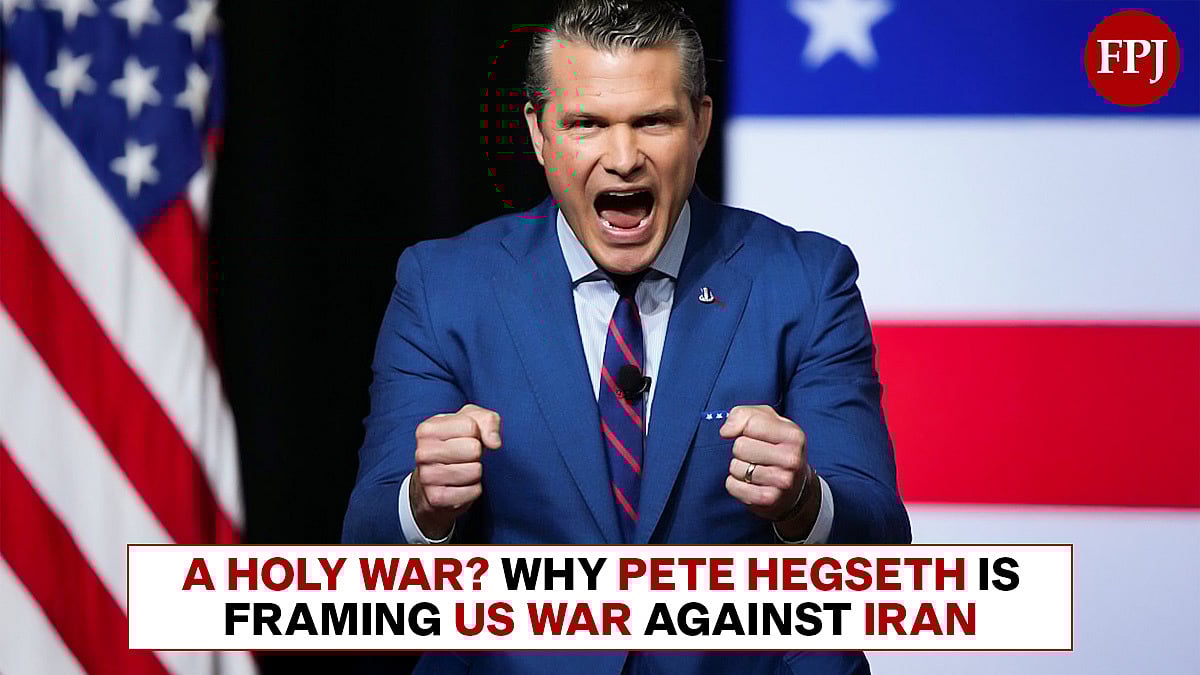
The war between the United States and Iran is fast shifting from a battle of missiles and strategy to a battle of theology. US Secretary of War Pete Hegseth has begun using explicitly religious language to describe military operations, framing the ongoing war as a modern-day crusade with divine sanction. By drawing parallels between military manoeuvers and the life of Jesus Christ, Hegseth is positioning the conflict not just as a matter of national security, but as a spiritual necessity.
What sparked the religious connection?
The narrative intensified following the rescue of an American airman on Easter Sunday 2026. Hegseth, speaking at a news conference alongside President Donald Trump, framed the rescue as a literal "resurrection." He noted that the airman’s F-15E was shot down on Good Friday—the day Christians mark the crucifixion of Jesus—and that the pilot spent Saturday hiding in a "crevice," which Hegseth likened to the tomb of Christ.
When the airman was recovered as the sun rose on Easter Sunday, Hegseth described him as "a pilot reborn," concluding his account with the phrase, "God is good." This rhetoric transforms a standard search-and-rescue mission into a symbolic reenactment of the central miracle of the Christian faith, suggesting that the US military’s efforts are being guided by a higher power.
Hegseth's ideology
Hegseth is a long-time advocate for a more "Christianised" approach to American nationalism. His worldview is deeply rooted in the history of the Crusades—the medieval religious wars fought between Christians and Muslims over the Holy Land. Hegseth famously has the Latin phrase "Deus vult" (God wills it) tattooed on his arm, a phrase used as a battle cry by Crusaders.
In his 2020 book, American Crusade, Hegseth argued that while the Crusades were bloody, they were a justified defence of Western Christendom against the expansion of Islam. By applying this logic to the current war against Iran—a theocratic, majority-Shiite Muslim nation—Hegseth is signalling that he views the conflict as a continuation of this centuries-old struggle.
According to The New York Times, this language aligns with a segment of conservative American Christianity that seeks to establish the US as a fundamentally Christian nation engaged in a holy war against secularism and rival faiths.
How has the Vatican and the Catholic Church responded?
The framing of the war as a "holy" endeavour has met significant resistance from the highest levels of the Catholic Church. Pope Leo XIV, the first American-born pontiff, has emerged as the leading critic of Hegseth’s "logic of violence." Speaking from Castel Gandolfo, the Pope explicitly rejected the idea that Christianity can be used to justify the war, stating, "Jesus is the King of Peace, who rejects war, whom no one can use to justify war."
Other high-ranking clergy have joined this dissent. Cardinal Robert McElroy, the Archbishop of Washington, D.C., told CNN that the war in Iran is "morally illegitimate" and does not meet the requirements of "just war" theory—a centuries-old Christian doctrine used to determine if a conflict is ethical. The Church’s concern is that using religious symbolism to fuel war "distorts" the Christian mission into one of domination rather than peace.
Why does this framing matter for the conflict?
When a war is framed as a crusade or a "divinely supported" mission, it changes the nature of the diplomacy required to end it. If one side believes they are acting on behalf of God, finding a political "off-ramp"—as Pope Leo XIV has urged President Trump to do—becomes much harder. Compromise can be viewed as a betrayal of faith rather than a strategic necessity.
Furthermore, this rhetoric risks escalating tensions by confirming the propaganda of the Iranian government, which often frames the US as a "crusader" state. By using scriptural justification for a "relentless bombing campaign," Hegseth is not just directing a military strategy, he is shaping a narrative of a global religious clash that many leaders, including the Pope, fear will lead to a "cycle of illusions" and "cascading global destructiveness."
Published on: Tuesday, April 07, 2026, 03:00 PM ISTRECENT STORIES
-
-
-
-
-