Indonesia Gets Its First Aircraft Carrier: Inside The 41-Year-Old Giuseppe Garibaldi, From Speed To Aircraft Capacity
Indonesia has received its first aircraft carrier, the former Italian Navy’s 41-year-old Giuseppe Garibaldi, at Jakarta’s Tanjung Priok port. Set to be renamed KRI Sriwijaya, the 180-metre vessel can carry fixed-wing aircraft and helicopters. Indonesia plans to primarily deploy it for humanitarian assistance, disaster relief, maritime security and logistics across its vast archipelago.

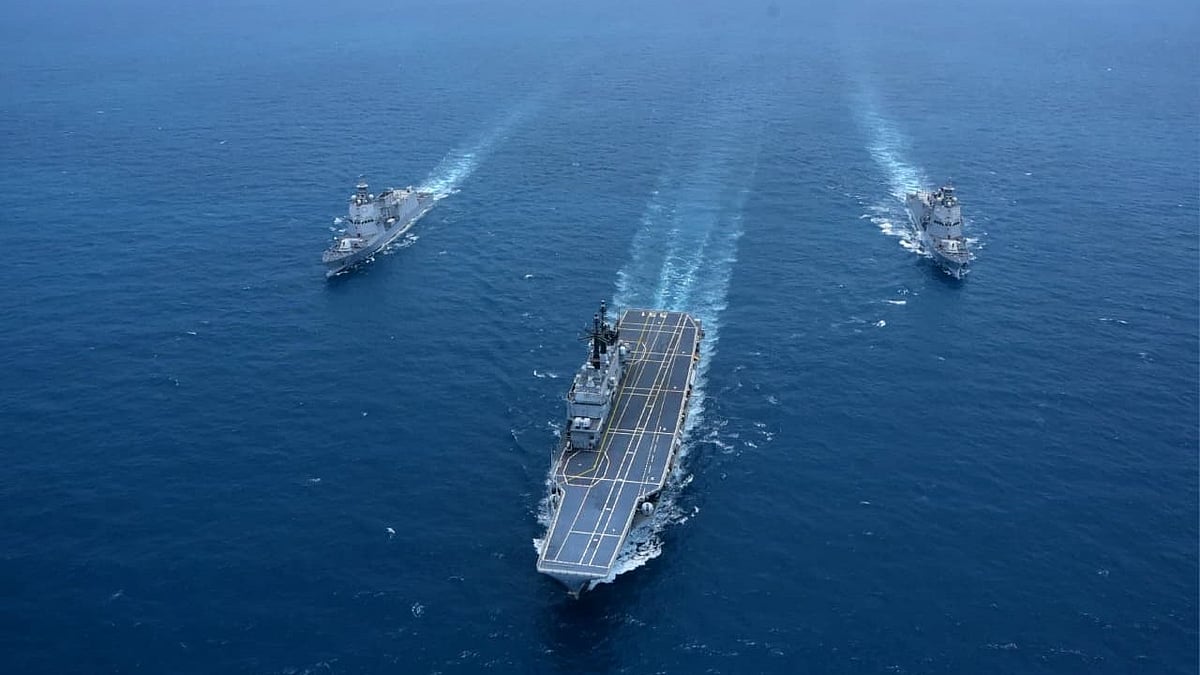
41-Year-Old Giuseppe Garibaldi | X
New Delhi: Indonesia has entered a new chapter in its naval history with the arrival of its first aircraft carrier, the former Italian Navy vessel ITS Giuseppe Garibaldi, at Tanjung Priok port in North Jakarta on Friday, September 18. The 41-year-old warship was transferred by Italy after being retired in 2024 and is now being prepared for service with the Indonesian Navy.
The carrier sailed from Italy on August 24 and travelled through the Suez Canal before making port calls, including in Sri Lanka. After entering Indonesian waters, it was escorted by Indonesian Navy frigates KRI Brawijaya-320 and KRI Prabu Siliwangi-321 before reaching Jakarta.
The vessel has been identified by the Indonesian Navy as KRI Sriwijaya, named after the historic maritime kingdom of Sriwijaya. Its arrival makes Indonesia only the second Southeast Asian country to operate an aircraft carrier, after Thailand.
Why Indonesia Wanted The Aircraft Carrier
Unlike traditional carrier operations focused on projecting fighter power far from home shores, Indonesia has said the ship will primarily support Military Operations Other Than War (MOOTW).
Its intended roles include humanitarian assistance, disaster relief, maritime security, command-and-control and logistics. With Indonesia spread across thousands of islands and frequently affected by floods, landslides, earthquakes and forest fires, the carrier is expected to provide a large mobile platform from which helicopters, drones and relief equipment can be deployed.
The Indonesian government has also described the vessel as a platform for responding to disasters and supporting operations across the country's vast archipelago.
A 41-Year-Old Italian Warship
The Giuseppe Garibaldi was built for the Italian Navy by Fincantieri and entered service in 1985. Named after Italian military and political figure Giuseppe Garibaldi, the vessel spent nearly four decades with the Marina Militare before being retired in October 2024.
It was Italy's first purpose-built ship designed to operate fixed-wing aircraft and helicopters from a continuous flight deck. Its design centres on STOVL Short Take-Off and Vertical Landing operations, allowing compatible aircraft to take off over a ski-jump and land vertically or at short distances.
The carrier was originally classified as an aircraft-carrying cruiser because of Italy's legal restrictions on aircraft carriers at the time. It was later operated as a conventional light aircraft carrier.
How Big Is Giuseppe Garibaldi?
The ship measures approximately 180.2 metres in length, with a beam of around 33.4 metres. Its full-load displacement is roughly 13,850 tonnes, rising to around 14,000 tonnes following its mid-life modernization.
Its flight deck stretches for about 174 metres and features a ski-jump at the bow for short take-offs. The vessel also has a large internal hangar served by two aircraft elevators.
Despite being considerably smaller than the giant aircraft carriers operated by the United States and other major naval powers, the Garibaldi was designed as a compact, versatile aviation platform capable of carrying a mix of fixed-wing aircraft and helicopters.
Four Gas Turbines, 30-Knot Top Speed
The Giuseppe Garibaldi is powered by a COGAG (Combined Gas And Gas) propulsion system using four LM2500 gas turbines. Together, the engines produce roughly 60,000 kW, or more than 80,000 horsepower.
The propulsion system drives two shafts and gives the vessel a maximum speed of around 30 knots, equivalent to roughly 56 kmph.
Its range is estimated at approximately 7,000 nautical miles at 20 knots, giving the ship the endurance required for extended deployments.
Built To Carry Aircraft And Helicopters
The defining feature of the Garibaldi is its aviation capability.
During Italian service, the ship was designed to operate AV-8B Harrier II/Harrier II Plus STOVL aircraft, along with a variety of helicopters. Depending on the aircraft mix and configuration, the vessel could accommodate roughly 16 to 20 aircraft.
Its helicopter operations included platforms such as the SH-3D Sea King, EH101/AW101, NH90 and AB212.
The flight deck does not use catapults. Instead, the ship's ski-jump arrangement enables compatible STOVL aircraft to launch from the forward section of the deck.
For Indonesia, however, the aviation component is expected to evolve around its current operational requirements, with helicopters and potentially unmanned systems expected to be particularly important.
More Than An Aircraft Carrier
The Garibaldi was not built simply as a floating runway. During its Italian service, it also carried command-and-control, surveillance, communications and maritime warfare systems.
Its original configuration included air-search and surface-search radars, electronic warfare equipment, sonar and defensive weapon systems. Some of its earlier offensive systems, including Otomat anti-ship missiles, were removed during its 2003 modernization as additional space was made available for aviation and communications capabilities.
What weapons, sensors and electronic systems the ship will ultimately carry under Indonesian service will depend on the country's ongoing refit and modernization programme.
Crew, Hangar And Operational Capacity
In its Italian configuration, the carrier could operate with a complement of roughly 780 to 830 personnel, including the ship's crew, aviation personnel and command staff.
The vessel's hangar is approximately 110 metres long, providing substantial space for aircraft and aviation support equipment. Its internal facilities and flight deck were designed to allow aircraft to be moved, maintained and deployed rapidly.
Indonesia has also begun preparing personnel for the ship's operation as it transitions from Italian to Indonesian service.
From Italian Flagship To Indonesian HADR Platform
The transfer marks a major change in the Garibaldi's role. After almost four decades as an Italian naval aviation platform, the vessel is now being adapted to Indonesia's requirements.
The Indonesian government has repeatedly highlighted humanitarian assistance and disaster relief as a central mission. Its large flight deck and ability to operate multiple helicopters could allow the vessel to function as a mobile base during major disasters, carrying relief supplies, personnel and aircraft closer to affected areas.
ALSO READ
The acquisition has nevertheless triggered debate in Indonesia over the costs of modernising and operating an ageing carrier. While Italy transferred the ship as a grant, Indonesia will have to bear the expenses associated with refurbishment, systems integration, training, aviation assets and long-term operations.
For now, the Giuseppe Garibaldi represents something new for Indonesia: not just a larger warship, but a mobile aviation, command and logistics platform designed to operate across one of the world's largest and most geographically dispersed archipelagos.
RECENT STORIES
-
-
-
-
-