Fierce Political Rivalry, Historic Achievements: Remembering Bangladesh's First Female Prime Minister Begum Khaleda Zia
Bangladesh’s first female PM and BNP leader, Begum Khaleda Zia, passed away at 80 after a prolonged illness. Known for her fierce rivalry with Sheikh Hasina, she played a key role in restoring democracy and introducing economic reforms. India’s PM Modi and EAM Jaishankar paid tribute, with Jaishankar attending her funeral in Dhaka. Her legacy remains complex and impactful.

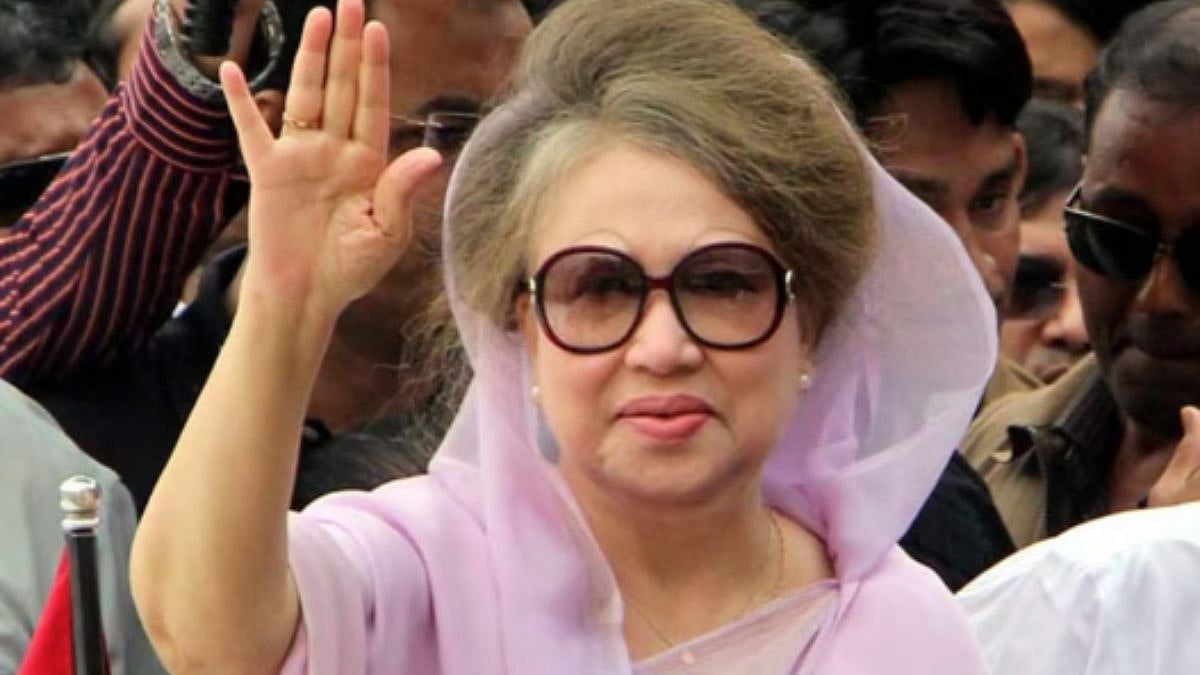
Fierce Political Rivalry, Historic Achievements: Remembering Bangladesh's First Female Prime Minister Begum Khaleda Zia | File Pic
New Delhi: Tributes flowed in as Bangladesh’s first female prime minister and leader of the Bangladesh Nationalist Party (BNP) Begum Khaleda Zia passed away on Tuesday at age 80. Zia, who had been battling a prolonged illness for some time, had a fierce rivalry with former prime minister Sheikh Hasina, who was ousted from power in August last year. The two women had dominated Bangladeshi politics ever since Zia took power in 1991.
Prime Minister Modi was quick to pay tribute. Writing on X, he said was “deeply saddened” to learn about her passing away of the the passing away and stated that her contribution “towards the development of India-Bangladesh relations would always be remembered.”
Only recently in an outreach, Prime Minister recalled that he had met her in Dhaka in 2015 and more recently gladdened the hearts of BNP supporters when he enquired about her health. In another calibrated move, External Affairs Minister Dr S Jaishankar will be going to Dhaka to attend her funeral. It has been slotted for Wednesday where with full state honors she will be buried alongside her husband, late president Ziaur Rahman, the interim government said on Tuesday. Tarique Rahman, the son and currently the acting chairperson of the BNP, recalled his mother in a lengthy emotional post on social media.
Writing in English, Rahman stated many looked upon Khaleda Zia as the “Mother of Democracy, the Mother of Bangladesh. Today, the country mourns the loss of a guiding presence that shaped its democratic aspirations.” But apart from grief there was also anger, anger against the woman who had placed his mother under house arrest - Sheikh Hasina. “She endured repeated arrests, denial of medical care, and relentless persecution. Yet even in pain, confinement, and uncertainty, she never stopped sheltering her family with courage and compassion. Her resilience was not loud, but it was unbreakable,” Rahman wrote The former Bangladeshi prime minister, who is currently living in India post her ouster in August, did not reply directly to the news of Begum Khaleda Zia’s death.
However, the Awami League released a statement attributed to her. “As the first woman Prime Minister of Bangladesh, and for her role in the struggle to establish democracy, her contributions to the nation were significant and will be remembered,” the statement said. Hasina’s short statement was in character given the fierce rivalry between the two women since the 1990s. However, there was a time when both had common cause. Both suffered personal loss and both fought together for the restoration of democracy in 1989-90 during a period known as the “Mass Uprising” against General Hussain Muhammad Ershad, who sought to impose military rule in the country.
ALSO READ
Ongoing protests, strikes, and growing international pressure led him to step down ensuring Khaleda Zia became the first female and democratically elected prime minister of Bangladesh in 1991. Sanjay K Bhardwaj, professor for South Asian Studies at the School for International Studies, Jawaharlal Nehru University feels that there were three major achievements that should be credited to the former BNP leader. “The first achievement of Zia was that she and Hasina jointly fought the military regime to reinstate democracy in Bangladesh.
The second was her introduction of caretaker government through a constitutional amendment in 1996. This was important as it allowed a temporary non-partisan administration to oversee elections. The third major achievement of Zia was her introduction of economic reforms, which led to liberalisation and globalisation,” said Bhardwaj. While Zia did a lot for the country, she remained a complex and divisive figure. Many Indian analysts viewed her as anti-India. Bhardwaj says that “Zia promoted an Islamic ethos and Islamic nationalism, which found her moving closer towards Pakistan.
ALSO READ
So whenever the BNP was in power, India and Bangladesh did not sign any significant agreements or MoUs.” Others agree but argue that the picture was a little bit more complicated. Dr Smruti S Pattanaik, Research Fellow (SS) at the Manohar Parrikar Institute for Defence Studies and Anlayses says. “Zia was much more ideological and very conscious of the fact that her party’s stance should be in contrast to the Awami League, which prompted her antiIndia stance. But in 2012, she made an attempt to change that, though that was opposed by factions of her party.
While this does not mean that the party will shed its anti-India stance overnight, or cool the ongoing tensions between the two nations, it could ensure that the party - considered the favourite to win the upcoming elections - may recalibrate its stance towards New Delhi - to the benefit of both India and Bangladesh. Meanwhile, Bangladesh summoned its envoy Riaz Hamidullah from Delhi for discussions.
RECENT STORIES
-
-
-
-
-