Kanwar Yatra: Where Faith, Governance & Politics Converge
The Kanwar Yatra, rooted in legends of Lord Shiva, Ravana, Parashuram and Shravan Kumar, has evolved into one of India’s largest annual pilgrimages. In Uttar Pradesh, the Yogi government has expanded security, healthcare and civic arrangements for devotees, while the yatra has also emerged as a symbol of faith, cultural identity, social unity and local economic activity.

Kanwar Yatra: Where Faith, Governance & Politics Converge | X
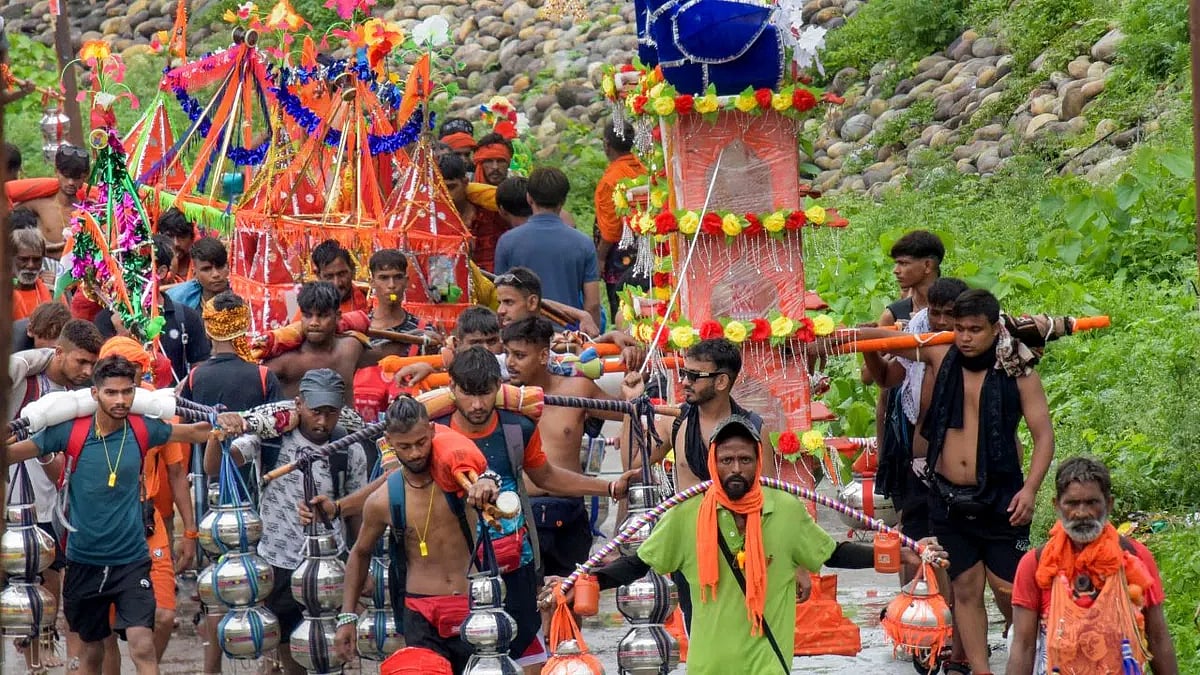
The month of Shravan has begun, and with it, saffron-clad Kanwariyas have started appearing on the roads of Uttar Pradesh, especially in the western districts. Kanwars resting on their shoulders, vessels filled with Gangajal hanging from them, and roads echoing with chants of "Bol Bam" and "Har Har Mahadev" present a living spectacle of Indian folk faith. This is not merely a religious ritual but a confluence of Sanatan sentiments that unite with Lord Shiva at the center. The Yogi Government understands the significance of this festival of devotion and faith, and that is why the entire state government stands in reverence before these devotees of Aughad Dani. From drone surveillance to flower showers from helicopters, from temporary hospitals to the repair of thousands of kilometres of roads, this yatra is not viewed by the government merely as a religious event but as a major platform to demonstrate the administration's respect for governance, social identity, and public faith. As the Mahant of a public welfare Peeth, Chief Minister Yogi Adityanath's reverence for these Kanwariyas is also evident, and it carries deeper implications. To understand these implications, it is first necessary to understand the roots of this tradition.
There is no systematic reference in any single scripture, Veda, or Purana explaining when or how the Kanwar Yatra began. It is a collective tradition of faith that evolved through the amalgamation of numerous mythological narratives and folk legends. The most widely known account is that of Samudra Manthan and Neelkanth. According to the mythological narrative, when the Devas and Asuras churned the ocean in search of Amrit, the deadly poison known as Halahal emerged, threatening to reduce creation to ashes. To protect the universe, Lord Shiva consumed the poison and held it in his throat, causing it to turn blue, after which he came to be known as "Neelkanth". The poison generated intense heat in his body, and it is believed that the Devas performed his Abhishek with Gangajal to provide relief. It is on the basis of this belief that during the month of Shravan, devotees of Lord Shiva bring water from the Ganga and offer it to the Shivling so that the heat generated by the consumption of poison may be pacified. This sentiment symbolizes not only devotion but also gratitude.
A legend associated with Ravana also points towards the ancient form of this tradition. According to popular belief, the great devotee of Lord Shiva, Ravana, brought Gangajal from Haridwar, established a Shivling at Pura Mahadev in Baghpat, and performed its Jalabhishek. This is considered the earliest reference to the Kanwar Yatra. Similarly, there is the account of Lord Parashuram, about whom it is said that he brought Gangajal from Garhmukteshwar and performed Jalabhishek of the Shivling at Pura Mahadev. The story of Shravan Kumar connects this journey with devotion and service towards one's parents. Although the story of carrying his blind parents in a Kanwar on a pilgrimage and serving them with Gangajal along the way is not directly connected with the Abhishek of Lord Shiva, it nevertheless established the Kanwar as a symbol of "service and devotion." Carrying a Kanwar on one's shoulders came to be regarded not merely as carrying water but as a test of sacrifice and dedication. A common thread runs through all these stories: the sanctity of Gangajal, unwavering devotion to Lord Shiva, and the aspiration for spiritual purification through rigorous penance.
Over time, the tradition of Jalabhishek gradually evolved into an organized socio-religious event. After Independence, this yatra was largely limited to a small number of saints, seers, and elderly devotees who quietly undertook the journey on foot carrying Gangajal. Governments also did not attach any special significance to it and regarded it merely as a religious ritual. However, over the past decade, this yatra has become synonymous with social identity, collective enthusiasm, and religious consciousness. Today, crores of devotees from across the country participate in it every year, making it one of the world's largest annual religious pilgrimages.
There is a specific reason behind this expansion. After assuming office in 2017, Chief Minister Yogi Adityanath associated the Kanwar Yatra not only with religious identity but also with the religious traditions of Uttar Pradesh and defined the responsibilities of the government accordingly. The movement of devotees was linked to the government's responsibility for law and order, traffic management, healthcare facilities, and security. This is why every year the Uttar Pradesh Government makes arrangements such as drone and CCTV surveillance along Kanwar routes, temporary medical camps, drinking water and toilet facilities, alternative traffic routes, and the deployment of a heavy police force. Special emphasis is also placed on sanitation, as maintaining cleanliness along the routes becomes essential due to the movement of lakhs of devotees. The first and most evident implication of these arrangements is administrative. Ensuring the safety of life and property of crores of people and preventing the possibility of stampedes or accidents is a fundamental responsibility of the state, and fulfilling this responsibility is essential for any government, whether the event is religious or otherwise. The Yogi Government has embraced this responsibility.
Beyond this lies a second implication, which is political and social in nature. In a state like Uttar Pradesh, where Hindu faith and cultural identity hold significance, extending broad support to events such as the Kanwar Yatra projects the image of being a protector of Sanatan faith. This yatra represents the cultural sentiments of the majority community, which remained neglected for a long time. A third implication is economic and social. Small shopkeepers, dhaba operators, voluntary organizations running service camps, and the local economy along the Kanwar route derive substantial benefit from this massive influx of devotees. The government's arrangements indirectly support this temporary economic ecosystem as well. A spirit of collective service emerges, which becomes an identity of the state.
In essence, the Kanwar Yatra reflects the collective memory of Indian society, where mythological narratives, folk beliefs, and social unity are woven together. Although this yatra may not be described in any single scripture, the narratives stretching from Samudra Manthan to Ravana, Parashuram, and Shravan Kumar have transformed it into a rich cultural heritage where faith, governance, and politics merge with one another. Herein lies the social significance of the Kanwar Yatra, as well as the profound essence of Sanatan culture.
RECENT STORIES
-
-
-
-
-