Kanwar Yatra: A Remarkable Confluence Of Faith And Discipline
Kanwar Yatra reflects the confluence of faith, discipline and devotion, and credits the Uttar Pradesh Government's administrative measures with ensuring the safety, convenience and dignity of devotees while preserving the sanctity of the annual pilgrimage.

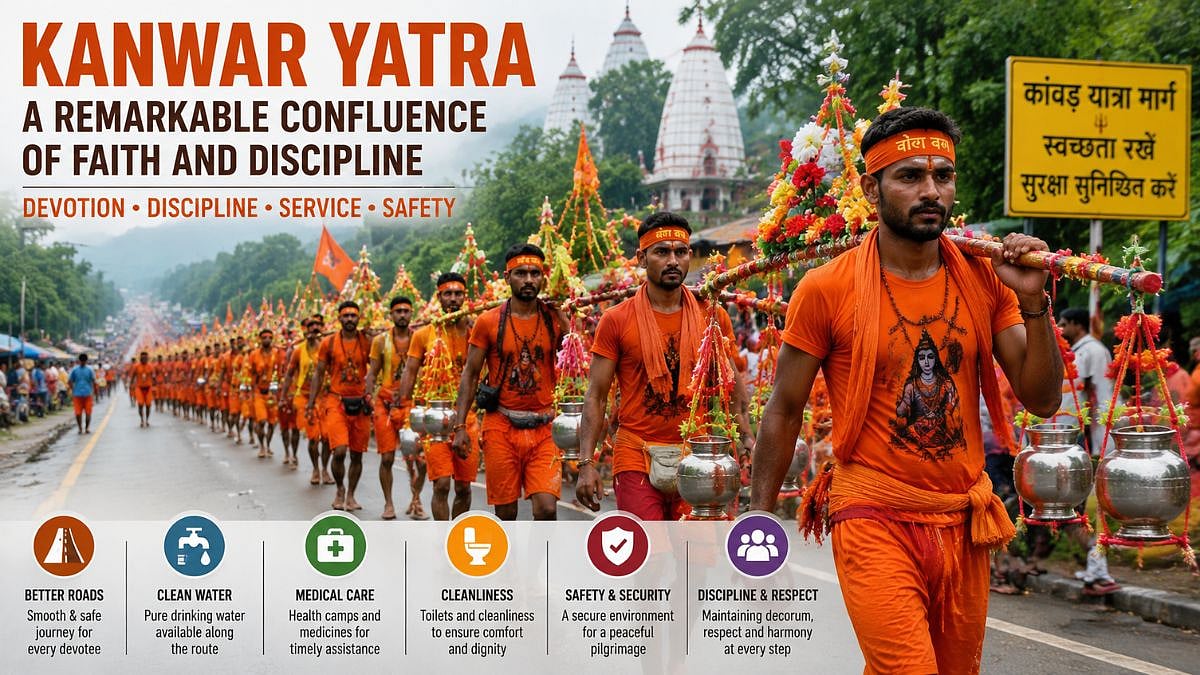
Devotees undertake the Kanwar Yatra during Shravan, reflecting the blend of faith, discipline and organised public arrangements highlighted in the article | AI Generated Representational Image
According to our ancient belief, devotion to Lord Shiva is the greatest pilgrimage and the highest form of penance. The Kanwar Yatra, undertaken during the holy month of Shravan, is one such act of penance that gives concrete expression to the resolve of devotees.
Carrying Gangajal on their shoulders and walking barefoot over hundreds of kilometres to reach Shiva temples, devotees embody a tradition that goes far beyond the ritual of Jalabhishek.
In essence, this pilgrimage is the flowing confluence of penance, restraint, and devotion that has continued uninterrupted in the Sanatan tradition for centuries.
Giving such a vast, sensitive, and immense stream of faith an organised framework, while preserving its dignity within the bounds of discipline, is possible only through administrative resolve that understands the significance of devotion.
The commitment demonstrated by the Uttar Pradesh Government under the leadership of Yogi Adityanath over the past nine years stands as an example of this rare balance between faith and discipline.
Government's Administrative Approach
Keeping the Kanwar Yatra in view, the seriousness with which Chief Minister Yogi Adityanath has personally alerted officials reflects that, for the government, this pilgrimage is not merely an administrative challenge but a matter of faith for crores of people.
The Chief Minister has made it clear that the safety, convenience, and dignity of every devotee are his highest priorities. This is a sensitive expression of the government's vision, in which the administration considers itself a fellow traveller of the devotee.
During the Kanwar Yatra, waves of devotion spread across Rohilkhand, Braj, Bundelkhand, Awadh, Purvanchal, and Western Uttar Pradesh, covering almost every district of the state.
Against such a vast canvas, the Chief Minister's direction that the standard of arrangements should remain uniform in every district demonstrates that the government's approach is inclusive and that every devotee matters.
The Kanwar Yatra has now become a symbol of nationwide spiritual consciousness. The Shiv Purana states that Jalabhishek performed with a sincere heart destroys all sins and leads the devotee towards Shivtatva.
This is why Kanwariyas observe discipline at every step of the pilgrimage. Not placing the Kanwar on the ground, maintaining decorum throughout the journey, and adhering to pure conduct are all manifestations of the self-discipline that is deeply embedded in the essence of Sanatan Dharma.
Respecting this spirit of self-discipline, the Chief Minister has directed officials to coordinate with their counterparts in Haryana, Rajasthan, Delhi, and Uttarakhand and to maintain regular communication with Kanwar associations there.
This initiative reflects that the sanctity of faith is not confined within the boundaries of a single state, but that efforts are being made to provide it with a uniform and coordinated framework through inter-state cooperation.
Facilities And Safety Measures
For the ascetics undertaking the Kanwar Yatra, roads must remain smooth and accessible. Chief Minister Yogi is equally serious about this and has directed the immediate repair of damaged roads so that no devotee faces physical obstacles during the pilgrimage.
The government is concerned for both the body and the mind of the devotee. Therefore, directions have been issued to ensure adequate lighting, cleanliness, drinking water, and toilet facilities along the routes, along with the effective operation of medical camps and the sufficient availability of essential medicines, including anti-venom and anti-rabies injections.
This framework of discipline is multidimensional, and one of its most sensitive aspects relates to food safety. The Chief Minister has clearly directed that meat and liquor shops remain closed along the Kanwar Yatra route so that devotees' religious sentiments are not hurt.
The requirement that every establishment prominently display the name of its operator ensures both transparency and accountability.
At the same time, the instruction that DJ sound systems must remain within prescribed limits and that deafening noise will not be tolerated under any circumstances reflects the principle that devotional celebrations should remain joyous without crossing the limits of decorum.
Protecting this vast stream of faith from the spread of misinformation and hostility is also the government's responsibility. Accordingly, directions have been issued for the immediate rebuttal of misleading and false information and for strict action against those who spread rumours to disturb social harmony.
Active participation by society is also an important component of this framework of discipline. Therefore, local administrations have been instructed to maintain continuous dialogue with Kanwar associations.
When discipline is strengthened through public support and communication, it ceases to be merely an imposed arrangement and instead becomes the natural expression of collective consciousness.
Faith And Governance
Before the Yogi Government came to power, the indifference shown towards matters of faith in Uttar Pradesh often resulted in disorder, and the safety of devotees was at times put at risk. In contrast, the organised framework provided to the Kanwar Yatra by the Yogi Government is the outcome of a long-term policy that has been continuously refined.
Its approach offers a new definition of the relationship between the state and faith, where the government does not distance itself from faith in the name of secularism but considers its protection to be its responsibility.
Another significant aspect of this entire framework is that it reflects the state's cultural commitment. When a government consistently, year after year and without interruption, provides respect and security to the faith of such a vast gathering of people, it also safeguards the nation's civilisational heritage.
A Model Of Collective Responsibility
This confluence of faith and discipline in the Kanwar Yatra establishes the truth that when devotion is combined with proper organisation, it becomes more effective, more secure, and more inclusive. Through its concrete efforts, the Yogi Government has demonstrated that strong discipline can be established while respecting faith, and that the essential dignity of devotion can be preserved while ensuring discipline.
This model of the Kanwar Yatra not only keeps alive the eternal tradition of devotion to Lord Shiva but also stands as an ideal example of administrative efficiency and social commitment that will remain worthy of emulation in the future.
The pilgrimage repeatedly reminds us that when the state and society unite for a common purpose, faith ceases to remain merely an individual experience and instead assumes the form of a cultured, secure, and dignified collective consciousness.
RECENT STORIES
-
-
-
-
-