PM Modi Turns 76: How India's Digital, Economic And Tech Landscape Changed Under His Leadership
Launched in 2015, Digital India has driven major technology-led changes in governance, payments and public services. Initiatives such as UPI, Aadhaar-linked transfers, DigiLocker, startup programmes, semiconductor projects and AI infrastructure have expanded digital access.

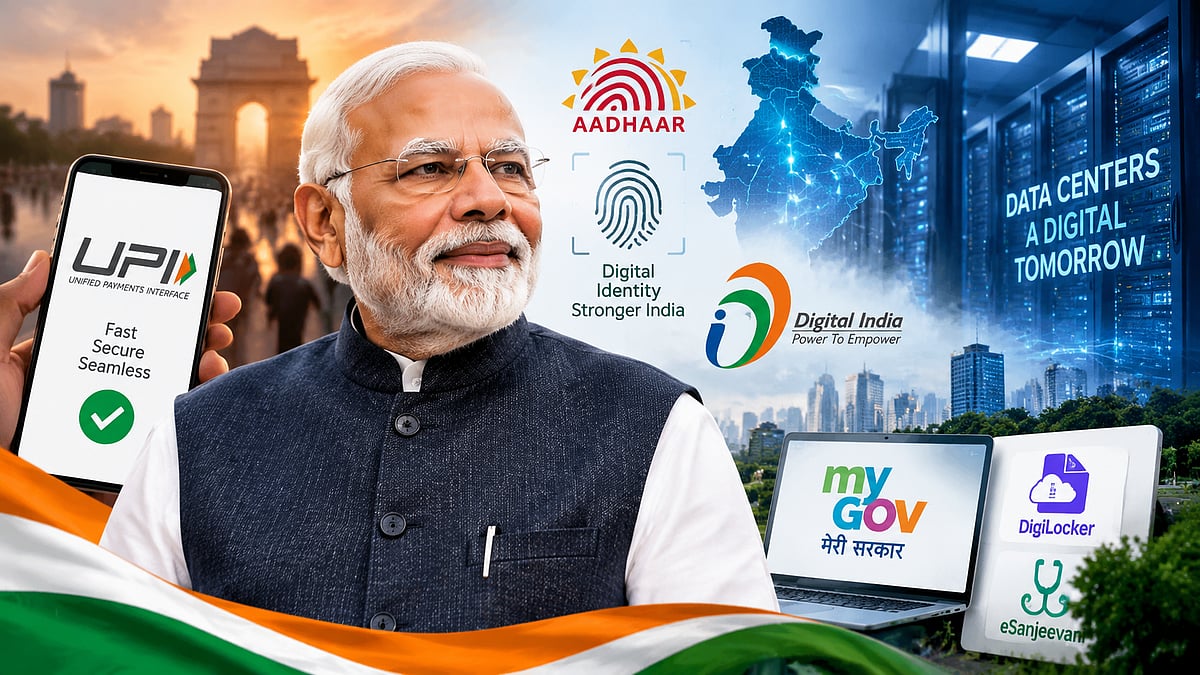
PM Modi Turns 76: From UPI To Data Centers, Here's How India Has Transformed Digitally |
As Prime Minister Narendra Modi marks his birthday, one of the most closely tracked threads of his tenure remains the government's sustained push to digitise India's economy and public services. Launched in 2015, the Digital India programme set out to transform governance, banking, and everyday citizen services through technology, and a decade on, several of its flagship initiatives have become part of daily life for hundreds of millions of Indians.
1. The JAM Trinity and Direct Benefit Transfers
Government materials cite over 50 crore bank accounts linked through Jan Dhan, Aadhaar, and mobile numbers, a combination officials say has enabled seamless Direct Benefit Transfers by curbing leakages and cutting out middlemen. Independent researchers studying the same infrastructure, however, have documented a persistent exclusion problem, where biometric authentication failures, Aadhaar mismatches, and poor rural connectivity have denied genuine beneficiaries access to welfare entitlements rather than only filtering out fraudulent claims.
2. Unified Payments Interface (UPI)
UPI is credited with revolutionising retail transactions and driving a majority share of real-time digital payments globally by volume, with the system now expanding to markets including the UAE, Singapore, France, Mauritius, and Sri Lanka. That growth has a documented cost side too: UPI-related fraud cases have risen sharply in recent years, with annual fraud value now running into thousands of crores, and transactions above Rs 10,000 accounting for the overwhelming majority of that fraud value, according to policy researchers tracking the ecosystem.
3. Expanding Digital Connectivity
The government points to over 42 lakh kilometres of optical fibre laid to villages and an accelerated 5G base station rollout across remote and border regions as evidence of closing India's connectivity gap. Researchers tracking rural digital access separately note that device affordability, inconsistent electricity supply, weak last-mile broadband, and limited local-language interfaces continue to restrict meaningful adoption in many of these same areas, suggesting infrastructure reach has not automatically translated into usage.
4. Digital Governance and Citizen Services
Centralised platforms such as DigiLocker, UMANG, CoWIN, and the Government e-Marketplace are positioned as having made public entitlements transparent, paperless, and accessible on demand. Data protection experts have flagged gaps in how some of these platforms handle sensitive information, including past concerns raised over the security of health data collected through CoWIN, alongside broader criticism that India's data protection law still faces implementation and enforcement challenges.
5. Healthcare and Education Reengineering
The government cites expanded telemedicine access through eSanjeevani, streamlined hospital operations via e-Hospital, and wider educational reach through PM eVidya and the PMGDISHA digital literacy programme as key outcomes of the digital push in these sectors. Independent assessments of digital literacy programmes in India have noted that reach and actual skill-building outcomes are not always the same thing, with significant portions of the population, particularly elderly and less-educated citizens, still reporting difficulty navigating digital services independently.
6. Startup and Deep-Tech Ecosystem
Startup India is credited with cultivating what the government describes as the world's third-largest startup ecosystem, surpassing 150,000 recognised startups, alongside newer strategic pushes into semiconductors, quantum computing, and the IndiaAI Mission. These figures reflect registration and recognition under the scheme rather than independent measures of startup survival rates or economic output, a distinction that is often absent from official framing. The government is also helping several indegenous AI platforms like Sarvam AI and BharatGen with compute and other initiatives.
7. Manufacturing Surge Under Make in India
Electronics and mobile phone manufacturing are cited as having grown substantially over the decade, framed as evidence of progress under the Aatmanirbhar Bharat and Make in India frameworks. Economists tracking the sector have pointed out that a meaningful share of this growth has come from assembly-stage manufacturing rather than deep value-chain localisation, meaning the domestic value-add in components and design remains a separate, less resolved question.
8. Financial Decentralisation
The government notes that mobile payments have regularly outpaced traditional ATM cash withdrawals, framing this as evidence that millions of previously unbanked citizens have been drawn into the formal economic mainstream. Whether this shift reflects genuine financial inclusion or simply a change in payment method among those already banked is a distinction researchers say is not always clearly established in the underlying data.
9. India Semiconductor Mission
Union Minister Ashwini Vaishnaw has touted the India Semiconductor Mission's progress in 2026, citing 12 approved semiconductor units backed by roughly $20 billion in committed investment, with three units already producing chips, alongside the newly approved Semicon 2.0 phase focused on domestic equipment, materials, and full-stack chip design capability. Projects under the mission include Micron's assembly and test plant in Sanand, the Tata-PSMC wafer fab at Dholera, and OSAT facilities from Kaynes Technology and Tata Electronics, spread across six states with a combined approved investment of over Rs 1.6 lakh crore as of mid-2026. This chip push is closely tied to India's parallel data centre boom, driven by rising AI compute demand.
10. The Data Centre Push in Vizag and Beyond
Perhaps the most striking recent development in this space has been the scramble to turn Visakhapatnam into what Andhra Pradesh officials call "AI City Vizag." Google has committed close to $15 billion to build a 1-gigawatt hyperscale data centre campus across three sites in the region, its largest such investment outside the United States, backed by new subsea cable landing stations meant to give the city direct international connectivity. Reliance Industries has separately proposed an even larger 1.5-gigawatt, Rs 1.6 lakh crore AI-focused data centre cluster nearby, while Meta and Tillman Global Holdings have signed on for additional facilities worth billions more in the same coastal belt. Andhra Pradesh's IT minister has claimed the state alone drew close to a quarter of all foreign direct investment into India in 2025, largely on the back of this cluster.
The scale of capital committed is real, but analysts tracking the sector caution that headline investment figures do not automatically translate into proportional local employment, since hyperscale data centres are highly capital-intensive but comparatively light on permanent jobs relative to the sums involved. Land acquisition for some of the proposed sites, including parts of the Tharluvada campus, has reportedly run into ongoing legal disputes, while the scale of power and water demand from gigawatt-class facilities in a single coastal cluster raises infrastructure and environmental planning questions that remain to be fully addressed as these projects move from groundbreaking to actual operation.
Together, these initiatives have made technology a central plank of India's governance model, one that continues to evolve as the country pushes further into AI adoption and digital manufacturing under its broader economic ambitions.
RECENT STORIES
-
-
-
-
-