DeepSeek AI Faces Global Trust Concerns Over China's Censorship & Information Controls: Report
A report by East Asia Forum highlighted concerns over Chinese AI models like DeepSeek, citing censorship and state controls on information as major limitations. DeepSeek’s R1 model gained attention for strong coding and maths performance but reportedly avoided politically sensitive topics. The article said such restrictions have affected global trust and adoption of Chinese AI systems.

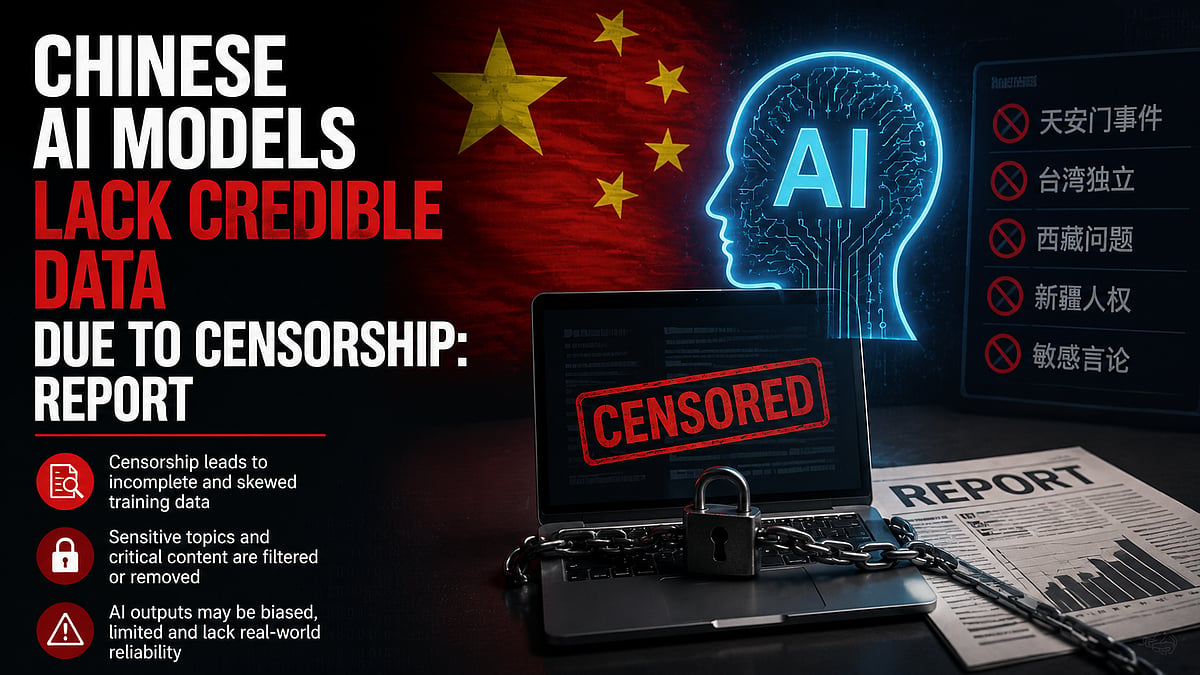
DeepSeek AI Faces Global Trust Concerns Over China's Censorship & Information Controls: Report | AI Representational Image
New Delhi, Aug 5: Chinese AI models like DeepSeek have a serious limitation due to the censorship on information in the authoritarian state and are distrusted by many governments and users worldwide even though they are cheap and capable, according to an article published by East Asia Forum.
When DeepSeek’s 'R1' model arrived in January 2025, it was seen as China’s big leap in artificial intelligence (AI). While 'R1' outperformed its Western competitors in Maths and coding, it also refused or deflected roughly 85 per cent of prompts concerning politically sensitive topics in China. This distinction lies at the heart of China’s bid to shape the global technological order, the article states.
The Chinese government considers the free flow of information as a political liability. The 2023 Interim Measures for the Management of Generative AI Services illustrated this priority by requiring any public-facing model to uphold ‘core socialist values’ and pass a state security review, the article observes.
China excels in technological products such as electric vehicles, batteries and solar panels and leads the world in investment in robotics. However, in contrast, generative AI is an inherently social technology. Its value lies in open-ended language.
Yet, this very capability is exactly what the Chinese government wants to control. This constitutes a stability tax — an unavoidable cost imposed on China’s frontier AI ambitions by the government’s overriding commitment to political control, the article observes.
It points out that censorship persists even when DeepSeek’s open-weight models are run privately and research shows that foundation models originating from China have higher refusal rates, shorter responses and less accurate answers to a battery of 145 questions about Chinese politics than models built elsewhere.
Also Watch:
Chinese state control of the media seeps into the training data on which all models depend, which steers all large language models towards more favourable portrayals of states with tightly controlled media, the article states.
Developers often adopt Chinese open-source models because they offer comparable performance at a lower cost. But most large enterprises contract directly with US providers or run their inference through the major US cloud platforms, where the penetration of Chinese models is far less.
Mainstream consumer audiences outside China continue to reach overwhelmingly for US models. DeepSeek’s consumer app has seen downloads tumble from an estimated 171 million in 2025 to an estimated 35 million in the first half of 2026. Australia, Taiwan and Italy have barred it from use in government systems, the article points out.
(Except for the headline, this article has not been edited by FPJ's editorial team and is auto-generated from an agency feed.)
RECENT STORIES
-
-
-
-
-