Asus Pad Review: Gorgeous Display, But Does It Deliver Enough?
Asus Pad enters India’s tablet market at Rs. 35,990 with a 12.2-inch 2.8K OLED display, 144Hz refresh rate, Dolby Atmos speakers and a 9,000mAh battery. The tablet delivers strong entertainment features and fast charging, but its bulky design, limited multitasking features and unclear software updates prevent it from being a complete package.

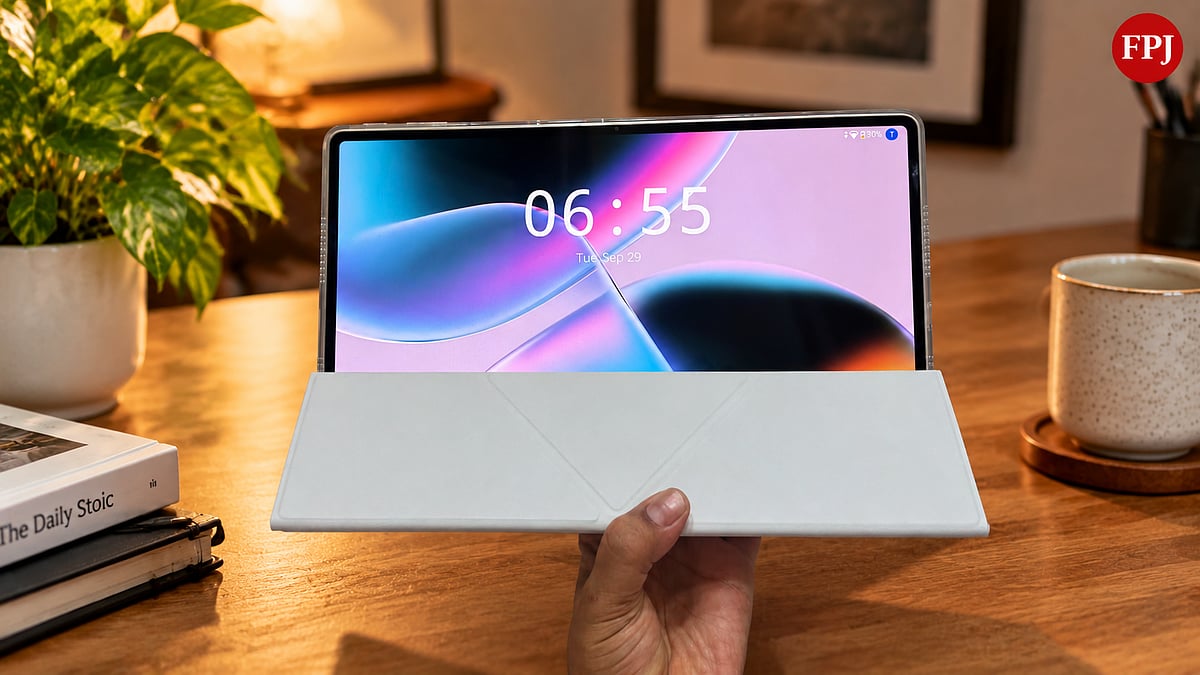
Asus Pad | FPJ
Asus's re-entry into India's tablet market after nearly a decade comes with the Asus Pad, priced at Rs. 35,990, and on paper it reads like a genuine steal - a 12.2-inch tandem OLED display, quad speakers with Dolby Atmos, and a 9,000mAh battery, all undercutting most OLED tablets in the country by a significant margin. We've spent time with the white variant as our daily tablet for streaming, reading, and casual use, and while the display alone makes a strong case for the Asus Pad, a few rough edges are there that we'd like to highlight.
Asus Pad review: Design
Asus has opted for a plastic build here rather than metal, which keeps the tablet at a claimed 523g and 6.5mm thickness on paper. In actual daily use, though, the Asus Pad doesn't feel anywhere near as slim or light as those numbers suggest, the sheer 12.2-inch footprint makes it feel considerably bulkier and more unwieldy to hold one-handed than the spec sheet implies, especially during longer reading sessions. The curved frame helps with grip, and the single pure white colourway looks clean, though we wish Asus offered more colour options at this price.
The box includes the tablet, a 45W charging adapter, a USB Type-C to Type-C cable, and a bundled transparent folio case that doubles as a stand. That folio case, unfortunately, is one of our bigger gripes with the package. It feels distinctly flimsy, doesn't stay firmly attached to the tablet, and flaps around with the slightest movement, offering little confidence when it comes to actually protecting the display. Port placement is sensible, with a microSD card slot, volume rocker, power button, and dual microphones on one edge, and a USB 3.0 port flanked by speaker grilles at the bottom.
Asus Pad Review: Display
This is where the Asus Pad genuinely earns its keep. The 12.2-inch tandem OLED panel runs at a 2.8K resolution with a 144Hz refresh rate, a 3:2 aspect ratio, and peak brightness touching 2,000 nits. Finding an OLED tablet under Rs. 40,000 is rare enough, and the quality on offer here doesn't feel like a compromise either, colours are rich and accurate, blacks are genuinely deep, and outdoor visibility holds up well despite the reflective finish. The 3:2 aspect ratio works nicely for reading and split-screen use, though it does mean thicker black bars when watching 16:9 content. Our only real complaint is the absence of any display colour profile settings, a strange omission given how much Asus is otherwise leaning on this panel as the tablet's headline feature.
The quad-speaker setup paired with Dolby Atmos is similarly impressive for the price, getting loud with decent separation, making the Asus Pad a genuinely pleasant tablet for movies and music without needing to reach for headphones or an external speaker.
Asus Pad Review: Performance
Under the hood is the MediaTek Dimensity 8300, paired with 8GB of RAM and UFS 3.1 storage. For everyday tasks, streaming, browsing, social media, and light multitasking, the chipset handles itself well and doesn't show signs of strain. Push it further, though, toward heavier workloads like video editing or juggling multiple demanding apps, and the limitations of a mid-range chipset become apparent fairly quickly. This clearly isn't a tablet built for power users chasing flagship-level performance, and Asus doesn't seem to be positioning it that way either.
Asus Pad Review: Battery
The 9,000mAh battery comfortably carries the Asus Pad through a full day of typical use, streaming, reading, and browsing. Charging is a genuine highlight, with the bundled 45W adapter taking the tablet from a low charge to full in under an hour in our testing, which is faster than most tablets, and even several smartphones, manage at this price.
Asus Pad Review: Cameras
The Asus Pad packs a 13-megapixel rear camera and a 5-megapixel front camera, and neither is designed to impress. The rear camera is serviceable for the occasional document scan, while the front camera gets the job done for video calls in good lighting, but struggles noticeably when shooting against light. Photography was clearly never meant to be a priority here, and that's a reasonable trade-off for a tablet at this price.
Asus Pad Review: UI
Software on the Asus Pad runs close to stock Android 16, and the minimalism here genuinely works in its favour. There's barely any bloatware beyond Asus's own GlideX app, which bridges the tablet with a PC for screen mirroring, file transfers, and remote access, a handy inclusion if you're already in the Asus ecosystem. That said, the minimalism occasionally tips into feeling underbaked - there's no floating windows support, no proper multitasking view, and no way to manually adjust the refresh rate, which also means battery life takes a hit from the display running at 144Hz at all times. Asus's silence on a long-term OS upgrade policy, with only three years of security updates confirmed, is a genuine concern at this price point.
Asus Pad Review: Verdict
At Rs. 35,990, the Asus Pad's OLED display alone makes it a genuinely compelling option in a segment still dominated by mediocre LCD panels. But the tablet doesn't feel like a fully finished product - the bulkier in-hand feel, a flimsy bundled cover, missing multitasking features, and an uncertain software update commitment all chip away at what could have been an outright win. Worth considering against alternatives like the HP OmniPad 12, which bundles a detachable keyboard, or the OnePlus Pad and Xiaomi Pad, both of which offer more mature multitasking software, if productivity matters more to you than display quality.
The Asus Pad is best suited to buyers who primarily want a large-screen device for streaming, reading, and casual browsing, students and casual users looking for a secondary screen rather than a laptop replacement.
Rating: 3.5/5
Pros
- Outstanding 2.8K OLED display with 144Hz refresh rate, rare at this price
- Loud, immersive quad speakers with Dolby Atmos support
- Fast 45W charging, tops up in under an hour
- Clean, near-stock Android with minimal bloatware
- Handy GlideX app for Asus ecosystem users
Cons
- Feels bulkier in hand than its spec sheet suggests
- Bundled folio case feels flimsy and doesn't stay securely attached
- No floating windows or proper multitasking support
- Unclear long-term OS upgrade policy
- Mid-range chipset struggles with heavier workloads
- No keyboard accessory available, unlike key rivals
RECENT STORIES
-
-
-
-
-