Anthropic's Claude Discovers New Enzyme System That Could Rewrite The Future Of Gene Editing: Here's Why It's A Big Deal
Anthropic said its Claude AI model helped identify a previously unknown enzyme system in bacteriophage DNA called ART. Around 950 Claude agents analysed over 200,000 sequences before researchers validated the finding through laboratory tests. The company said the discovery could support future gene-editing research, though ART’s biological role and applications remain under investigation.

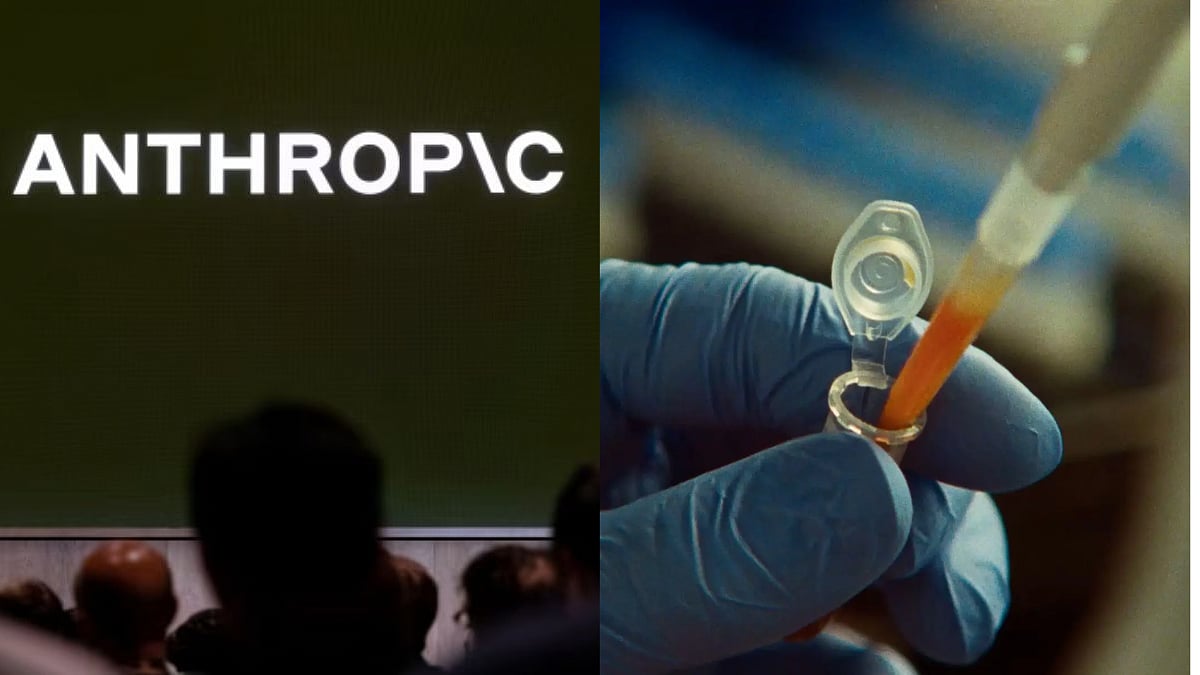
Anthropic's Claude Discovers New Enzyme System That Could Rewrite The Future Of Gene Editing: Here's Why It's A Big Deal |
Amid months of anxious debate over whether advanced AI could pose an existential threat to humanity, Anthropic has offered a different kind of narrative today. Its AI model Claude has helped uncover a previously unknown enzyme system in bacteriophage DNA, one that could eventually feed into gene-editing technology. The announcement, made by Anthropic CEO Dario Amodei, marks the first major result from the company's newly formed life sciences research lab and arrives just weeks after rival OpenAI said its AI agents had made a breakthrough on the 90-year-old Navier-Stokes mathematics problem.
What has Claude achieved exactly?
According to Anthropic, roughly 950 Claude agents spent 21 hours combing through more than 200,000 reverse transcriptase sequences, using about 210 million tokens in the process. One of the agents flagged an unusual pattern of a repeating array of DNA sitting beside the gene for an atypical reverse transcriptase - an enzyme that copies RNA into DNA. The layout bore a resemblance to CRISPR, the gene-editing system that has already transformed medicine.
Anthropic's scientists have named the newly identified system 'array-associated reverse transcriptases', or ART. It consists of three components - the reverse transcriptase itself, a neighbouring partner gene, and the long stretch of evenly spaced DNA repeats. Company researchers say Claude approached the discovery much as a human scientist would - counting the repeats, measuring their spacing, comparing the arrangement against known RT systems, and scouring existing literature before concluding it had found something new. Human researchers at Anthropic's lab then validated the finding through wet-lab experiments, confirming that the repeats do produce short RNA sequences, though what the system actually does in nature remains unclear.
Why does this matter? Historically, the discovery of programmable DNA-editing systems - CRISPR chief among them - has taken years to translate into usable medical tools. Amodei argued that AI's ability to sift through enormous genomic datasets could dramatically shorten that timeline, potentially accelerating the entire pipeline of biomedical discovery, from identifying new drug targets to speeding up experimental research. He pointed to a broader pattern in which AI systems have gone from struggling with basic tasks to outperforming experts within a few years - citing mathematics as an example, where models moved from solving high-school-level problems in 2023 to tackling some of the field's hardest open questions by 2026.
What is Gene Editing?
Gene editing is a set of technologies that let scientists make precise changes to an organism's DNA i.e. adding, removing, or altering specific genetic sequences rather than working with the genome as a whole. CRISPR is the best-known tool for this, using a guide molecule to find a target DNA sequence and an enzyme to cut and modify it, and it has become central to developing new treatments for genetic diseases.
This discovery comes soon after OpenAI's mathematical progress
That trajectory was echoed just weeks earlier when OpenAI said an internal model, running through thousands of autonomous agents over roughly 88 hours, had made significant progress on the long-unsolved Navier-Stokes existence and smoothness problem - one of mathematics' seven Millennium Prize problems. OpenAI was careful to note its result addressed only part of the problem and has not yet been independently verified.
Anthropic, similarly, has been cautious about overselling the biology find. The company has released a preprint detailing the discovery but stressed that ART's precise biological function is still under investigation, and that any biotechnological application remains speculative for now.
RECENT STORIES
-
-
-
-
-