AI Data Centres In Space? Google Launches First Prototype Satellite With Four AI Chips Into Orbit
Google has launched the first prototype for Project Suncatcher, sending an AI satellite with four Tensor Processing Units into orbit aboard SpaceX’s Transporter-18 mission. Built with Planet Labs, the satellite will test how Google’s AI chips handle radiation, extreme temperatures and launch stress. Google plans to study the results as it develops its long-term orbital AI concept.

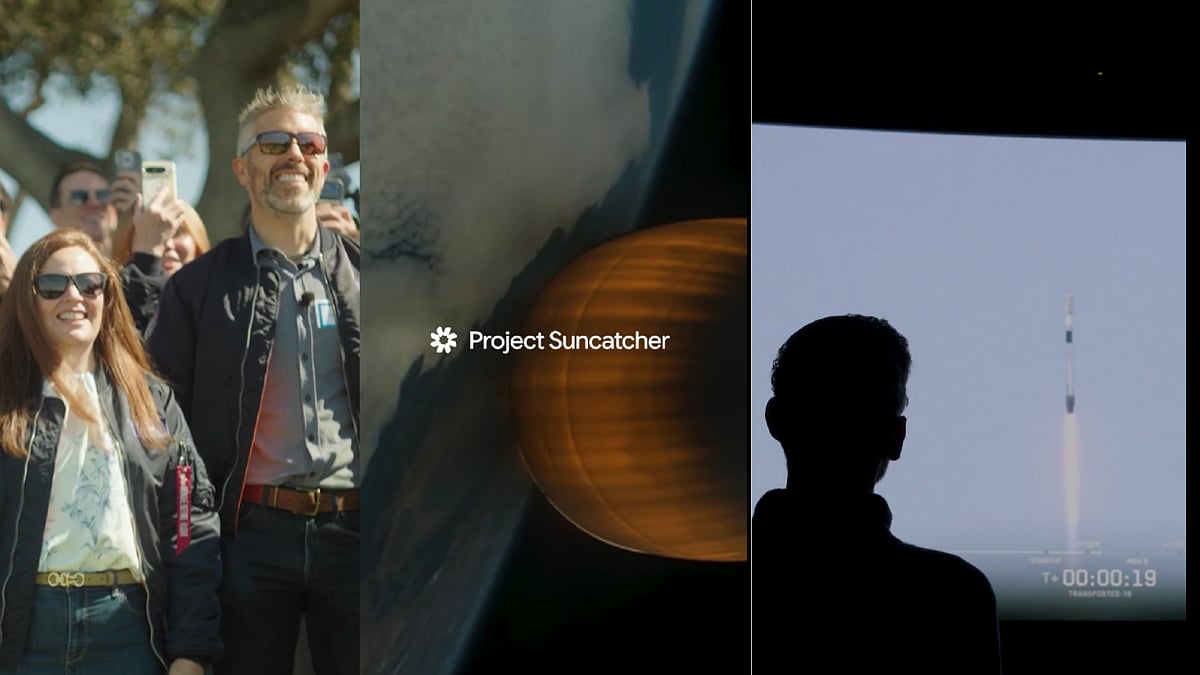
Google's first prototype satellite for Project Suncatcher launched aboard SpaceX's Transporter-18 rideshare mission from Vandenberg Space Force Base in California. Google built the satellite with Planet Labs. It carries four Tensor Processing Units (TPUs), the company's AI chips. SpaceX's deployment schedule lists the satellite as Project Suncatcher M1, released about 61 minutes after liftoff. It was one of 130 payloads on the flight.
Travis Beals, Suncatcher's senior director, said after launch that the team had confirmed contact and that the satellite was operating as expected.
Pichai: 'How far there is to go'
Google CEO Sundar Pichai marked the launch in a post on X. He recalled the first meeting where the team pitched the idea of putting compute in space and called it an exciting one. He said the successful launch shows how far the project has come, but also "how far there is to go." He thanked SpaceX for the lift and noted that it had made another spectacular booster landing.
What the test will measure
Over the coming weeks, Google plans to gather data on how the chips cope with launch stress, radiation and extreme temperatures in orbit. Before launch, the team shook the satellite along all three axes to simulate launch vibration, and Google says the hardware held up. Its Trillium-generation chips were also exposed to a proton beam at UC Davis, equivalent to a five-year radiation dose.
The satellite runs on solar arrays rated at around one kilowatt. Google has not detailed which AI workloads it will run.
From prototype to constellation
Google revealed Suncatcher in November 2025 as a 'moonshot'. It describes the project as research and does not call it a data centre in space. The long-term design envisions clusters of 81 satellites flying within a one-kilometre radius, linked by laser connections. Google has committed to a 2027 launch of two TPU-equipped satellites with Planet to test those laser links in orbit.
The cost question
Economics are the main obstacle. Google estimates space-based AI clusters could become feasible around 2035, but only if launch costs fall to roughly $200 per kilogram. Current prices run between $1,500 and $2,900. Analysts also point to unresolved challenges in radiation tolerance, networking, heat rejection and launch costs.
The idea is gaining traction beyond Google. SpaceX has pitched orbital supercomputers as the next frontier for AI infrastructure, citing "infinite real estate" in space as a way to escape the backlash against data centres on the ground.
RECENT STORIES
-
-
-
-
-