FPJ Exclusive | From Growing Up Blind To Chasing Asian Para Games Glory: Swimmer Himanshu Nandal Opens Up On Childhood Struggles, Family Sacrifices And Olympic Inspiration
Indian para swimmer Himanshu Nandal opened up about his journey from Rohtak to international competition ahead of the Asian Para Games 2026. From judo to swimming, Nandal discussed his family’s support, achieving the Paris Paralympics MQS, missing out on Paris and preparing for Aichi-Nagoya. The blind swimmer aims to improve his 100m backstroke personal best and represent India proudly.

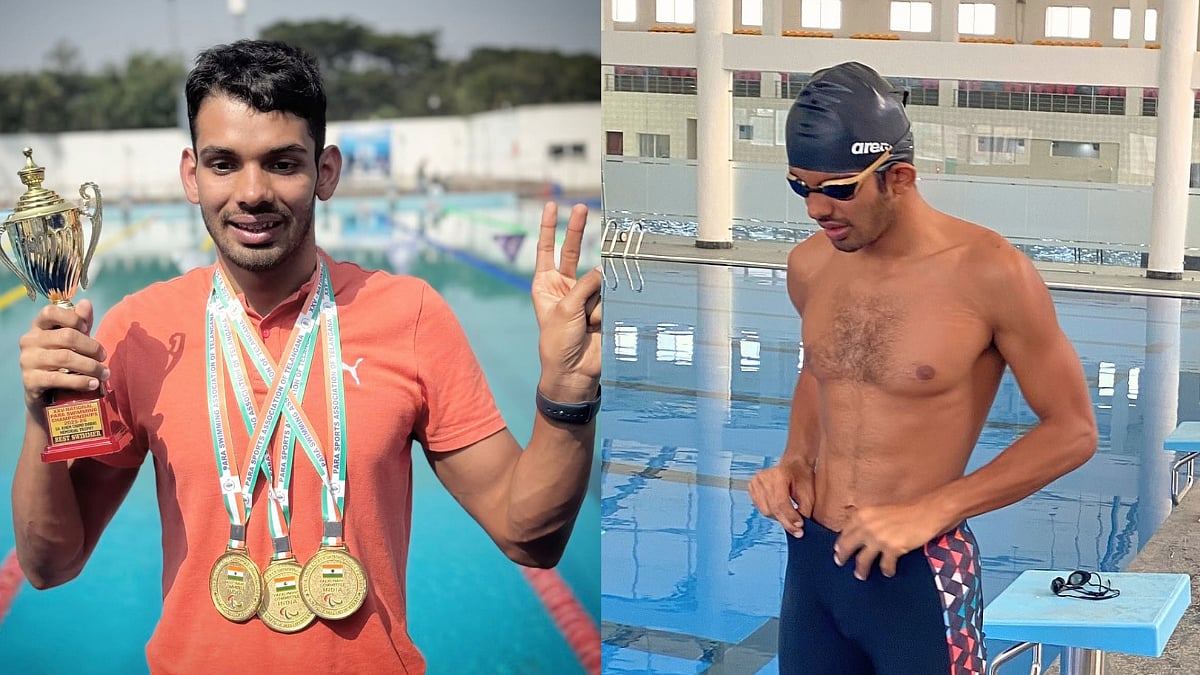
Himanshu Nandal/Instagram
Indian para swimmer Himanshu Nandal is gearing up for the Asian Para Games 2026 in Aichi-Nagoya with a clear focus on performance, personal improvement and representing the country with pride.
Speaking to The Free Press Journal ahead of the Games, Nandal opened up about his childhood in Rohtak, his journey through judo and swimming, and the challenges and milestones that have shaped his career.
Excerpts...
1. Could you tell us a little about your childhood and upbringing in Rohtak? What was Himanshu like as a child?
As a child, I was encouraged by my parents to try different activities. Before I started sport professionally, they exposed me to things like playing the piano, harmonium and other activities. I was especially interested in cycling and used to do it a lot. On a lighter note, my family often says that nobody else has gone through as many cycles as I did!
As a blind child, I was very interested in sounds. Whenever I heard a sound that fascinated me, I would run towards it and try to find out what it was After I turned four, my parents, my sister and I moved to Delhi in search of better education and opportunities. We had limited resources, so there were many struggles, especially when it came to managing the logistics of education and everyday life. But with my parents' dedication and constant support, we managed to overcome them.
2. You come from a family with a strong sporting background, with your father being a national-level hockey player and your uncle having represented India in judo. How much did sport influence you while growing up?
Sport influenced me a lot from childhood. Even before I became a professional athlete, my family encouraged us to stay active, whether through running, general fitness or other physical activities. At that time, I wasn't sure whether I wanted to pursue sport as a career because I had studied in an environment where there wasn't much awareness about sport as a profession. Watching the Tokyo Olympics with my family changed something for me. It inspired me to see how far I could take myself and to chase the highest level I could.
3. Before swimming, you pursued judo. How did you first get into judo, and what did that sport teach you?
I first got into judo through my uncle and his social circle, who recommended that I give it a try. My family had detailed knowledge of two sports hockey and judo.
Given my visual impairment, judo was a more accessible option for me at that time. Judo taught me patience and discipline, and the progress I made there gave me confidence to keep improving. That experience eventually helped me transition into swimming.
4. What made you eventually move away from judo and take up para swimming?
At the time when I was doing judo, athletes with different levels of vision competed together, and there wasn't the same kind of vision-based classification system that I later found in para swimming.
Para swimming was the first sport through which we became aware of the different classifications for athletes with physical, visual and intellectual impairments. I was also already familiar with swimming. My father first introduced me to a swimming pool in 2011, and we would continue going to the pool during summer vacations. But being familiar with swimming recreationally and learning it professionally are two very different things. It took a lot of work to learn the strokes properly and correct my stroke mechanics. And honestly, those corrections are still ongoing today.
5. You went on to represent India at the Asian Para Games in Hangzhou. What did it mean to you to compete at your first major continental event?
Competing at the Asian Para Games in Hangzhou was a very special experience for me. I was inspired by the athletes around me and by the scale of the event.
From counting down the days until we departed to returning home to Delhi, the whole experience was exciting. It was also the first time I really understood what it meant to be part of such a large international para-sporting environment.
I am very grateful for that opportunity because it gave me a much bigger sense of what competing at the international level requires. It also motivated me to train with even greater intent and helped me perform better at the tournaments that followed.
6. In 2024, you became the first Indian blind swimmer to achieve the Minimum Qualification Standard for the Paris Paralympics. What did that achievement mean to you, especially after such a rapid rise in para swimming?
The first moment was honestly surprising. Before that qualifying meet, I wasn't in the best shape because I had been ill. But all the training I had done before that helped me produce a strong performance when it mattered.
Achieving the MQS was a very important moment for me because it showed me that I could reach a level that I had previously only imagined. It also gave me confidence that the work I was putting in could translate into performances at the international level. Although I ultimately could not compete at Paris because of the available quota allocation, achieving the MQS itself remains one of the most important milestones of my career.
7. You are currently training for the Asian Para Games. How has the final phase of your preparation been going, and what have you been working on most intensely?
The final phase has been going very well. At this stage, it is mainly about sharpening, tapering and getting myself ready to race at the Games. The most intense part of the preparation has been learning to control my pace knowing when to conserve energy and when to use it. At the highest level, it is not only about having energy; it is about preserving it and using it at exactly the right moments of the race.
8. What are your targets for Aichi-Nagoya? Are you going into the Games with a specific medal or timing in mind?
My main targets for Aichi-Nagoya are to achieve personal bests, represent India proudly, wave the Indian flag even higher and reach new heights in my performance. My personal best in the 100m backstroke is 1:12.04, and I am looking forward to improving on that and seeing how fast I can go at the Games. More than focusing on a particular medal or a specific number, I want to give my best performance on the day and see where that takes me.
9. When you enter the pool as a completely blind swimmer, how much of the race is about trusting your training, muscle memory and communication with your tapper?
When I enter the pool as a completely blind swimmer, a huge part of the race is about trusting my training, muscle memory, instincts and communication with my tapper. A race happens very quickly, so there isn't time to look for visual cues or search for the lane lines. I have to trust the technique I have practised and react through instinct.
Sometimes I can manage to stay relatively straight for the first 25 metres purely through muscle memory and feel for the water. The tapper then becomes extremely important as I approach the wall, because I cannot see it and the timing of that communication has to become almost automatic. It helps me know when I need to turn or finish.
10. How do you mentally prepare for a major race when you cannot rely on the visual cues that sighted swimmers normally use?
I rehearse the race in my mind from the beginning. I imagine the start, the stroke rhythm, the turn and the finish. I also try to imagine where the race might hurt the most physically and mentally, so that when I reach that point during the actual race, I am already prepared for it. For me, mental preparation is about knowing what I am going to experience before I actually experience it.
11. Any message for the Indian fans who would be supporting you at the Asian Para Games?
I want to thank everyone for their blessings, cheering and support. Your support gives us the confidence to believe in the process even more. Please continue to support and encourage all our para athletes. We are representing India with pride, and knowing that people back home are watching and cheering for us means a lot.
RECENT STORIES
-
-
-
-
-