FPJ Exclusive | 'This Is India's Medal': Jay Meena Reflects On Historic Soft Tennis Bronze Medal At Asian Games 2026
Jay Meena created history by winning India’s first-ever Asian Games medal in soft tennis at Aichi-Nagoya. Recalling his dramatic comeback from 5-3 down in the deciding tiebreak, Meena opened up about his 16-year journey, family and government support, struggles with results, and his future ambitions, including winning gold at the 2030 Asian Games and becoming a world champion.

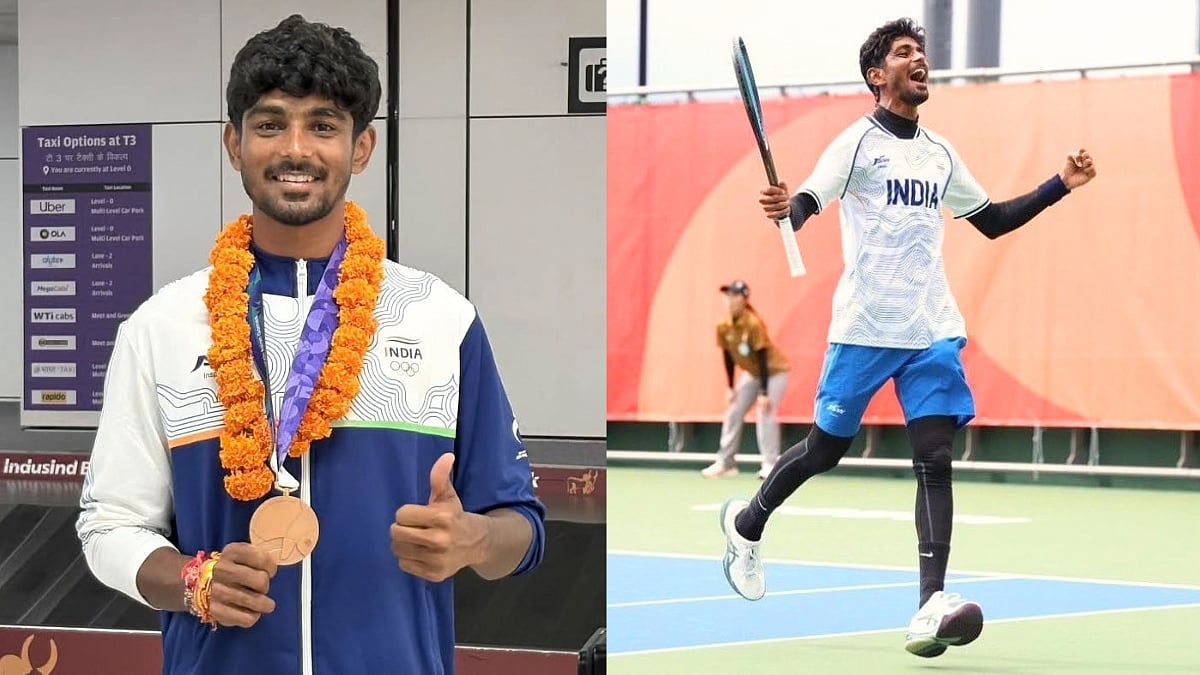
Jay Meena/Instagram
Indian soft tennis player Jay Meena etched his name in history by winning the country’s first-ever Asian Games medal in the sport. Speaking to The Free Press Journal about his bronze medal-winning campaign, Meena opened up on his emotional journey, the dramatic five-point comeback in the deciding tiebreak, the support from his family, coaches and the government, and his ambitions to win gold at future international events.
Excerpts...
Q. Jay, congratulations on winning the bronze medal at the Asian Games. How are you feeling after achieving this milestone?
It’s a really emotional moment for me, my family, and my team. This is a historic medal for India because I won the country’s first-ever Asian Games medal in soft tennis. This is a really big achievement.
I’m really proud of myself, and I’m so grateful to God for blessing me and giving me the opportunity to win a medal for my country, make my nation proud, and make my family and coach proud. I’m feeling great. I’ve been receiving congratulations and greetings from people all over India. There is so much love from the people. It’s truly a life-changing moment for me, and I’m very happy.
Q. What does winning an Asian Games medal mean to you personally and for your career?
It means everything to me. I have been playing soft tennis for the past 16 years, and this medal represents every single drop of sweat, every effort, and all the hard work I have put in throughout my career.
During this five-day Asian Games event, I could almost recap my entire life because there were so many ups and downs. On September 18, we played against Indonesia and reached the quarterfinals of the men’s team event. India had a chance to win a medal that day, and soft tennis could have opened India’s medal tally at the Asian Games.
It was a great opportunity to win India’s first-ever Asian Games medal in soft tennis, but unfortunately, it was heartbreaking that we lost the match due to some technical issues. We had problems with our plans, and things didn’t work out as we had expected.
Then, on September 20, there was the mixed doubles event. Adhya Tiwari and I played in the pre-quarterfinals but lost against the Philippines. That was another heartbreaking moment for us and the entire Indian team because only one event remained.
In the end, I was the only Indian player to reach the singles quarterfinals, while the other two players were knocked out in the league rounds. That was our only chance to create history. This was my third Asian Games. At the 2018 Asian Games, I reached the pre- quarterfinals but lost. At the 2022 Hangzhou Asian Games, I reached the quarterfinals and lost again.
This time, I couldn’t bear another loss because I had prepared so much. The Indian government supported me a lot, and the entire team worked extremely hard, so I had to win a medal for my country. After a hard-fought match against the Philippines, I finally won the deciding tiebreak and created history by winning India’s first-ever Asian Games medal in soft tennis. It has been a complete roller-coaster ride for me. I can’t explain it in words.
Q. Can you take us through your medal-winning performance? What was going through your mind during the crucial moments?
I just want to tell everyone listening that soft tennis is very similar to tennis. In soft tennis, the deciding stage is called a tiebreak, in which you have to reach seven points. The first player to reach seven points with a two-point difference wins the match. I was down 5-3. My opponent needed only two more points, while I needed five points in a row.
Even if I lost a single point, I would be almost certain to lose the match. At that moment, everyone in my team looked disappointed. My coaches and my father were praying to God and hoping for a miracle. But in my mind, I never thought even for a single moment that I was going to lose that match.
I just focused on how to win those five points. The important thing was to focus point by point. Once a point is over, it’s gone. I had to completely commit myself to the next point. That’s how I won five points in a row, made history, and won the medal.
I also want everyone to understand that winning five points in a row at the international level is extremely difficult. At that level, the margins between players are very small. Even top-ranked international players can win matches by only a narrow percentage of points. So winning five points consecutively at that level was a huge achievement.
I’m really proud of myself because I managed to stay calm. At that moment, I made my decision very clearly and confidently. I never thought for a single moment that I was going to lose. The only thing I kept telling myself was, “Focus on the point. Focus on the points.” It was really challenging, and at that moment, it was completely a mental game.
Q. Soft tennis is not as widely followed in India as some other sports. How did you get introduced to the sport?
Soft tennis is very similar to tennis. The major differences are the ball and the racket. The rackets are the same size as lawn tennis rackets, but they are made from graphite and are very lightweight, weighing between around 250 and 500 grams. The ball is completely different. It is a rubber ball that you have to fill with air using a pump. Those are the two major differences.
Otherwise, almost everything is the same, especially the playing surface. Soft tennis can be played on all the same surfaces as tennis, including synthetic courts, grass courts, clay courts, and even wooden courts.
So you don’t need a separate ground to play soft tennis. You can play soft tennis on lawn tennis courts as well. The events are also similar to tennis. There are team events, individual singles, individual doubles, and mixed doubles. There is also a mixed team event. So there are five events in soft tennis. That’s the major difference.
Q. We have heard that you wanted to become a cricketer, but you couldn’t do so and eventually shifted to soft tennis. What was that experience like?
Actually, my dream was not to become a professional cricketer. I used to play cricket in the gully with my friends during my childhood. I was quite aggressive while playing. I used to beat the players I played with and tease them, and their parents would complain to my parents that I was bullying and beating their children.
In the fourth standard, I was even expelled from my first school. I used to shoot paper balls at the teachers, the director, and the principal with a rubber band. I would also tear apart my classmates’ books, tease them, bully them, and get into fights.
So, in the fourth standard, the director gave my father a letter saying that I was being expelled from the school. My father pleaded with him not to expel me because he was worried that my future would be affected and that no other school would give me admission.
But the director said they couldn’t continue with me as a student. After that, my destiny changed. I believe everything is destined. If I had not been expelled from that school, I might never have been introduced to soft tennis. When I got admission to Pioneer Public School in Dewas, there were two synthetic courts where soft tennis had been played since 2000. That’s how I was introduced to soft tennis.
I got admission during the summer, and during the summer vacation, I joined the soft tennis academy at my school. That’s how I started playing soft tennis in 2010, and the journey has continued until now. From that time until today, I don’t even remember how I went from becoming a district-level player to a national-level player and now winning a historic Asian Games medal for India.
Q. How important was the support of your family, coaches and teammates throughout your journey?
I really want to tell everyone listening that the biggest support I received was from the government. My coaches and parents have always been with me when I was losing matches and when I didn’t win medals at the Asian Games. Only my coach and my parents know what I went through during that period. They know how disappointing those years and nights were and how long we had been hoping to win a medal.
When an athlete doesn’t win a medal or achieve their dreams, it can be a very difficult and stressful period. As I said, it has been a roller-coaster journey. My journey in soft tennis has been really inspiring, and winning this historic Asian Games medal is a great achievement for our country. I also want to thank my parents and my coach because there were several moments when I considered quitting soft tennis.
There were three or four times when I thought about leaving the sport because I was disappointed with my results. For the first eight years of my career, I didn’t have any major achievement. My parents and my coach gave me tremendous moral support during those difficult times.
But now, the Indian government and the Sports Authority of India have played a huge role in my Asian Games journey. I want to thank our Honourable Prime Minister. His vision is really inspiring, and the schemes for sports are extremely helpful for athletes who want to win medals at the international level. The Sports Authority of India has given us tremendous support.
For example, if I need a particular shoe or equipment from another country, the government sanctions the amount within a week. Even when I need to travel to another country for a month of training, the government arranges everything, including accommodation, food, flight tickets, and other requirements.
They provided us with two international training opportunities — 1 month in Korea and one month in Japan ahead of the Asian Games — along with two more national training camps in India. The Sports Authority of India gives its best to every athlete participating in the Asian Games and supports us as much as possible. I’m proud to say that because of their support, I was able to win this medal for my country and create history. I give credit for this medal to my government, my coaches, and my parents.
Q. Talking about family, your cousin Dev Meena competed in the pole vault event and broke the national record. How do you feel about that?
I’m really proud of Dev Meena because he means a lot to me. I know he finished seventh, but he created a national record for India. He produced the best performance in the history of Indian pole vault and is now the national record holder after beating his own record. I’m really, really proud of Dev, and I’m very happy. Recently, before this interview, I spoke to him. He told me, “I did my best. That’s what I wanted from this Asian Games.”
He knows he has to work much harder, but right now he is happy that he gave his best and created a national record. Dev Meena is a real inspiration for athletics, and it is also a big achievement for India. He finished seventh, but that doesn’t matter. The important thing is that he is improving and has also achieved a personal best.
That’s the only thing that matters for athletes. At every tournament, you just have to give your best. Winning and losing is something that may be destined or in the hands of God. But giving your best is the only thing that is in your control. That’s what Dev Meena did. He gave his best and created a national record. I have no regrets. I’m not disappointed. I’m extremely happy and proud of him, and I hope the whole of India is proud of Dev Meena.
Q. With this medal under your belt, what are the next targets you have set for yourself?
My next big target is to concentrate on the upcoming Commonwealth Games. Soft tennis is not currently part of the Commonwealth Games, but in 2030, the Commonwealth Games will be held in India.
If soft tennis is included in the Commonwealth Games in 2030, I want to tell everyone listening that I will promise every Indian and our Honourable Prime Minister that all the gold medals in the soft tennis events will stay in India.
No other country will win a gold medal in any soft tennis category if the sport is included in the Commonwealth Games. That is my next target. I’m also preparing for the 2030 Asian Games. I have already made history, but my next target is to change the colour of the medal. I want to win gold.
There is also a World Championship next year, so the upcoming events are really important for me. I want to become a world champion and make history again.
Q. What would you tell young Indian athletes who want to take up soft tennis but know very little about the sport?
I just want to tell every Indian soft tennis player that this is our time. This is where soft tennis will rise in India because, after this medal, I’m sure the Sports Authority and the government will support the sport as much as they can. The sport can gain a lot of popularity in India because developing soft tennis is relatively easy for the government. There is no need to build separate infrastructure for the sport.
We already have a large number of tennis courts in India because soft tennis can be played on tennis courts. You don’t need to build separate courts for soft tennis. You can play it on the same courts used for lawn tennis. I hope soft tennis will grow significantly in India, and I hope the government will support the sport because now the government knows that this sport has already made history. With more support, we can achieve even better results in the future.
So, to every Indian parent listening to this, please consider putting your children into soft tennis. It is a very athletic sport and provides physical as well as mental challenges. I’m sure soft tennis will rise significantly in India after this medal.
Q. Finally, what message would you like to give to the people in India who supported you during your Asian Games campaign?
I just want to tell everyone that this is not my medal. This is not Jay Meena’s medal. This is India’s medal. Every citizen of India deserves this medal. I want to give this medal to every Indian because representing the Indian flag is not just about representing a flag. We are representing the whole of India. Every Indian prays that our athletes perform their best for the nation. So, I did this with their blessings and support. This medal is not my medal. This is India’s medal. It is every Indian’s medal.
RECENT STORIES
-
-
-
-
-