NASA's IXPE Telescope Reveals Stunning Polarised X-Ray Image of Supernova Remnant SN 1006
The first-of-its-kind polarised X-ray images of SN 1006 from NASA's IXPE telescope, highlighting the link between magnetic fields and the flow of high-energy particles from exploding stars.

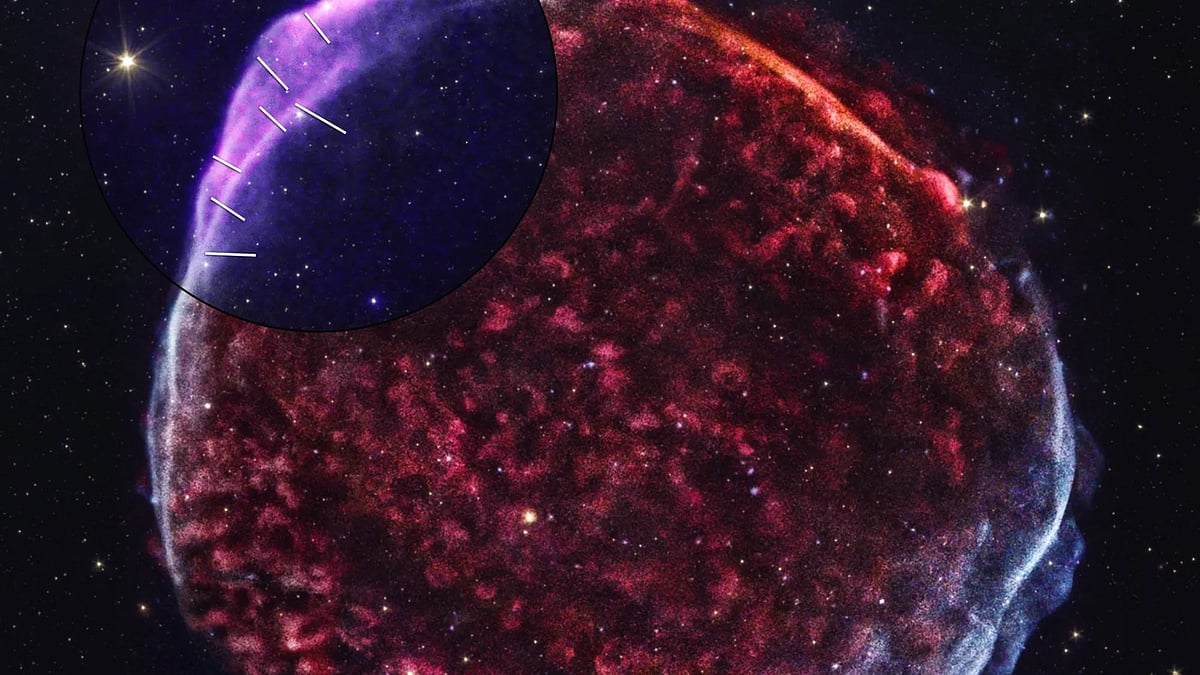
Supernova remnant SN 1006 | NASA
The universe is loaded with many mysteries and regularly surprises observers with astonishing events. Out of all, supernova is the most stunning space event as they are massive and incredible in their qualities. Recently, NASA's Imaging X-ray Polarimetry Explorer (IXPE) telescope has uncovered some information regarding the historic supernova remnant, SN 1006. The first-of-its-kind polarised X-ray images from the telescope have highlighted the link between magnetic fields and the flow of high-energy particles from exploding stars.
Dr Ping Zhou, an astrophysicist at Nanjing University in Jiangsu, China and lead author of a report recently issued in The Astrophysical Journal, explained, "Magnetic fields are challenging to measure; however, IXPE provides an efficient way for us to probe them. Now we can observe that the magnetic fields of SN 1006 are turbulent, but they also have an organised direction."
IXPE telescope observations
Previous SN 1006's X-ray observations relieved the first evidence that supernova remnants can dramatically accelerate electrons. These discoveries revealed expanding nebulae around burst stars as the origins of highly intense cosmic rays capable of moving at almost the speed of light.
Scientists have proposed that the unique structure of SN 1006 was linked to the orientation of its magnetic field, implying that supernova blast waves aligned with the magnetic field direction might more efficiently accelerate high-energy particles. Recent IXPE disclosures have now validated and clarified these notions, highlighting the telescope's reliability and robustness.
The evidence proves a link between magnetic fields and high-energy particle outflow from the remnant. Although the magnetic fields in SN 1006's shell are relatively disorganised, they nonetheless have a favoured orientation. As the shock wave from the original explosion crosses through the surrounding gas, magnetic fields align with it, trapping charged particles. These particles are then accelerated, maintaining the strength and turbulence of the magnetic fields. Researchers' understanding of how particles accelerate in extreme celestial objects is evolving as they further study the IXPE data.
About SN 1006
SN 1006 is the lone remnant of a massive explosion witnessed by humanity in 1006 CE. It is located 6,500 light-years away in the Lupus constellation. For years, observers in China, Japan, Europe, and the Arab world witnessed this explosion, which was supposed to be caused by the merging of two white dwarfs or by a white dwarf siphoning mass from a counterpart. It is still considered the brightest documented stellar event by modern astronomers.
While scientists have long been perplexed by SN 1006's uncommon double structure, differentiating it from other spherical supernova remnants, researchers have also found the luminous 'limbs' or edges detectable in X-ray and gamma-ray spectra. According to Douglas Swartz of NASA's Marshall Space Flight Centre, "Close-proximity, X-ray-bright supernova remnants such as SN 1006 are ideally suited to IXPE measurements, given IXPE's combination of X-ray polarisation sensitivity with the capability to resolve the emission regions spatially."
RECENT STORIES
-
-
-
-
-