Southern Command Conducts Military-Civil Fusion Abhiyan To Boost National Preparedness In Pune
The joint efforts promoted mutual understanding of emerging threats, adoption of common procedures and validated the value of integrated planning in areas such as Internal Security, Airspace Awareness, Crisis Response, Disaster Management, Technology-enabled Monitoring and Protection of critical zones

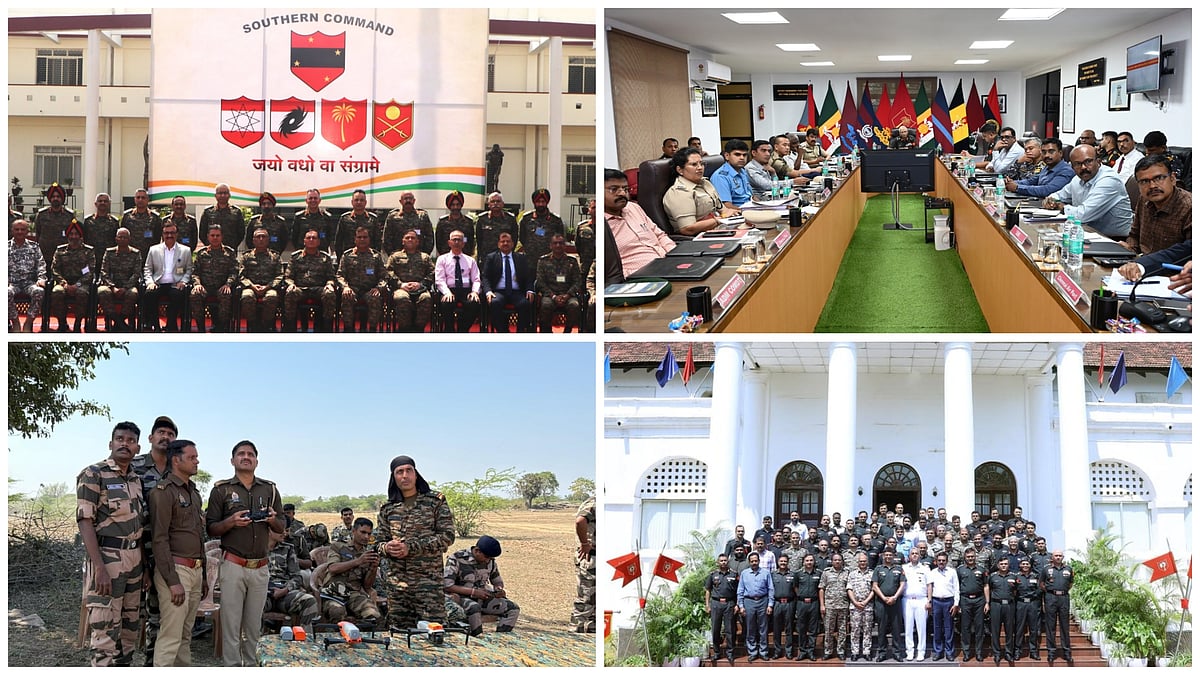
Southern Command Conducts Military-Civil Fusion Abhiyan To Boost National Preparedness In Pune | Sourced
Pune: Southern Command conducted a wide-ranging series of Military Civil Fusion activities as part of a Military Civil Fusion Abhiyan, across its area of responsibility, bringing together the Armed Forces, civil administration, security agencies, academia and industry in a coordinated effort to strengthen integrated national preparedness. Spanning multiple stations across the Southern Command area in Maharashtra, Gujarat, Rajasthan and the Southern states, the initiative reaffirmed the Indian Army’s commitment to a Whole-of-Nation approach to security by fostering institutional convergence, improving inter-agency coordination and enhancing the collective ability of diverse stakeholders to respond to emerging and complex challenges in a dynamic security environment.
The Abhiyan showcased a deliberate fusion of operational, technological, administrative and knowledge-based capacities through the participation of a wide range of stakeholders including Central Armed Police Forces, State Law Enforcement, Civil Administration, Central and State level Disaster Response agencies, Airports and Civil Aviation agencies, Forest and Mining authorities, NCC, academic institutions and industry partners. The joint efforts promoted mutual understanding of emerging threats, adoption of common procedures and validated the value of integrated planning in areas such as Internal Security, Airspace Awareness, Crisis Response, Disaster Management, Technology-enabled Monitoring and Protection of critical zones.
A high-level Table Top exercise to assess the emerging Multi-Domain threats in the hinterland was conducted at Headquarters Southern Command at Pune. The exercise was presided over by Lt Gen Dhiraj Seth, PVSM, UYSM, AVSM, General Officer Commanding-in-Chief, Southern Command and attended by senior functionaries from Govt of Maharashtra, Divisional Railway Managers from various Zones and senior representatives from CAPF, Law Enforcement and other agencies.
A series of focused engagements tailored to emerging requirements were conducted as part of the endeavor. At Pune, a multi-agency exercise at Aundh Military Station brought together the Armed Forces, Civil Administration, Disaster Response Agencies, Police, and NCC to validate coordinated response mechanisms and common operating procedures. At Bhopal, a Counter-UAS seminar with participation of military professionals, civil aviation stakeholders and representatives of the Airports Authority of India, strengthened collaborative understanding of emerging aerial threats. At Babina, integrated activities involving the Army, Police, Forest and Mining departments, supported by surveillance, joint patrolling and outreach in adjoining villages, enhanced ground-level coordination and area security.
At Chennai, a Security Conference at the Victory War Memorial brought together senior representatives of the Armed Forces, civil administration and state agencies to deliberate on internal security and crisis response. Engagements at Belagavi and Hyderabad further reinforced inter-agency cooperation in training, preparedness and institutional coordination, while activities in Jodhpur and Jaisalmer strengthened civil-military synergy, information sharing and collective readiness in strategically significant areas.
ALSO READ
What truly stood out in these joint efforts was not just coordination, but agencies coming together with a shared sense of purpose. Indian Army and govt/ civil agencies worked side by side, bringing their unique strengths to the table and learning from each other in the process. These collaborations enabled mutual confidence, improved information flows, faster decision making and synergised response to evolving situations.
The Military Civil Fusion Abhiyan underscored that contemporary security challenges can no longer be addressed in isolation and require a seamless partnership between the military and the wider national ecosystem. By linking operational preparedness with civil capacity, technological awareness and inter-agency coordination, Southern Command advanced a model of preparedness that is collaborative, adaptive and future-oriented
RECENT STORIES
-
-
-
-
-