Dhule Activist Proposes 70-MW Solar Canopy Along Mumbai-Agra Highway; NHAI Lauds Concept
A concept to construct an ‘elevated solar canopy’ stretching nearly 28 kilometres along the Mumbai–Agra National Highway has been proposed, and the proposal has reached Union Minister for Road Transport and Highways, Nitin Gadkari. The National Highways Authority of India (NHAI) has also reportedly appreciated the project and praised the concept.

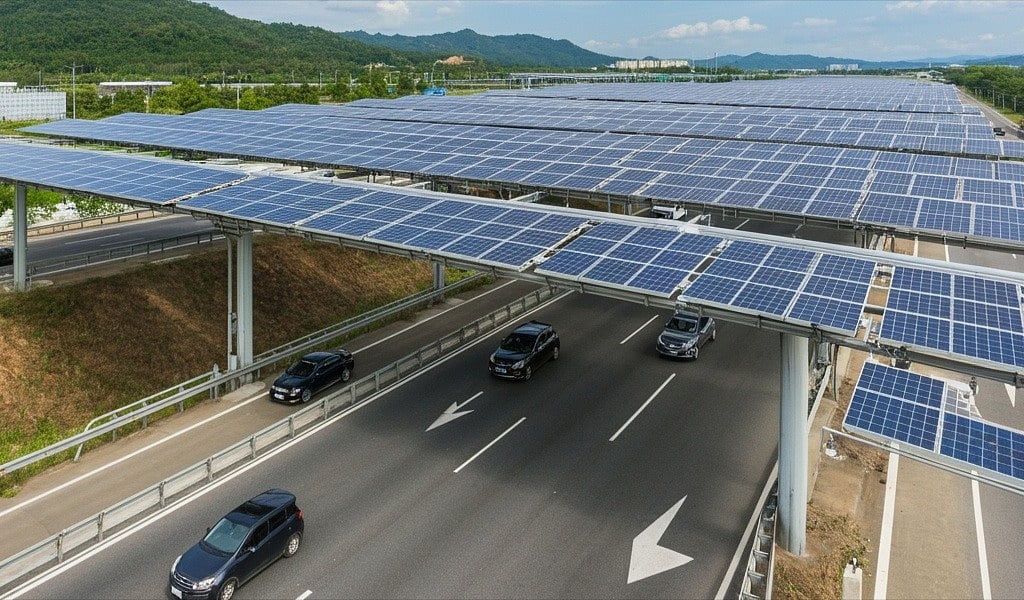
Dhule Activist Proposes 70-MW Solar Canopy Along Mumbai-Agra Highway; NHAI Lauds Concept | Shutterstock (Representative Pic)
Nashik: A concept to construct an ‘elevated solar canopy’ stretching nearly 28 kilometres along the Mumbai–Agra National Highway has been proposed, and the proposal has reached Union Minister for Road Transport and Highways, Nitin Gadkari. The National Highways Authority of India (NHAI) has also reportedly appreciated the project and praised the concept.
This proposed project, conceived by Dhule-based social activist Jayesh Bafna, is under consideration for the stretch between Laling Toll Plaza and Songir Toll Plaza on the Mumbai–Agra National Highway. It is being viewed as a hub for power generation along with substantial economic savings.
The concept aligns with Nitin Gadkari’s vision of “waste to wealth” (or “from waste to sustainable”). As this would be the first project of its kind in the country, it could serve as a pioneering model. By utilizing the median and the open spaces along the sides of the highway, a 28-kilometer-long elevated solar canopy project can be developed, Bafna said.
What are the benefits of the project?
Under this project, a solar power facility with a capacity of 70 megawatts could be established. It is expected to utilise around 700,000 square meters of area. Assuming a cost of ₹5 crore per megawatt, the total project cost could be around ₹400 crore.
The project could prove highly beneficial to the proposed Delhi–Mumbai Industrial Corridor. In addition, the solar energy generated could be supplied at lower rates to the Avadhan and Nardana industrial estates. By supporting industrial development, the project could indirectly contribute to employment generation.
It is also claimed that the project would help keep road temperatures lower, thereby minimising wear and tear of the asphalt surface. According to Bafna, the project could generate approximately 125 million units of electricity annually.
ALSO READ
Contribution to environmental protection
According to Bafna, constructing an elevated solar canopy would make a significant contribution to environmental protection. The electricity generated could be used not only for industrial estates but also for vehicle charging and public utilities.
If the project is implemented on a BOT (Build–Operate–Transfer) basis, the financial burden on the government would be reduced. Bafna also pointed out that Dhule district’s geographical location and climate are highly conducive to solar power generation.
RECENT STORIES
-
-
-
-
-