Year-Ender 2025: Mumbai Metro Line 3 Goes Fully Underground, Transforming City’s Public Transport Landscape
2025 marked a turning point for Mumbai’s transport network with the full launch of Metro Line 3, alongside rail infrastructure upgrades, a bike taxi policy push, leadership changes at BEST, and renewed safety concerns following the Mumbra suburban rail tragedy.

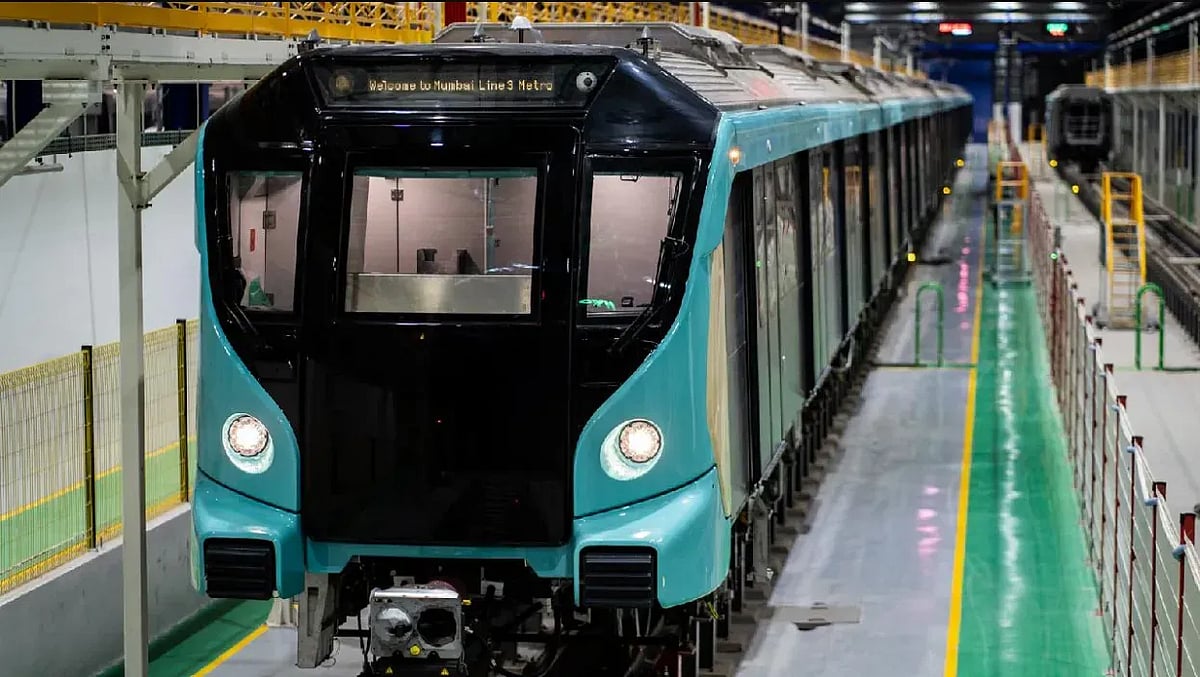
Mumbai Metro Line 3 becomes fully operational in 2025, marking a historic leap in underground mass transit connectivity across the city | File Photo
Mumbai, Dec 29: The year 2025 will be remembered as a historic milestone for Mumbai’s public transport system, marked by the full operational launch of Mumbai Metro Line 3—the city’s first fully underground metro corridor and a long-awaited game changer for urban mobility.
While the initial phase of Metro Line 3, connecting Aarey to Bandra-Kurla Complex (BKC), was inaugurated in 2024, the momentum decisively picked up this year. In May 2025, Phase 2A, extending services from BKC to Acharya Atre Chowk (Worli), was opened to the public, significantly improving east-west connectivity and easing pressure on road traffic and suburban railways.
The most defining moment came later in the year. The final phase of Metro Line 3—from Acharya Atre Chowk to Cuffe Parade—was inaugurated by Prime Minister Narendra Modi on October 8, 2025, with full commercial operations beginning on October 9, 2025.
With this, the entire 33.5-km Aqua Line became fully functional, connecting Mumbai’s northern suburbs directly to its southern business districts. October 8 and 9, 2025, have thus gone down as landmark dates in the history of Mumbai’s public transport, symbolising a new era of faster, cleaner and more efficient mass transit for India’s financial capital.
Leadership vacuum at BEST raises concerns
The post of General Manager of the Brihanmumbai Electric Supply and Transport (BEST) undertaking remained vacant for several months, highlighting administrative uncertainty at one of Mumbai’s most critical public transport utilities. After a significant gap, additional charge of the post was entrusted to S. V. R. Srinivas. However, following his retirement, the position once again fell vacant.
According to sources, reluctance among senior officers to take charge as BEST General Manager contributed to the prolonged vacancy, underscoring the challenges associated with leading the financially and operationally stressed undertaking.
After nearly nine months without a full-time head, BEST finally got a permanent General Manager in September, when the Maharashtra government appointed IAS officer Sonia Sethi to the post.
Bike taxi policy push sparks union opposition
The state government’s push to introduce a formal bike taxi policy emerged as one of the most debated transport issues of the year. Determined to decongest roads and provide affordable last-mile connectivity, the government moved ahead with plans to clear the way for bike taxi services in Mumbai and other major cities.
The proposal, however, faced stiff opposition from transport unions, including auto-rickshaw and taxi bodies, which argued that bike taxis would threaten livelihoods and operate without a level playing field. Despite sustained protests and objections, the government maintained a firm stance, signalling its intent to press ahead with structural reforms in urban mobility.
WR achieves 100% electrification milestone
Western Railway scripted a major achievement by fully electrifying its entire Broad Gauge network, strengthening its commitment to sustainable, energy-efficient rail operations.
Mumbra tragedy casts shadow on Mumbai’s lifeline
The year was overshadowed by a grim tragedy on Central Railway’s suburban network after five commuters lost their lives in June 2025 when they fell from two moving local trains between Diva and Mumbra during peak hours.
The incident highlighted the chronic overcrowding on the Central Railway’s busiest stretch and raised serious questions about passenger safety on the city’s lifeline. Disturbing visuals of the victims lying on the tracks circulated widely, triggering public outrage and renewed debate over inadequate infrastructure, insufficient safety measures, and the daily risks faced by millions of suburban commuters.
CR advances key infrastructure projects
Central Railway made notable progress with the CSMT platform extension project and accelerated development at coaching terminals such as Panvel to ease congestion and boost capacity.
WR tops punctuality charts
Western Railway emerged as the most punctual zone, with Mail and Express trains achieving nearly 97% punctuality in November and about 96% cumulatively—the best among all zonal railways.
Also Watch:
ALSO READ
Capacity boost through new lines
Western Railway completed 234 km of new lines, doubling and gauge conversion works, significantly enhancing network capacity, flexibility and operational resilience.
To get details on exclusive and budget-friendly property deals in Mumbai & surrounding regions, do visit: https://budgetproperties.in/
RECENT STORIES
-
-
-
-
-