Mumbai Monorail To Resume With New Trains, CBTC System; Operational Losses Likely To Continue
Mumbai Monorail will resume operations with new Made-in-India trains, CBTC signalling and improved Metro connectivity. While the upgrades are expected to enhance safety, reliability and reduce annual losses, officials say the corridor will continue operating at a loss due to its limited passenger-carrying capacity.

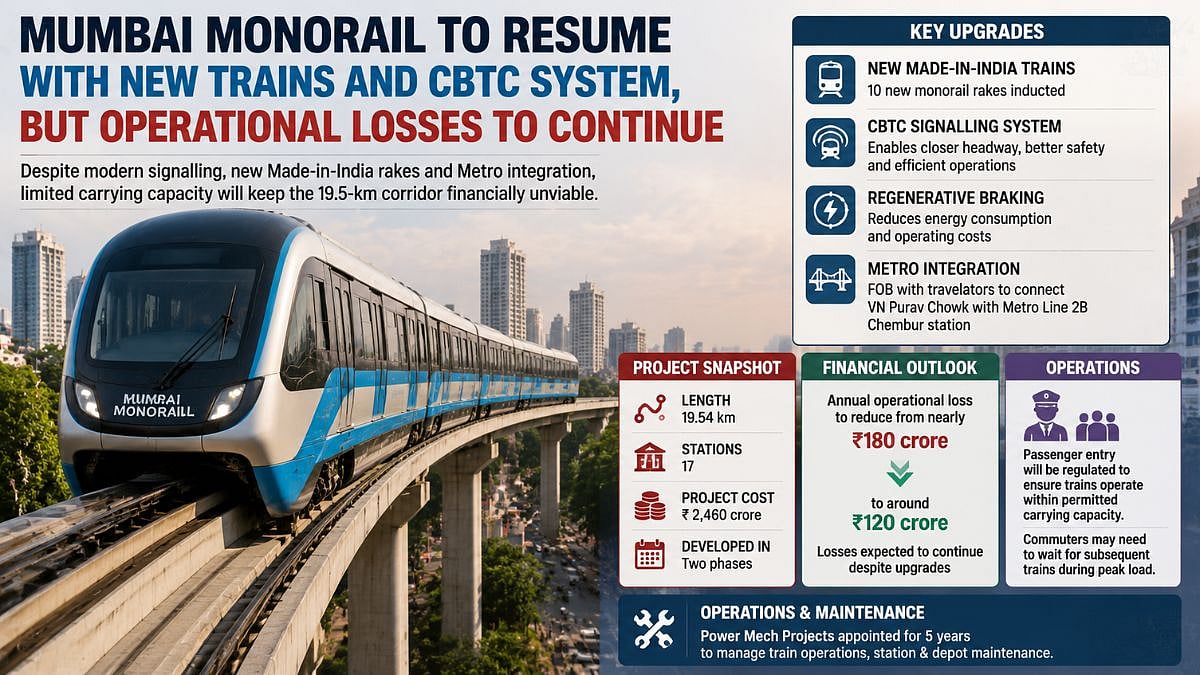
Mumbai Monorail is set to resume operations with new trains, upgraded signalling and Metro integration despite expected operational losses | AI Generated Representational Image
Mumbai, July 1: Mumbai's long-awaited Monorail is set to return to service with a completely upgraded signalling system, a "brand new avatar", a new fleet of Made-in-India trains and improved connectivity with the city's expanding Metro network.
However, despite the technological overhaul, sources acknowledge that the system is expected to continue operating at a financial loss because of its permitted passenger-carrying capacity.
According to sources, the Mumbai Metropolitan Region Development Authority (MMRDA) expects operational losses to continue from the day services resume.
While annual operational losses are estimated to reduce from nearly Rs 180 crore to around Rs 120 crore following the modernisation programme, the project is unlikely to achieve operational profitability.
"The losses have reduced substantially because of improved technology and energy savings, but operational losses will continue," a source said.
CBTC Upgrade Cleared
The revival follows the Commissioner of Metro Rail Safety (CMRS) granting final statutory clearance for operations under the upgraded Communication-Based Train Control (CBTC) signalling system.
MMRDA has already approached the Maharashtra government seeking permission to restart passenger services, and approvals have been granted for the same.
As part of the upgrade, the authority has inducted 10 new monorail rakes while retrofitting the existing fleet with CBTC technology. The new signalling system enables continuous communication between trains, allowing reduced headway, improved scheduling and enhanced operational safety.
It also incorporates regenerative braking technology, which feeds power back into the system during braking, reducing electricity consumption and lowering operating costs.
Officials said these improvements will allow more frequent services and improve overall reliability. However, they pointed out that the monorail's design inherently limits its passenger capacity.
Capacity Limits Remain
Unlike suburban trains or Metro services, monorail trains cannot be operated beyond their prescribed passenger limits because they run on a single elevated guideway. To prevent overcrowding, station staff will actively regulate passenger entry inside the monorail once services resume.
According to sources, commuters may be required to wait for subsequent trains whenever the permitted carrying capacity is reached.
The crowd management measures stem from previous operational experience. Before services were suspended for the ongoing modernisation programme last monsoon, the monorail experienced disruptions after sudden surges in passenger demand.
In one such instance, MMRDA had attributed a service interruption to heavy overcrowding after commuters shifted to the monorail following disruptions on the Harbour suburban railway line.
Sources said strict standard operating procedures will now be implemented to prevent similar situations and ensure trains operate within safe load limits once services resume.
Metro Integration Planned
The 19.54-km corridor connecting Sant Ghadge Maharaj Chowk in Mahalaxmi and Chembur was built at a cost of approximately Rs 2,460 crore and remains India's first operational monorail system. It comprises 17 stations and was originally developed in two phases.
The upgraded monorail is also expected to benefit from improved multimodal integration. MMRDA is constructing a new foot overbridge with travelators to directly connect V.N. Purav Chowk Monorail station with the upcoming Metro Line 2B Chembur station, located about 50 metres away.
Once Metro Line 2B's Chembur station becomes operational, commuters will be able to travel seamlessly from Mahalaxmi, the southern terminal of the monorail, to Mandale via the Metro corridor, significantly improving east-west connectivity in Mumbai's eastern suburbs.
Also Watch:
MMRDA has also appointed Power Mech Projects to undertake operations and maintenance of the network for five years, covering train operations, station management and depot maintenance.
MMRDA believes the modernisation and Metro integration will improve commuter convenience and reliability. However, it concedes that the monorail's structural limitations mean it is unlikely to become financially self-sustaining despite the latest technological upgrades.
To get details on exclusive and budget-friendly property deals in Mumbai & surrounding regions, do visit: https://budgetproperties.in/
RECENT STORIES
-
-
-
-
-