Mumbai Metro: Newly Opened Dahisar-Mira Road Stretch Sees Strong Footfall With Nearly 22K Passengers Per Day; Chembur-Mandale Link Lags Behind
Mumbai’s newly opened metro stretches have seen contrasting ridership trends, with Line 9’s Dahisar–Kashigaon corridor drawing over 22,000 daily commuters, while Line 2B’s Diamond Garden–Mankhurd stretch has struggled with under 4,000. Officials cite poor last-mile connectivity and limited stations as key reasons, though ridership may rise as connectivity improves.

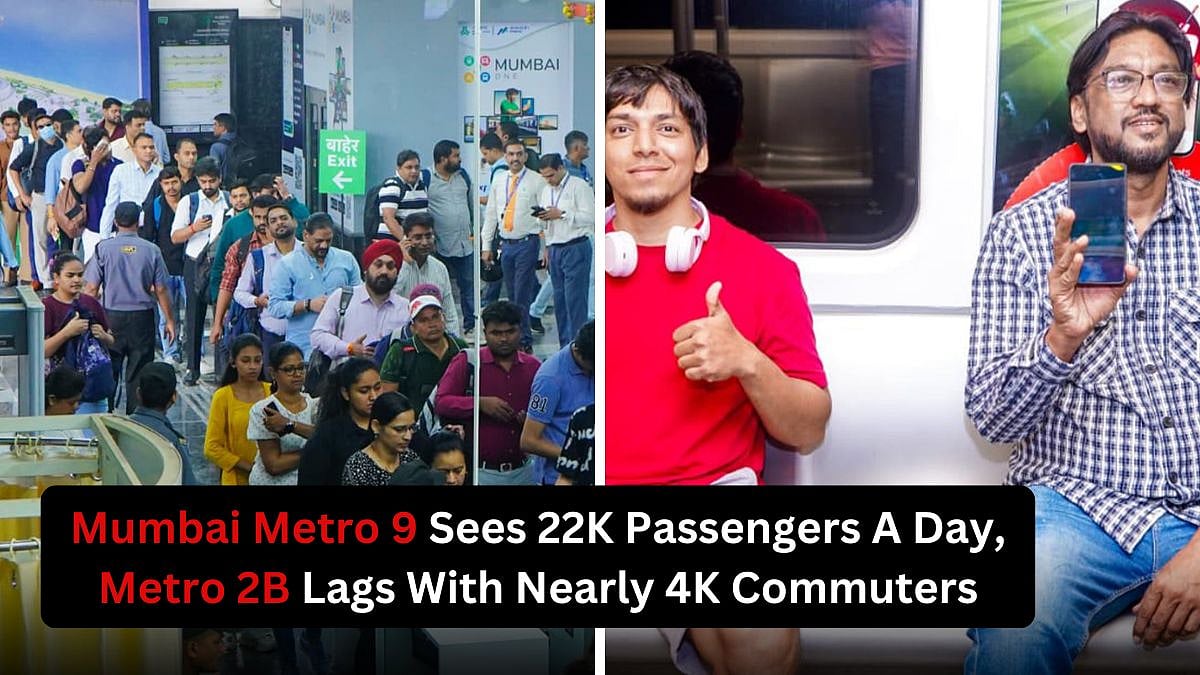
Mumbai Metro: Newly Opened Dahisar-Mira Road Stretch Sees Strong Footfall With Nearly 22K Passengers Per Day; Chembur-Mandale Stretch Lags Behind |
Mumbai: The newly operational metro stretches in Mumbai have received a mixed response from commuters, with the Dahisar–Kashigaon Phase 1 corridor witnessing strong ridership, while the Diamond Garden–Mankhurd Phase 1 stretch has seen a notably weak turnout since its launch on April 8.
According to a Loksatta report citing data shared by Mumbai Metropolitan Region Development Authority, the Dahisar–Kashigaon section of Metro Line 9 has emerged as a preferred choice for daily commuters, recording an average daily ridership of 22,356 passengers. However, the Diamond Garden–Mankhurd stretch of Metro Line 2B has managed to attract only around 3,885 passengers per day.
Challenges Found By Analysing Numbers
Officials attribute the disparity primarily to connectivity gaps. While the Dahisar–Kashigaon stretch offers seamless travel options, allowing commuters to extend their journey towards Andheri West and Gundavali via interlinked metro corridors, the Diamond Garden–Mankhurd section currently has only five stations and lacks last-mile connectivity. Passengers are required to rely on alternate modes of transport such as buses, taxis or autos beyond these points, discouraging metro usage on this route.
Between April 8 and April 12, a total of 14.25 lakh commuters travelled across four key metro lines, Metro 2A (Dahisar to Andheri West), Metro 7 (Dahisar to Gundavali), Metro 9 (Kashigaon to Dahisar), and Metro 2B (Diamond Garden to Mankhurd).
ALSO READ
Of these, Metro 2A recorded the highest ridership at 7.53 lakh passengers, followed by Metro 7 with 5.40 lakh. Metro 9 saw 1.11 lakh passengers, while Metro 2B lagged majorly behind with just 19,426 commuters over the five-day period.
Commuters also questioned the decision to operationalise the Diamond Garden–Mankhurd stretch in its current limited form, arguing that the line may only see meaningful ridership once it is extended to key commercial hubs like Bandra-Kurla Complex (BKC) or Andheri West.
Responding to the low turnout, MMRDA officials stated that summer vacations may have temporarily impacted commuter numbers, suggesting that ridership could improve in the coming weeks, as reported by Loksatta.
Mumbai One Card Subscription, Online Ticketing Sees Surge
Meanwhile, the expansion of the metro network has contributed to a rise in the adoption of digital ticketing. The number of Mumbai One Card users has increased by 37.41 per cent, reaching over 5.33 lakh users.
Additionally, commuters are increasingly opting for WhatsApp-based ticketing and mobile QR tickets, reflecting a shift towards contactless travel solutions in the city. With six metro lines now operational, authorities remain optimistic that improved connectivity and upcoming extensions will drive higher ridership across all corridors.
To get details on exclusive and budget-friendly property deals in Mumbai & surrounding regions, do visit: https://budgetproperties.in/
RECENT STORIES
-
-
-
-
-