Mumbai: IIT Bombay Develops Indigenous Technology To Tackle LPG Shortage - Watch
IIT Bombay has developed a biomass gasification system that converts dry leaf waste into cooking fuel, reducing LPG use by 30–40 percent in campus kitchens. Led by Sanjay Mahajani, the project began in 2014 and was deployed in 2024, cutting emissions and boosting sustainability

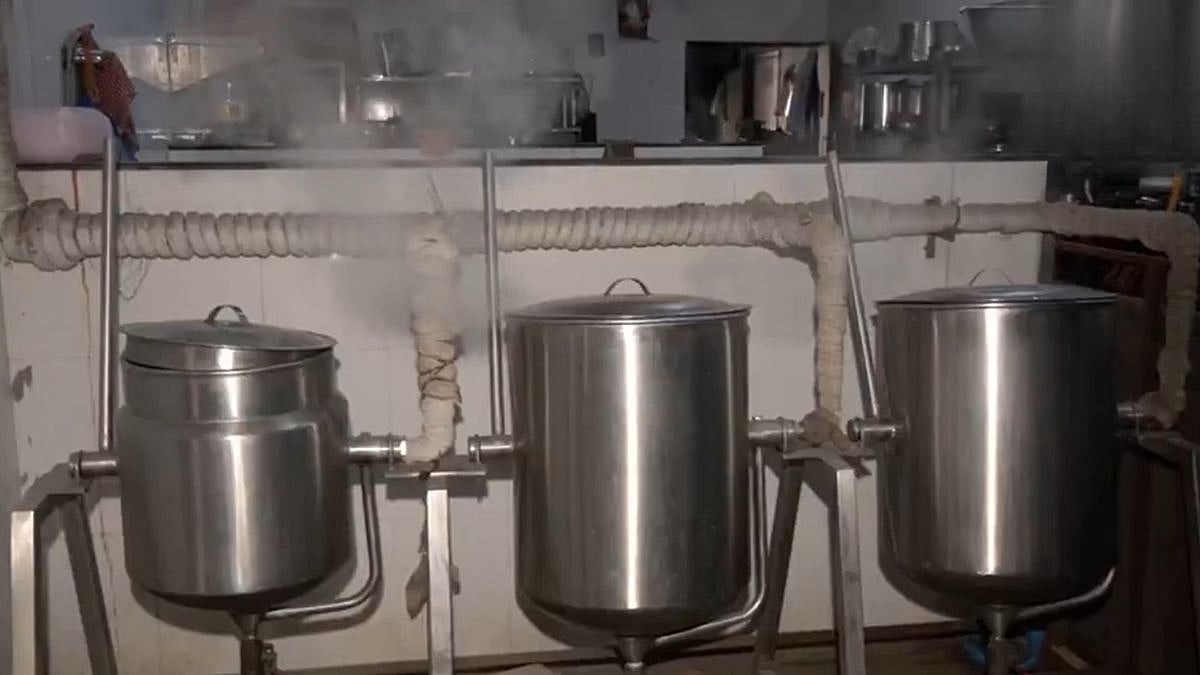
Mumbai: IIT Bombay Develops Indigenous Technology To Tackle LPG Shortage - Watch | ANI X Account
At a time when rising fuel prices and concerns over LPG availability persist, the Indian Institute of Technology (IIT) Bombay has developed a sustainable and self-reliant solution by converting dry leaf waste into cooking fuel. Using a patented biomass gasification system, the institute has enabled its campus kitchens to continue functioning efficiently while significantly reducing dependence on conventional fuel.
The initiative, which began in 2014, was led by Professor Sanjay Mahajani from the Department of Chemical Engineering. Faced with the challenge of disposing of large quantities of fallen leaves across the institute’s expansive green campus, the team explored ways to convert this waste into usable energy.
Explaining the concept, Mahajani said, “These dried leaves and twigs, if we simply burn them, they do yield energy. However, IIT Bombay has a vast green cover, resulting in a large volume of such waste. We realised that since this material inherently contains energy, it could be harnessed for internal applications such as cooking and other thermal needs on campus.”
He noted that the process required extensive research and was not straightforward. “Gasification involves converting leaves into pellets by compressing them, and then feeding these pellets into a specially designed gasification unit. When burned directly, such material generates high emissions, particularly particulate matter. So, we engineered the system to drastically minimise emissions,” he said.
The gas produced through this process, known as “producer gas,” primarily contains carbon monoxide and hydrogen. “We combust this gas immediately, and the emissions are extremely low. The energy released is then used to generate steam from water, which is channelled into the canteen to power steam-based cooking equipment and other utilities,” Mahajani added.
The journey, however, was marked by initial challenges including heavy smoke, operational issues, and resistance from kitchen staff. A key technical hurdle was the formation of clinkers, solid residues that clogged conventional systems. By 2016, the team had developed a refined and patented gasifier that significantly reduced these issues.
According to a report by Hindustan Times, further improvements were made after Professor Sandeep Kumar from the Department of Energy Science and Engineering joined the project in 2017, contributing to the design of an improved burner. With support from the institute’s Living Lab initiative, the system underwent real-time testing, eventually being successfully deployed in the staff canteen by 2024.
Currently, the canteen operates with 30 percent to 40 percent reduced LPG consumption, achieving around 60 percent thermal efficiency with minimal emissions. The system also cuts approximately eight tonnes of carbon dioxide emissions annually.
Plans are underway to scale the technology to hostel messes, potentially saving up to Rs. 50 lakh annually while further reducing the institute’s carbon footprint. Complementing this effort, IIT Bombay also operates a biomethanation plant that processes nearly two tonnes of wet kitchen waste daily into energy, reinforcing its commitment to sustainable waste-to-energy solutions.
To get details on exclusive and budget-friendly property deals in Mumbai & surrounding regions, do visit: https://budgetproperties.in/
RECENT STORIES
-
-
-
-
-