Mumbai: Activists To Launch Second Phase Of Anti-SIR Campaign On Constitution Day, Demand Cancellation Of Electoral Roll Revision
Activists announced in Mumbai on Tuesday that the second phase of the nationwide campaign against the Special Intensive Revision (SIR) of electoral rolls will begin on November 26, Constitution Day. The campaign will focus on Maharashtra and states where SIR remains incomplete. Activists alleged procedural irregularities, although the Supreme Court upheld the ECI's authority to conduct SIR.

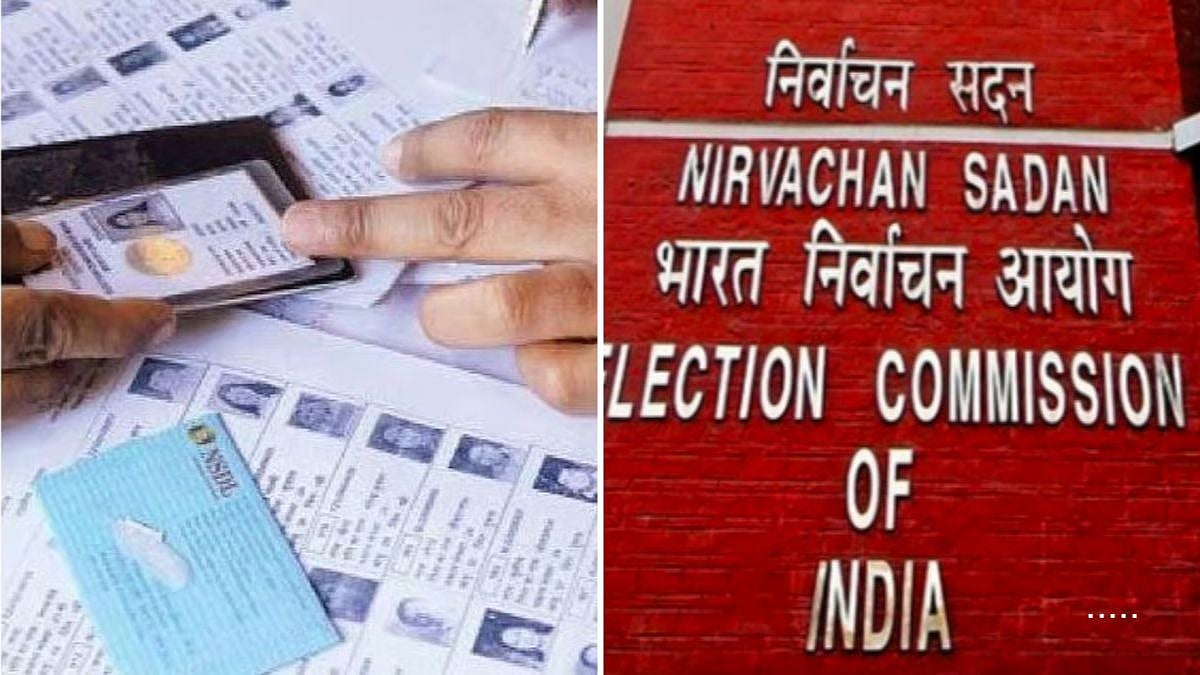
Mumbai: Activists To Launch Second Phase Of Anti-SIR Campaign On Constitution Day, Demand Cancellation Of Electoral Roll Revision |
Mumbai: The second phase of the campaign to scrap the Special Intensive Revision (SIR) of electoral rolls will begin on Thursday, November 26, observed as Constitution Day, with a focus on Maharashtra and other states where the revision process is still incomplete, activists associated with the nationwide protests announced in Mumbai on Tuesday.
Civil Rights Groups Question ECI's Decision To Conduct SIR
Addressing the media, the activists said the SIR was unconstitutional, arguing that the Election Commission of India (ECI) had not taken a formal decision to conduct it. They called for its cancellation, contending that the exercise in West Bengal bore no resemblance to what was being carried out in Maharashtra. Asserting that the campaign had neither slowed down nor scaled down, representatives of the Association for Protection of Civil Rights (APCR), People's Union for Civil Liberties (PUCL), Maharashtra SIR Janajagruti Abhiyan and the Cockroach Janata Party said the ECI had no documents to show that the decision to conduct the exercise had been taken by the Commission. The Supreme Court, in its May 27, 2026 judgment concerning the Bihar SIR, upheld the ECI's authority to conduct the exercise.
Anjali Bhardwaj Raises Concerns Over Potential Voter Disenfranchisement
Anjali Bhardwaj, co-convenor of the National Campaign for People's Right to Information (NCPRI), said nearly 100 crore voters were being asked to prove their citizenship or risk disenfranchisement. “In June 2025, without any consultation, the ECI issued an order that, beginning with Bihar, SIR would be conducted across the country. There was no explanation for why it was being done, even as public funds were being used and the voting rights of citizens were at stake. We asked the ECI for documents on the basis of which the SIR was being conducted. The ECI said no such documents existed. If the ECI has not taken the decision, who has? Was it taken in the Prime Minister's Office or the office of the Bharatiya Janata Party?” asked Bhardwaj.
Prashant Bhushan Alleges Arbitrary Additions And Deletions In Electoral Rolls
Prashant Bhushan, senior advocate at the Supreme Court, said an application under the Right to Information (RTI) Act had revealed that there was no information on how the decision to conduct the SIR was made. He said that while only local Electoral Registration Officers (EROs) had the authority to add names, there had been arbitrary additions and deletions in several places. Bhushan alleged that the revision process had witnessed several opaque and illegal additions.
“They listed 11 documents that could be used while filling up the enumeration form and said Aadhaar would not be proof of citizenship and that passports could be fake. This raises the question of how citizenship will be decided. Then they introduced a new category called 'logical discrepancy' without defining what it means. Voters have to prove their lineage in India going back several generations,” said Bhushan. The Supreme Court subsequently directed the ECI to consider Aadhaar, Electors Photo Identity Card (EPIC) and ration cards as additional documents. Bhushan's statement should be understood in the context of the initial guidelines.
Yogendra Yadav Raises Concerns Over India's Electoral Integrity
Yogendra Yadav, convenor of the Bharat Jodo Abhiyan, said he had once admired India's electoral process and had been an ambassador of the ECI when it completed its golden jubilee in 2001, during Atal Bihari Vajpayee's tenure as Prime Minister. He said India was once a 'Vishwaguru' in conducting free and fair elections, and its ECI model had been replicated in other countries. Asked about the rigging of the 1987 and 1992 elections in Jammu and Kashmir and Punjab, respectively, Yadav described them as aberrations, alleging that electoral rigging had now become the norm.
Yadav said the SIR had been triggered by the BJP's loss of seats in Parliament in the 2024 elections. “To prevent such a shock, it was decided to change the election architecture,” he alleged, citing delimitation and the 'One Nation, One Election' proposal as part of the changes.
Activists Allege Electoral Reforms Could Disadvantage Women And Minorities
“Elections are mandatory for the 21st century and dictators have to ensure that elections are held and won. So fundamental changes are being made to the election process. Places where the Bharatiya Janata Party (BJP) is not prominent are being reduced in size through delimitation. Constituency boundaries are being redrawn to ensure that the BJP wins. Assam's delimitation is an example,” Yadav said, adding that women and minority groups were among those being targeted for exclusion from the electoral rolls.
ALSO READ
Commenting on court proceedings concerning the SIR, advocate Mihir Desai of the PUCL said, “We have some hope from the court. I said 'some' because I am an advocate. We will fight in court, but winning and losing will be decided on the streets.”
Asked why activists had approached the courts if they lacked faith in them, Yadav said that if the government did not allow a discussion in Parliament on the removal of the Chief Election Commissioner, the issue would be taken to the streets. He added that
Responding to questions about restoring ballot papers in place of Electronic Voting Machines (EVMs), Bhushan said that large-scale tampering with EVMs would be difficult as it would require the involvement of hundreds of election staff, making such manipulation difficult to conceal.
To get details on exclusive and budget-friendly property deals in Mumbai & surrounding regions, do visit: https://budgetproperties.in/
RECENT STORIES
-
-
-
-
-