FPJ Interview: Mumbai–Pune Missing Link’s Tallest Cable-Stayed Bridge Ready Ahead Of May 1 Opening; Weighs 1.25 Lakh Tonnes To Withstand High Winds
The tallest cable-stayed bridge on the Mumbai–Pune Missing Link project is ready ahead of its proposed May 1 opening. Built by Afcons Infrastructure over nearly six years, the structure is designed for high winds, heavy loads and a 100-year lifespan.

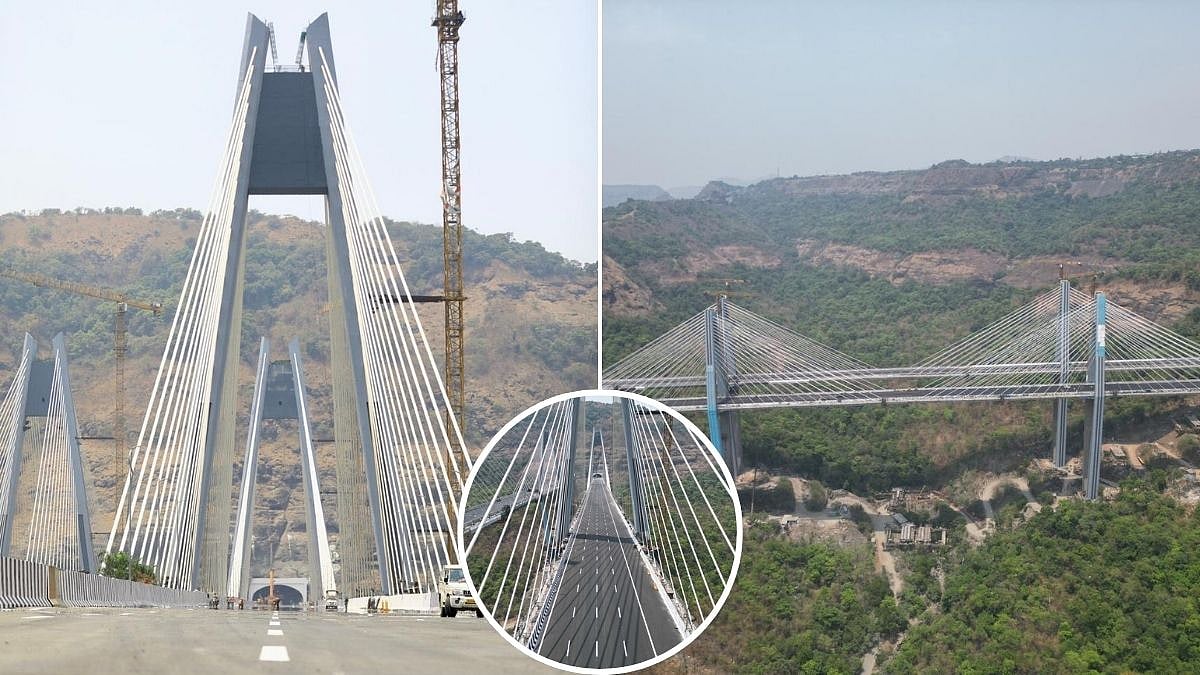
Engineering milestone as tallest cable-stayed bridge on Mumbai–Pune Missing Link nears opening | File Photo
Mumbai, April 25: With the Mumbai–Pune Missing Link project slated to open from May 1, the corridor’s tallest bridge—built by Afcons Infrastructure—has been completed after nearly six years marked by engineering complexity, logistical constraints and global collaboration.
In an interview with Sweety Bhagwat, Principal Correspondent, Afcons Project Director Ranjan Kumar Mishra, who spearheaded the project from the start, outlined the key challenges, technological innovations and milestones that shaped the landmark structure.
Describing it as one of the most demanding assignments, Mishra said the bridge rises between two hills in the rugged Western Ghats, making site access a major hurdle during construction.
Now ready for operations, the structure is designed for speeds of up to 100 kmph and an operational lifespan of about 100 years, underscoring its durability and strategic importance.
Q. The bridge, India’s tallest road cable-stayed bridge constructed by Afcons Infrastructure—what were the key engineering challenges from day one?
A. From the outset, this was an extremely complex assignment because of the alignment. The bridge is located between two hills in the Western Ghats, and there was no direct access to the site. Before even starting construction, we had to create connectivity—first reaching via the Pali Road stretch and then developing an additional 10–12 km access road to mobilise equipment, materials and manpower.
The initial challenge was not just engineering but logistics. We had to establish full site infrastructure from scratch—transporting machinery, setting up worker accommodations, and ensuring basic facilities and welfare arrangements for labour and their families. Only after this groundwork could construction begin.
From a design perspective, the location between two hills meant significant wind forces and complex aerodynamic behaviour. This required detailed analysis to finalise structural elements such as the size of piers, pylons, type of cables, and cable-stay systems. These are highly technical decisions that directly impact the bridge’s stability and performance.
Since such specialised testing facilities were not available in India, we carried out advanced studies abroad. We developed scaled models of the bridge and conducted wind and stability tests in international laboratories to understand its behaviour under different conditions.
Q. You mentioned specialised testing. How was this carried out, especially during the Covid period?
A. This was a critical part of the project. Around 2020–21, during Covid, there were travel restrictions which delayed the process. Once restrictions eased, we conducted advanced testing in international laboratories in Copenhagen and London.
We created a scaled model of the bridge—reducing the actual length of over 600 metres to a model of about 4 metres. In laboratory conditions, we simulated wind and environmental forces to study the bridge’s behaviour.
We analysed stability at multiple stages—during pylon construction, during incremental segment construction, and finally under live traffic conditions. These tests helped us finalise key design parameters and ensured long-term safety and stability.
Q. What is the weight of the bridge, and how has durability been ensured?
A. The bridge has been designed as twin carriageways, each functioning as an independent structure with a 4+1 lane configuration. Each carriageway weighs approximately 1.25 lakh tonnes.
Given its location in a high-wind zone, we carefully optimised the structural configuration to balance wind forces and traffic loads. Every parameter—from material strength to load-bearing capacity—has been calibrated to ensure stability, safety and long-term durability under extreme conditions.
Q. What monitoring or safety mechanisms have been installed?
A. We have installed a comprehensive structural health monitoring system. It continuously tracks parameters such as cable vibrations, pylon inclination and overall structural behaviour.
These systems will remain operational throughout the bridge’s lifecycle, not just during construction. The bridge has been designed for a 100-year lifespan.
A centralised control room has also been set up to monitor both the bridge and the associated tunnel infrastructure. All parameters will be tracked round-the-clock, allowing immediate response to any irregularities.
Q. What kind of traffic load has the bridge been designed for?
A. The bridge has been designed as per the highest loading standards under Indian codes—IRC Class 70R loading, prescribed by the Indian Roads Congress.
This means it is not a conventional bridge meant only for regular traffic. It can handle extremely heavy loads, including military tanks and specialised industrial trailers.
We have considered maximum axle loads far beyond normal highway conditions. Even if multiple heavy vehicles are present simultaneously, the bridge will remain safe and stable. This makes it a high-capacity, strategic infrastructure asset.
Q. What kind of manpower was deployed for the project?
A. Manpower varied across stages. On average, about 500 workers were engaged, but during peak construction phases, the number went up to nearly 1,500. Managing such a large workforce in a remote and challenging terrain required extensive planning and coordination.
Q. Can you share details about materials and construction technologies used?
A. We used high-quality materials, including 53-grade concrete and 15.7 mm galvanised HDPE-coated cables along with 15.2 mm prestressing strands. Structural steel used was Fe-500 grade, sourced from leading companies like Tata Steel, Rashtriya Ispat Nigam Limited and JSW Steel.
In terms of construction, we used jump form systems for pylons—allowing casting in 4-metre vertical segments—and segmental construction using traveller systems for the deck, with segments of about 9 metres.
The bridge has four pylons, the tallest reaching 182 metres. The maximum span is 305 metres, and the deck is about 125 metres above ground level. This makes it one of the tallest road bridges in India.
Also Watch:
ALSO READ
Q. What is the design speed of the bridge?
A. The bridge has been designed for speeds up to 120 kmph. However, 100 kmph has been set as the optimal and safe operating speed considering traffic and safety parameters.
To get details on exclusive and budget-friendly property deals in Mumbai & surrounding regions, do visit: https://budgetproperties.in/
RECENT STORIES
-
-
-
-
-